Brown Catsnake
Boiga irregularis
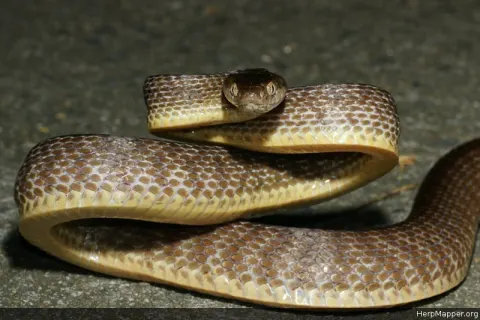
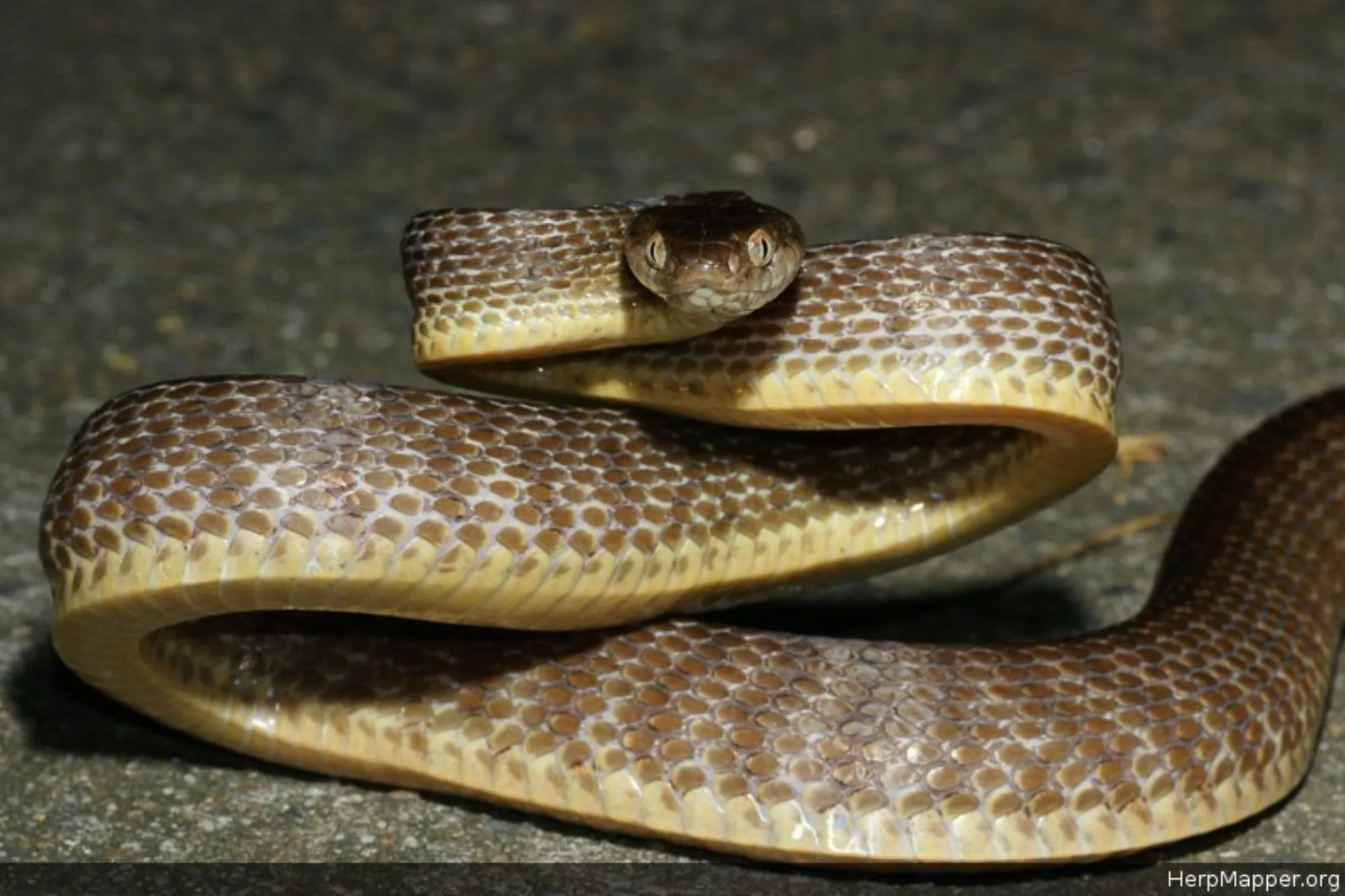
Slender and at home in trees, the Brown Catsnake can reach 2 metres in length and has a head that looks large beside its body. Its colour can be brown with light markings, yellowish green or beige, and some have red blotches shaped like saddles. It has vertical pupils and is usually active at night. During daylight, it takes shelter in places such as hollow logs, rock crevices, caves and palm crowns.
Its native range extends from eastern Indonesia through Papua New Guinea and islands of northwestern Melanesia to coastal northern and eastern Australia. It lives in grasslands and sparsely wooded areas as well as forests, and is often found around trees, caves and limestone cliffs. In Papua New Guinea, it inhabits varied terrain as high as 1,200 m. It also turns up around buildings and other places disturbed by people. On Guam, where it was accidentally introduced, primary and secondary forests are its most frequent habitats.
At night, the snake hunts in the rainforest canopy and on the ground, using visual and chemical cues to find prey. Its native diet includes birds, lizards, bats and small rodents, while smaller snakes also eat frogs. Females lay 4 to 12 leathery eggs in sheltered sites, including hollow logs and rock crevices. The eggs may hatch around 90 days later, and females can produce up to two clutches a year. When threatened, the snake may lunge and strike repeatedly. On Guam, control efforts include trapping, searches and poisoned bait. Food shortages there have been linked to chronic stress and suppressed reproduction, while lack of shelter, overcrowding and climate change have also been studied as pressures on the population.
Written from the English Wikipedia article Brown tree snake (CC BY-SA 4.0).
- Records
- 2,572
- Countries
- 5
- Atlas places
- 5
These are open occurrence records, so they show where people looked for and recorded the Brown Catsnake as much as where it lives. Cells are up to 25 km across, and every location is generalised to its cell.
Generalised encounter areas, not exact locations. Each shape is a grid cell coloured by how likely the species is there.
- Very likelyAustralia25 km zone · medium confidence · 2061 records · updated 80 days ago
- Very likelyGuam25 km zone · high confidence · 386 records · updated 80 days ago
- Very likelyPapua New Guinea25 km zone · medium confidence · 66 records · updated 80 days ago
- LikelySolomon Islands25 km zone · medium confidence · 52 records · updated 80 days ago
- LikelyIndonesia25 km zone · medium confidence · 7 records · updated 80 days ago
Conservation status not assessed here yet, so every location is generalised to its grid cell.