Boa Constrictor
Boa constrictor
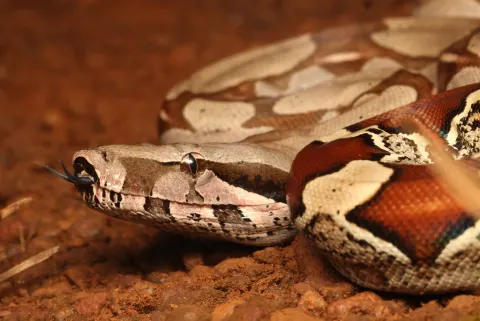
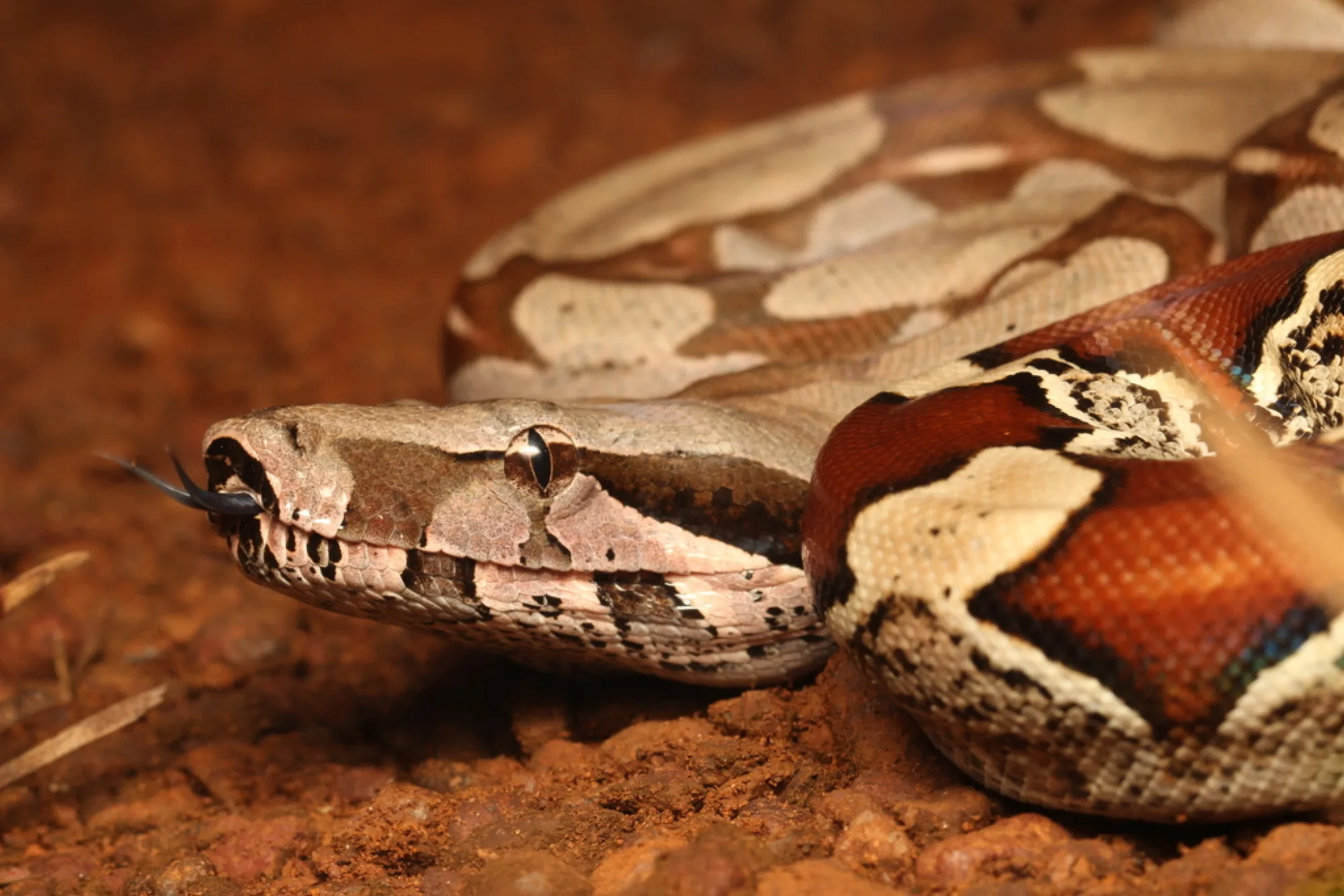
Heavy-bodied and non-venomous, the Boa Constrictor is a large snake native to tropical South America. Its colouring varies with location, but a brown, grey or cream background usually carries brown or reddish-brown saddle markings that stand out more towards the tail. The arrow-shaped head has stripes running from the snout towards the eyes and along the top of the head. Mature females usually measure 2.1 to 3.0 m and are generally larger than males.
Across its range, the boa occupies habitats from tropical rainforest to dry semidesert, though it favours rainforest for its warmth, humidity, cover and prey. It is a capable swimmer, often found in or beside rivers and streams, and can shelter in mammal burrows. Usually solitary and active at night, it may bask by day when nights are too cold. Young boas climb trees and shrubs to forage, while older, heavier snakes spend most of their time on the ground.
Boas often wait in ambush, then seize prey and constrict it before swallowing it whole. Rodents make up much of their diet, but they also eat birds, frogs, lizards and a range of other mammals. Breeding generally takes place in the dry season, and females give birth to live young that are independent from birth. In some regions, people and other animals prey on boas, while excessive capture for pets and skins has also severely reduced their numbers. Boas are also hunted for meat and skins, and wild-caught snakes have placed considerable pressure on some populations.
Written from the English Wikipedia article Boa constrictor (CC BY-SA 4.0).
- Records
- 275
- Countries
- 16
- Atlas places
- 8
These are open occurrence records, so they show where people looked for and recorded the Boa Constrictor as much as where it lives. Cells are up to 25 km across, and every location is generalised to its cell.
Generalised encounter areas, not exact locations. Each shape is a grid cell coloured by how likely the species is there.
- Very likelyBrazil25 km zone · medium confidence · 179 records · updated 80 days ago
- Very likelyUnited States25 km zone · medium confidence · 32 records · updated 80 days ago
- Very likelyColombia25 km zone · medium confidence · 13 records · updated 80 days ago
- Very likelyPanama25 km zone · medium confidence · 8 records · updated 80 days ago
- Very likelyBolivia25 km zone · medium confidence · 7 records · updated 80 days ago
- Very likelyTrinidad & Tobago25 km zone · medium confidence · 7 records · updated 80 days ago
- Very likelyHonduras25 km zone · medium confidence · 5 records · updated 80 days ago
- Very likelyVenezuela25 km zone · medium confidence · 4 records · updated 80 days ago
- Very likelyU.S. Virgin Islands25 km zone · medium confidence · 3 records · updated 80 days ago
- LikelyPuerto Rico25 km zone · medium confidence · 7 records · updated 80 days ago
Conservation status not assessed here yet, so every location is generalised to its grid cell.