Marsh Deer
Blastocerus dichotomus
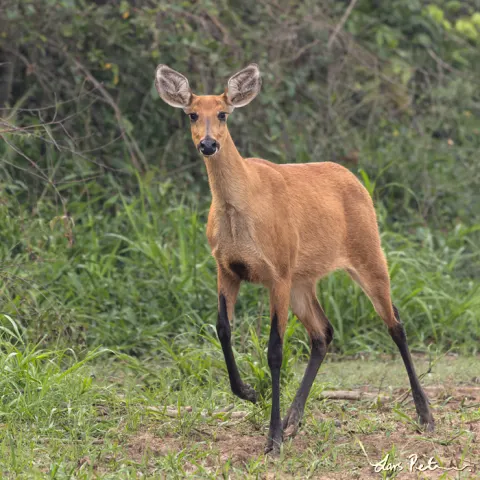
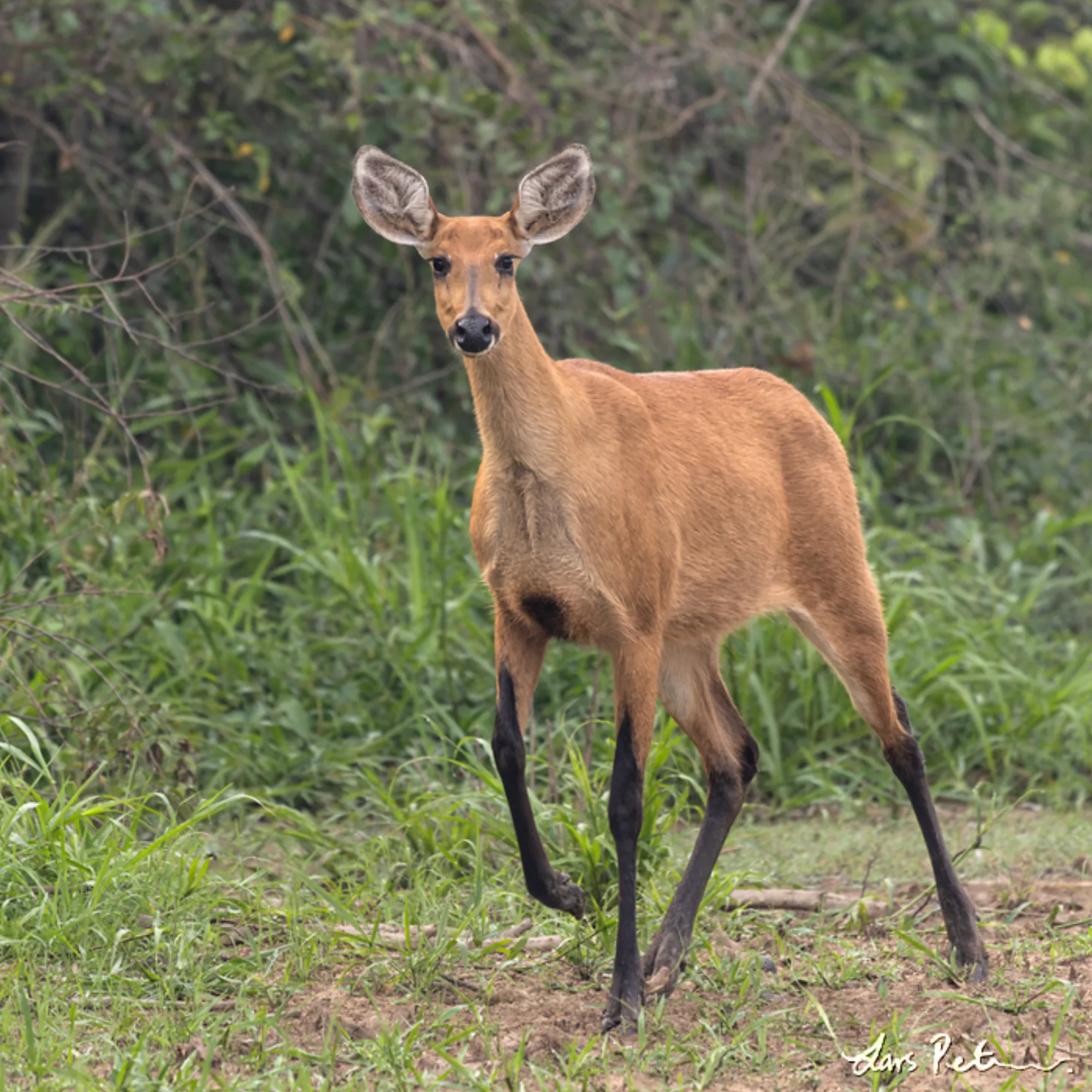
South America's largest living deer, the Marsh Deer has a red-gold to tawny brown coat, long dark legs and very large ears lined with white hair. Its muzzle and lower legs are black, with white marks around the eyes and on the hips. The coat darkens in winter. Males carry branching antlers that can reach 60 centimetres, while females have none. The head and body measure 153 to 200 cm, and shoulder height ranges from 100 to 127 cm.
Marsh Deer occur across parts of South America, from Peru and Bolivia to Brazil, Paraguay, Uruguay and Argentina, though their range has shrunk largely to isolated populations around marshes and lagoons in several river basins. Small populations also live in the southern Amazon, including in Peru's Bahuaja-Sonene National Park. They inhabit marshes such as the Pantanal and Chaco, where the water is less than 70 cm deep. Dense vegetation provides food and shelter from predators, and the deer are swift swimmers. They live alone or in groups of fewer than 6, and move with changing water levels between dry and flooded seasons. Aquatic plants make up much of their diet, alongside swamp flowers and shrubs; what they eat changes with the seasons.
Breeding usually coincides with the dry season, although timing varies between animals. After approximately 271 days of gestation, females normally give birth to one fawn between October and November, occasionally producing twins. Habitat destruction is now the main threat: dams alter wetlands, while marshes are drained for farmland and cattle farming. Diseases passed on by cattle are also a problem, and hunting for antlers was formerly a major threat.
Written from the English Wikipedia article Marsh deer (CC BY-SA 4.0).
- Records
- 499
- Countries
- 3
- Atlas places
- 3
These are open occurrence records, so they show where people looked for and recorded the Marsh Deer as much as where it lives. Cells are up to 25 km across, and every location is generalised to its cell.
Generalised encounter areas, not exact locations. Each shape is a grid cell coloured by how likely the species is there.
- Very likelyArgentina25 km zone · high confidence · 396 records · updated 80 days ago
- Very likelyBrazil25 km zone · medium confidence · 103 records · updated 80 days ago
- UncommonBolivia25 km zone · low confidence · 0 records · updated 80 days ago
Conservation status not assessed here yet, so every location is generalised to its grid cell.