Bale Mountains Adder
Bitis parviocula
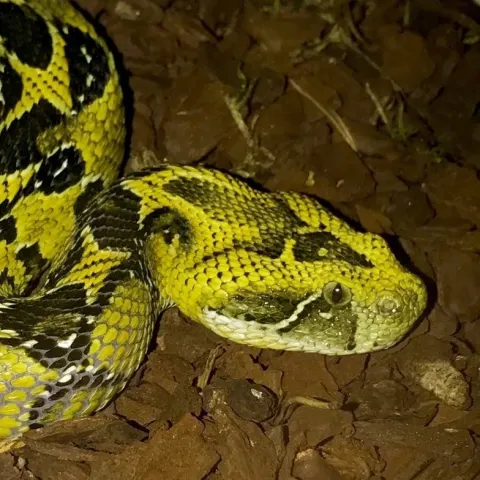
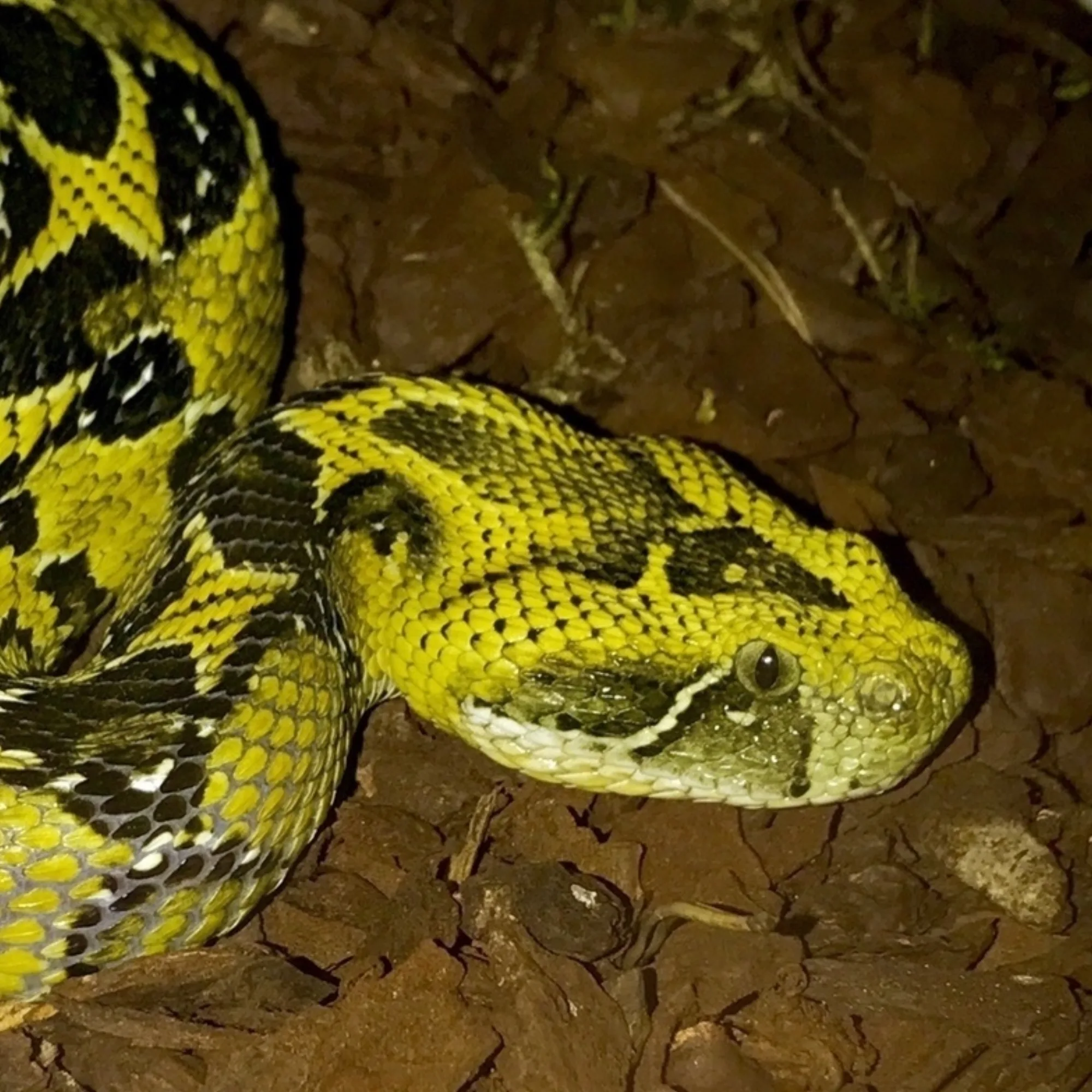
This large, venomous viper is found only in Ethiopia, where it lives on both sides of the Rift Valley. Reaching lengths of at least 130 cm, the Bale Mountains Adder is recognized by its flat, triangular head and a cylindrical body marked with striking geometric patterns. A chain of yellow butterfly shapes separates black hexagons along its brown back, while the flanks feature greenish-gray and black triangles. Its small eyes and large nostrils, set forward on the head, are distinctive features for those lucky enough to spot one.
Travellers might find this snake in the Bale Mountains or between Bonga and Jimma, at altitudes ranging from 1,700 to 2,800 metres. It inhabits varied landscapes, including high grasslands near rocky streams and forested areas such as old coffee plantations. Though its natural history remains largely a mystery, it is believed to be a nocturnal, ground-dwelling species. While one captive individual appeared less likely to strike than a typical puff adder, the species struggles fiercely when restrained and is viewed as very dangerous by local people.
Because these snakes live in densely populated regions, they are thought to be responsible for at least some local snakebites. While their venom was long a mystery, it can now be neutralized by specific antivenom. Beyond its natural habitat, the species has been kept in captivity since 2007 and successfully bred in international zoos, offering a safeguard for a snake known from only a few specific locations in the wild.
Written from the English Wikipedia article Bitis parviocula (CC BY-SA 4.0).
- Records
- 0
- Countries
- 1
- Atlas places
- 0
These are open occurrence records, so they show where people looked for and recorded the Bale Mountains Adder as much as where it lives. Cells are up to 25 km across, and every location is generalised to its cell.
Generalised encounter areas, not exact locations. Each shape is a grid cell coloured by how likely the species is there.
- Very likelyEthiopia50 km zone · low confidence · 0 records · updated 1 day ago