Rhinoceros Viper
Bitis nasicornis
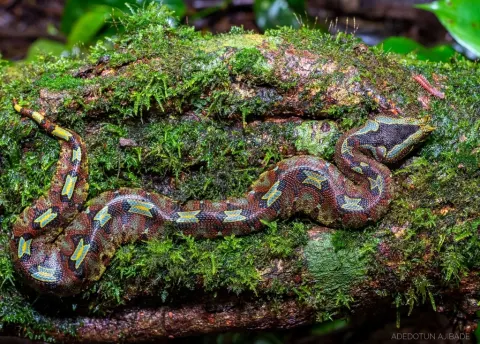
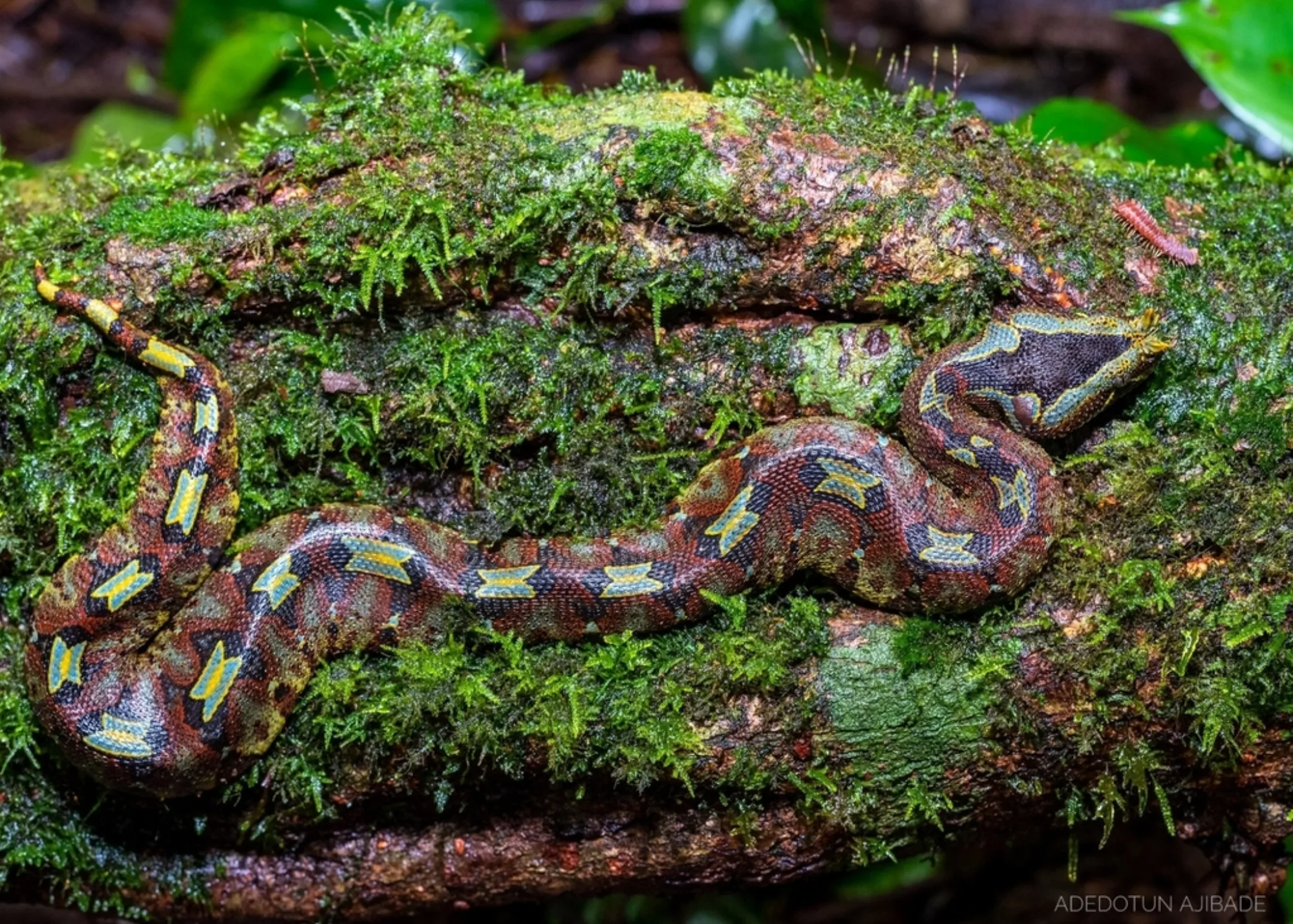
A stout forest snake with a patterned back and horn-like scales on its nose, the Rhinoceros Viper is venomous. It usually measures 72 to 107 cm in total length, with females growing larger than males. Blue or blue-green markings, each crossed by a yellow line, sit within irregular black patches along its back. Dark crimson triangles edged in green or blue run along its sides, while a black arrow marks the blue or green head. Snakes in the west tend to be bluer, while those farther east are greener. After shedding, their colours soon fade as silt from the damp surroundings gathers on their rough scales.
The species lives in forests across parts of West and Central Africa, from southern Guinea to western Kenya, and rarely ventures into woodland. It is mostly active at night and spends daylight hours hidden among leaf litter, holes, fallen trees or tangled roots. On the forest floor, its colours blend into the broken light, making it difficult to spot. Although it spends most of its time on the ground, it can climb into trees and thickets, sometimes reaching 3 m above ground. It is also a powerful swimmer and may be found in shallow pools.
The viper moves slowly but can strike quickly forwards or sideways, without first coiling or giving a warning. When approached, it often hisses loudly. It hunts from ambush, apparently spending much of its life still as it waits for prey. Small mammals make up most of its diet, though it also eats frogs, toads and fish in wetlands. The young are born alive; in West Africa, six to 38 arrive in March or April, at the start of the rainy season.
Written from the English Wikipedia article Bitis nasicornis (CC BY-SA 4.0).
- Records
- 42
- Countries
- 3
- Atlas places
- 1
These are open occurrence records, so they show where people looked for and recorded the Rhinoceros Viper as much as where it lives. Cells are up to 25 km across, and every location is generalised to its cell.
Generalised encounter areas, not exact locations. Each shape is a grid cell coloured by how likely the species is there.
- Very likelyBenin25 km zone · medium confidence · 30 records · updated 80 days ago
- Very likelyCameroon25 km zone · medium confidence · 10 records · updated 80 days ago
- UncommonUganda25 km zone · medium confidence · 2 records · updated 80 days ago
Conservation status not assessed here yet, so every location is generalised to its grid cell.