Gaboon Adder
Bitis gabonica
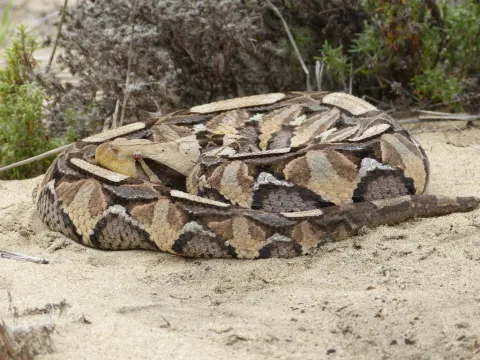
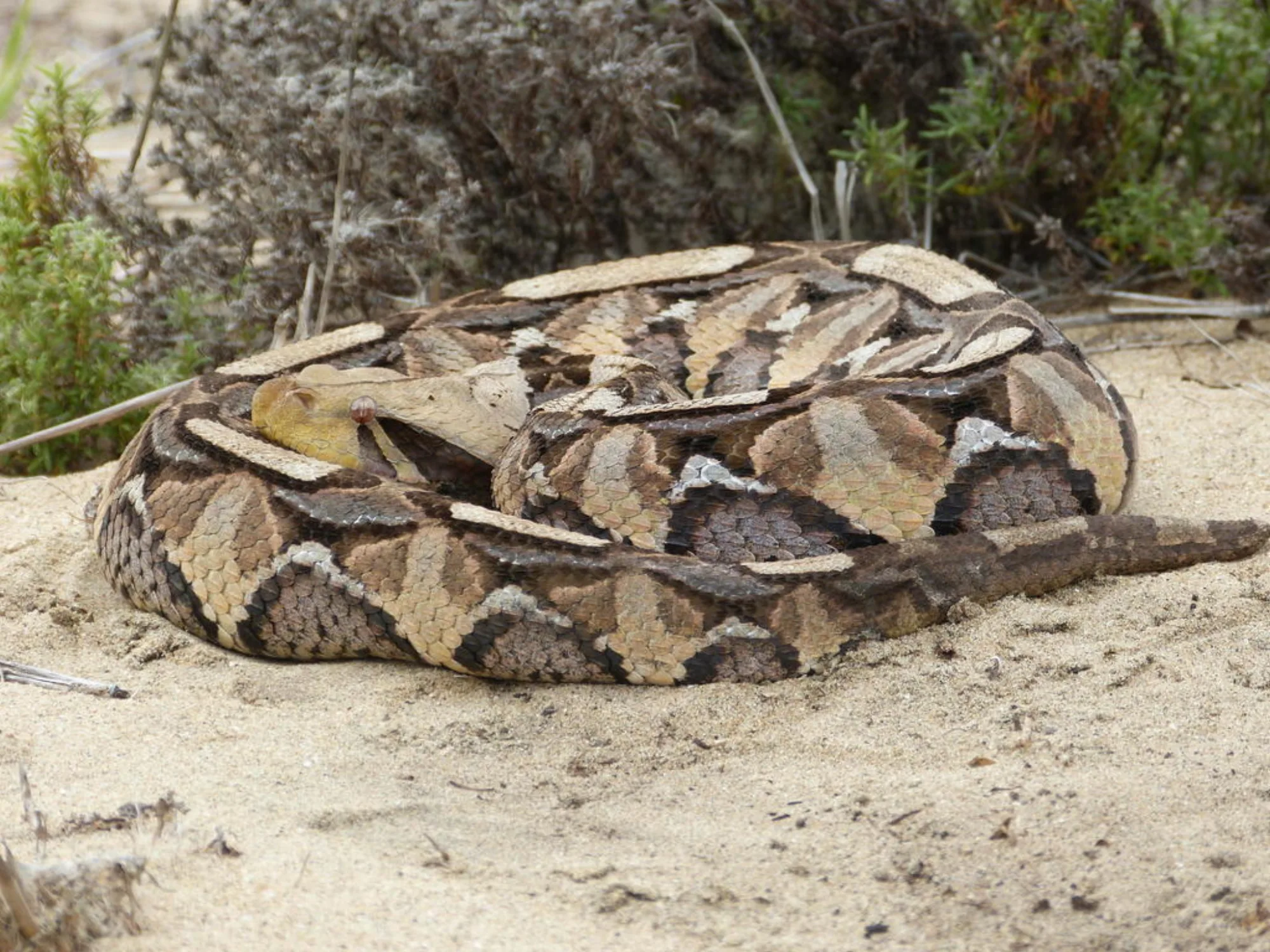
On a forest floor, the Gaboon Adder can be easy to miss, even when fully exposed among dry leaves. Its patterned skin provides camouflage beneath trees, with pale patches down the back alternating with dark, yellow-edged hourglass markings. Brown or fawn shapes mark its sides, while its cream or white head carries a fine dark line and a dark triangle below each eye. This highly venomous snake has a heavy body, a broad triangular head and a much narrower neck. Adults are typically 125 to 155 cm long.
Its range extends across parts of sub-Saharan Africa, from Guinea and Ghana through central Africa to eastern Zimbabwe, Mozambique and northeastern South Africa. It usually lives in rainforest and nearby woodland, mainly at low altitudes, but also occurs in swamps and near water. In different parts of its range, it has been found in thickets, plantations, farmland and grasslands close to forest. It may also appear on roads at night.
Primarily nocturnal, the adder often waits motionless for long periods, ambushing passing prey, although it sometimes hunts actively. Its varied diet includes amphibians, birds and mammals, from field mice and rats to hares and rabbits. Once it strikes prey, it holds on with its long fangs. Females give birth to live young and can have 50 to 60 at a time. Usually slow-moving and placid, the snake may hiss loudly when threatened, and a bite is a serious medical emergency. People can also pose a threat to it: ranch hands in Kumasi, Ghana, regularly killed these snakes around stables near a forest.
Written from the English Wikipedia article Gaboon viper (CC BY-SA 4.0).
- Records
- 122
- Countries
- 6
- Atlas places
- 1
These are open occurrence records, so they show where people looked for and recorded the Gaboon Adder as much as where it lives. Cells are up to 25 km across, and every location is generalised to its cell.
Generalised encounter areas, not exact locations. Each shape is a grid cell coloured by how likely the species is there.
- Very likelySouth Africa25 km zone · medium confidence · 84 records · updated 80 days ago
- Very likelyBenin25 km zone · medium confidence · 30 records · updated 80 days ago
- LikelyCameroon25 km zone · medium confidence · 5 records · updated 80 days ago
- PossibleTanzania25 km zone · medium confidence · 3 records · updated 80 days ago
- UncommonGabon25 km zone · low confidence · 0 records · updated 80 days ago
- UncommonNigeria25 km zone · low confidence · 0 records · updated 80 days ago
Conservation status not assessed here yet, so every location is generalised to its grid cell.