Puff Adder
Bitis arietans
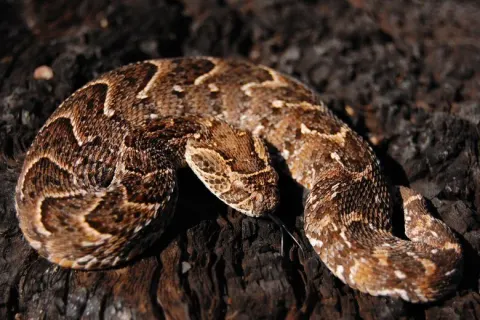
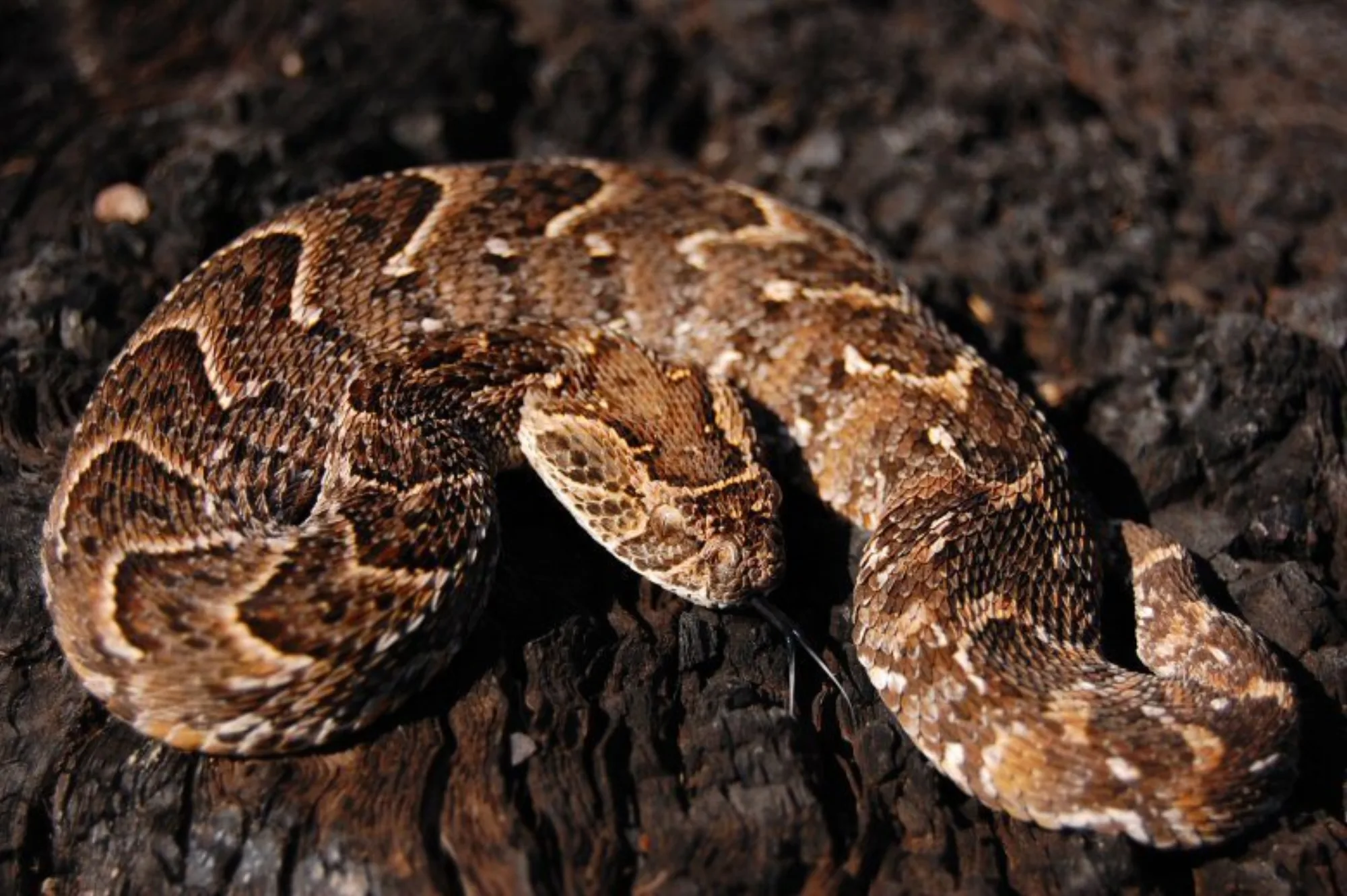
A broad head, blunt snout and stout body give the Puff Adder a distinctive outline. This highly venomous viper usually measures about 1.0 m in total length, although larger individuals have been reported. Its colouring varies from straw yellow and light brown to orange or reddish brown, with dark bands running backwards along the body and tail. These markings are usually shaped like chevrons, though in some areas they look more like the letter U. Two dark bands mark the top of the head and the area between the eyes, while the belly is yellow or white with scattered dark spots.
Puff Adders live across much of Africa and in parts of the Arabian Peninsula, and are most often associated with rocky grasslands. They are absent from true deserts, rainforests and tropical alpine habitats. Usually sluggish, they rely on camouflage for protection and spend most of their time on the ground, although they can swim and climb and are often found basking in low bushes. They also bask beside footpaths and may sit quietly when approached. If disturbed, a Puff Adder can hiss continuously, coil tightly and strike suddenly, including to the side.
Mostly active at night, it usually waits to ambush passing prey rather than searching for food. Its diet includes rodents and other mammals, birds, amphibians, lizards, snakes and tortoises. Females give birth to live young, with litters of 50 to 60 not unusual. Scent-hunting predators include dogs and meerkats, though the snake has a form of scent concealment that makes it difficult for them to detect.
Written from the English Wikipedia article Puff adder (CC BY-SA 4.0).
- Records
- 414
- Countries
- 15
- Atlas places
- 22
- Kruger National Park· South Africa
- Addo Elephant National Park· South Africa
- iSimangaliso Wetland Park· South Africa
- Garden Route National Park· South Africa
- Table Mountain National Park· South Africa
- Kgalagadi Transfrontier Park· South Africa
- Ngorongoro Conservation Area· Tanzania
- Serengeti National Park· Tanzania
- uKhahlamba-Drakensberg Park· South Africa
- West Coast National Park· South Africa
- Dorob National Park· Namibia
- Golden Gate Highlands National Park· South Africa
- Maasai Mara National Reserve· Kenya
- Mana Pools National Park· Zimbabwe
- Mountain Zebra National Park· South Africa
- Nairobi National Park· Kenya
- Namib-Naukluft· Namibia
- Nyerere National Park· Tanzania
- Okavango Delta· Botswana
- Samburu National Reserve· Kenya
- Tarangire National Park· Tanzania
- Walvis Bay· Namibia
These are open occurrence records, so they show where people looked for and recorded the Puff Adder as much as where it lives. Cells are up to 25 km across, and every location is generalised to its cell.
Generalised encounter areas, not exact locations. Each shape is a grid cell coloured by how likely the species is there.
- Very likelyBenin25 km zone · medium confidence · 200 records · updated 80 days ago
- Very likelySouth Africa25 km zone · medium confidence · 176 records · updated 80 days ago
- Very likelyTanzania25 km zone · medium confidence · 20 records · updated 80 days ago
- LikelyMozambique25 km zone · medium confidence · 6 records · updated 80 days ago
- LikelyEswatini25 km zone · medium confidence · 4 records · updated 80 days ago
- LikelyMorocco25 km zone · medium confidence · 4 records · updated 80 days ago
- LikelyNamibia25 km zone · medium confidence · 3 records · updated 80 days ago
- PossibleBotswana25 km zone · medium confidence · 1 record · updated 80 days ago
- PossibleGuinea25 km zone · low confidence · 0 records · updated 80 days ago
- PossibleSenegal25 km zone · low confidence · 0 records · updated 80 days ago
Conservation status not assessed here yet, so every location is generalised to its grid cell.