Baird's Beaked Whale
Berardius bairdii
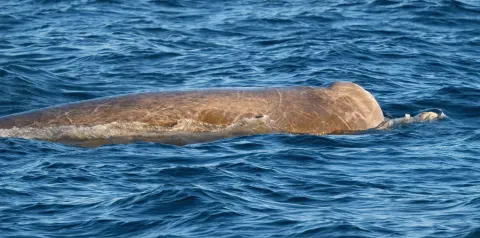
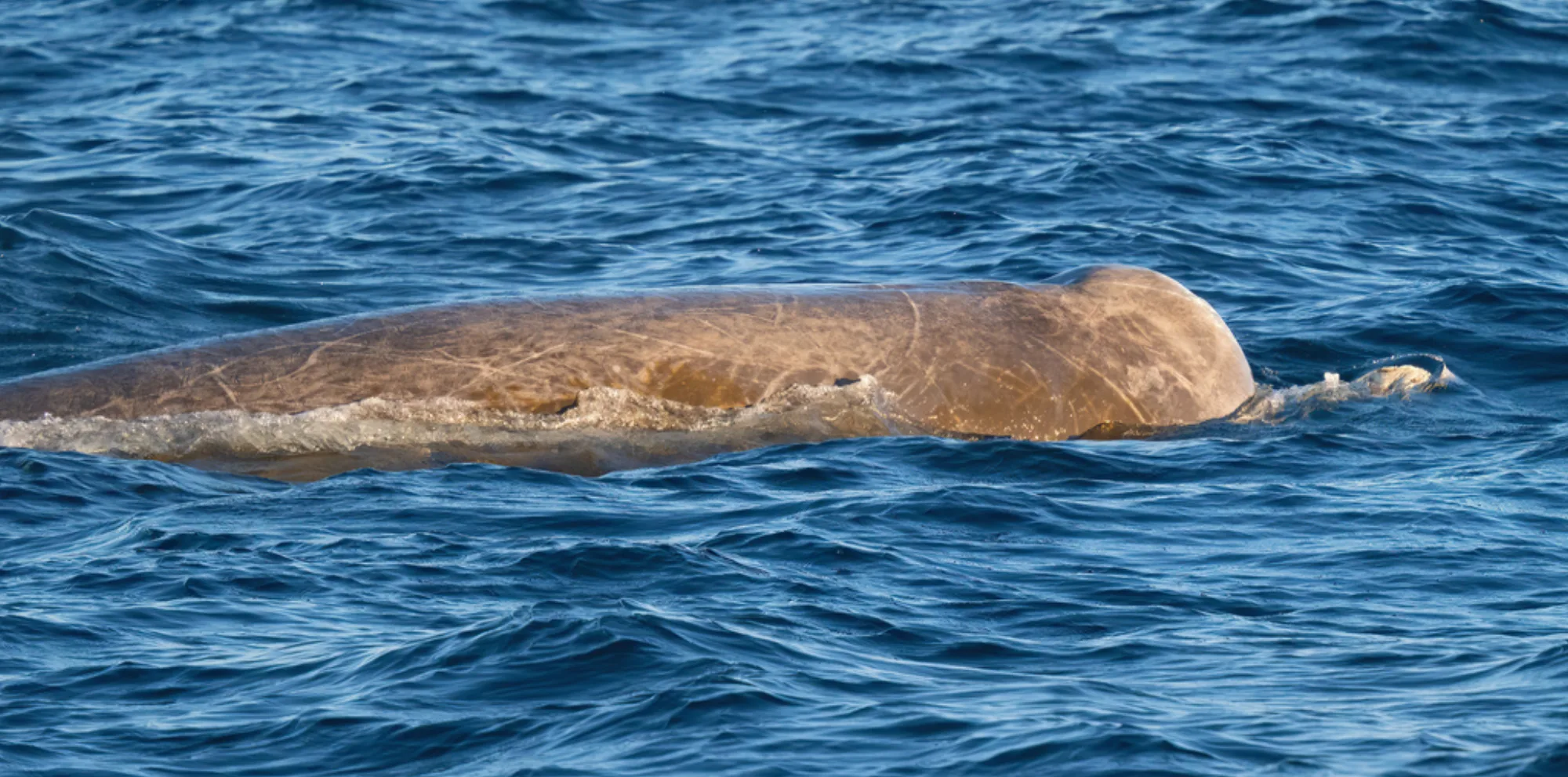
With an elongated beak and a body that can reach 12.8 metres in females, the Baird's Beaked Whale is the largest of the beaked whales. Males reach about 11.9 metres, and individuals often carry scars from confrontations with others of their species. At the surface, they gather in tight schools of up to 100, a formation that may help defend them against orcas.
This whale lives mainly in the North Pacific, searching for prey in deep water, often from 1,000 to 3,000 m below the surface. In the northwest, sightings include Hokkaido, Sakhalin, Kamchatka and the Aleutian Islands, as well as the Okhotsk and Bering seas. Farther east, the recorded range stretches south from Alaska to northern Baja California, including San Diego and the U.S. West Coast. Some populations also use shallower water: around the Commander Islands, a group regularly occupies areas much shallower than those usually associated with the species. Whales familiar with these areas use them more often, while newcomers adopt the behaviour after spending time with residents.
Much of their foraging takes place below the surface, in long, deep dives interspersed with shorter ones. Some deep dives reach the seafloor, and changes in depth suggest the whales may follow its contours as they feed. Their diet includes deep-water fish and squid, with fish dominant off the Pacific coast of Honshu and cephalopods predominant in the southern Sea of Okhotsk. Young whales stay with their mothers for 6 to 9 years. Historically, at least 4,000 have been hunted, and commercial whalers in Japan continue to hunt them.
Written from the English Wikipedia article Baird's beaked whale (CC BY-SA 4.0).
- Records
- 129
- Countries
- 3
No atlas park has a record of the Baird's Beaked Whale in or around it yet.
These are open occurrence records, so they show where people looked for and recorded the Baird's Beaked Whale as much as where it lives. Cells are up to 25 km across, and every location is generalised to its cell.
Generalised encounter areas, not exact locations. Each shape is a grid cell coloured by how likely the species is there.
- Very likelyUnited States25 km zone · medium confidence · 88 records · updated 80 days ago
- Very likelyJapan25 km zone · medium confidence · 41 records · updated 80 days ago
- RareMexico25 km zone · low confidence · 0 records · updated 80 days ago
Conservation status not assessed here yet, so every location is generalised to its grid cell.