Arnoux's Beaked Whale
Berardius arnuxii
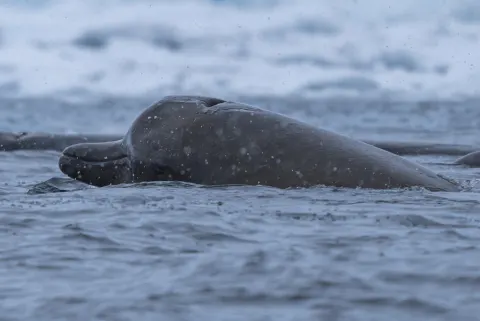
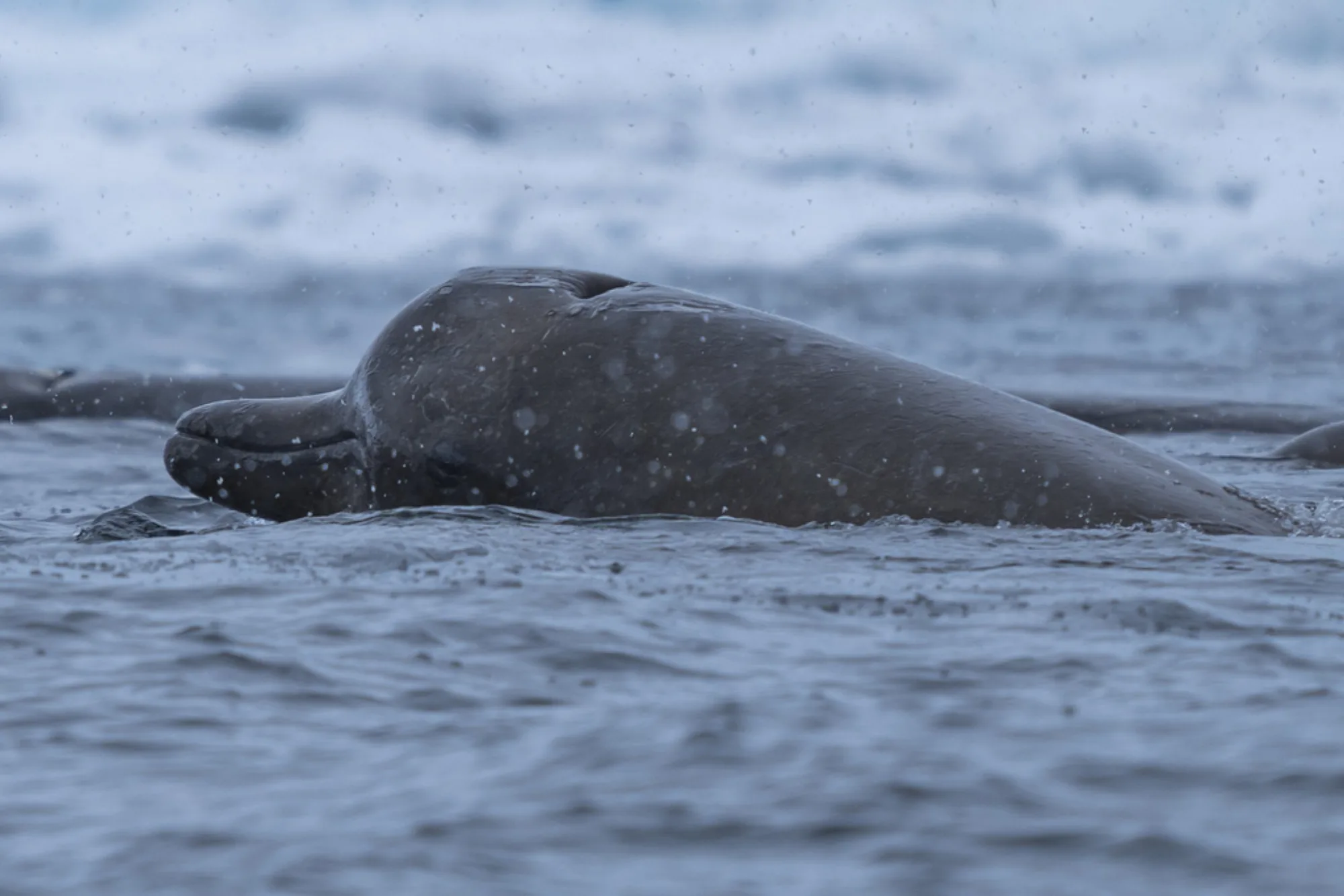
Reaching similar sizes to its northern cousin, the Arnoux's Beaked Whale is distinguished by a bulbous melon and a long beak. Its lower jaw extends past the upper, revealing front teeth even when the mouth is shut. These whales have small, rounded flippers and a dorsal fin positioned far back on the body. As they age, both males and females accumulate white linear scars from social interactions, which contrast with their thick blubber. These inquisitive animals often approach boats and have been seen breaching, spyhopping, or slapping their flippers on the water.
This species lives in the Southern Ocean, preferring the coasts of icy landmasses. They inhabit polar, cool, and temperate waters, sometimes appearing in inland fjords or near continents. Highly social, they travel in pods of up to 47 individuals, though groups of 80 have been recorded. These deep-diving suction-feeders use throat grooves to draw in prey like a biological vacuum. They can dive for up to an hour, reaching depths possibly as great as 3000 m to hunt squid and fish.
While these whales have rarely been exploited, they face natural threats in the open sea. Killer whales are the only potential animal predator, sometimes leaving scars on their fins and flukes. They also suffer wounds from cookiecutter sharks, which remove chunks of tissue. Though no official abundance estimates exist, they are protected by a memorandum of understanding for cetacean conservation in the Pacific Islands.
Written from the English Wikipedia article Arnoux's beaked whale (CC BY-SA 4.0).
- Records
- 0
- Countries
- 1
- Atlas places
- 0
These are open occurrence records, so they show where people looked for and recorded the Arnoux's Beaked Whale as much as where it lives. Cells are up to 25 km across, and every location is generalised to its cell.
Generalised encounter areas, not exact locations. Each shape is a grid cell coloured by how likely the species is there.
- Very likelyAntarctica25 km zone · low confidence · 0 records · updated 4 days ago
Conservation status not assessed here yet, so every location is generalised to its grid cell.