Tripodfish
Bathypterois grallator
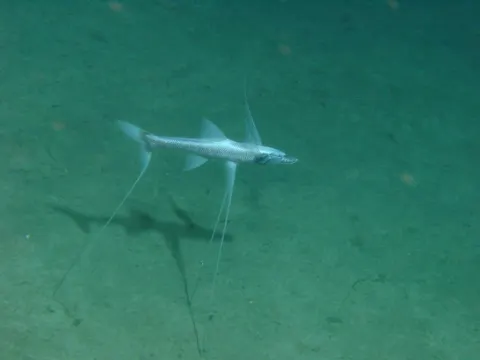
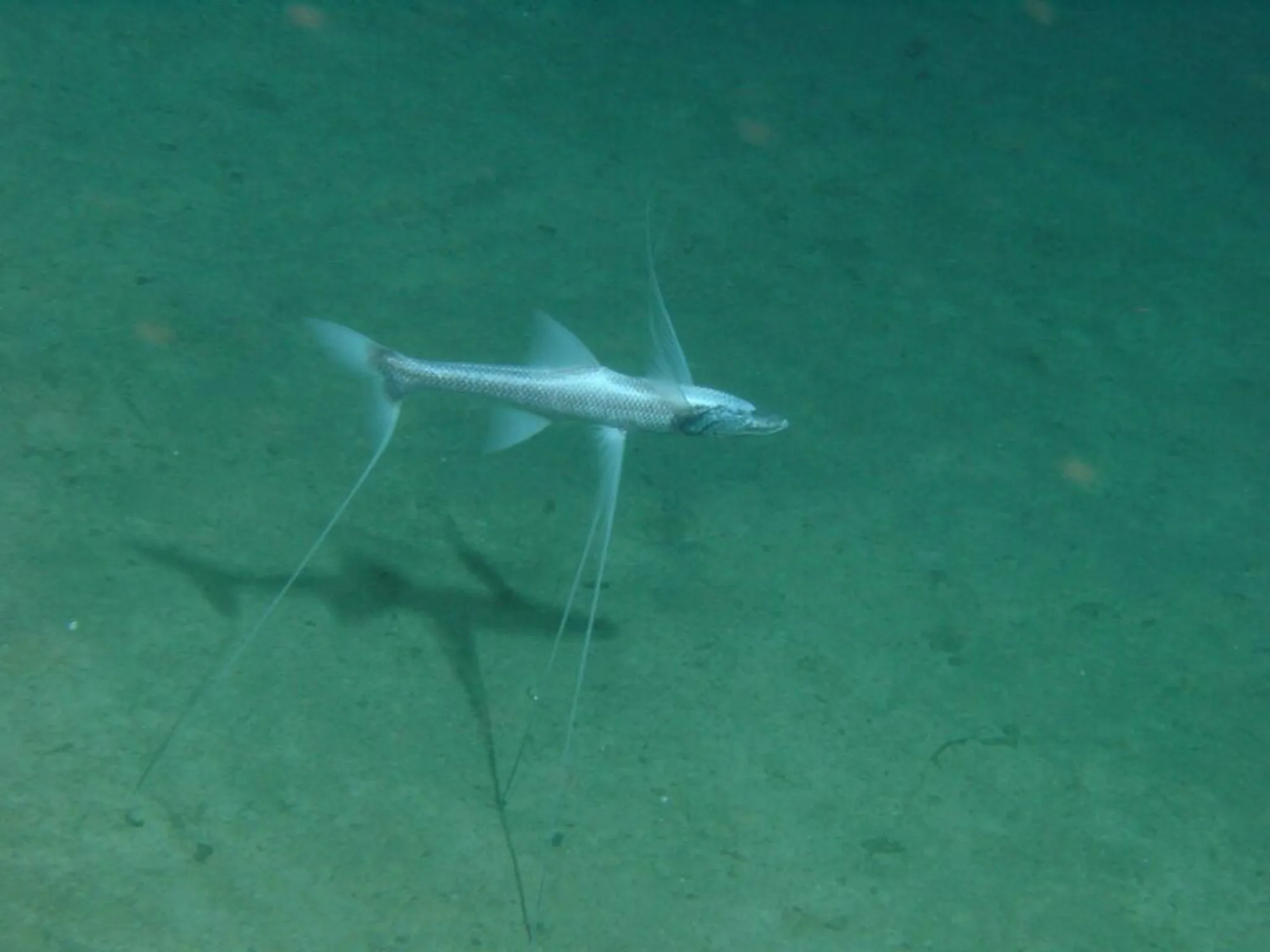
Balanced above the deep seafloor on three long fin extensions, the Tripodfish has a stance that gives it its name. Its body is mostly silver or white, with darker colour around the head and gills and a stripe along each side. It commonly exceeds 30 cm in standard length and can reach 43.4 cm in total length. The fin extensions are flexible when it swims and stiff when it rests.
This fish ranges across the Atlantic, Pacific and Indian oceans, with records near Madagascar and the coasts of Africa, Central America and North America. It has been found on continental slopes and abyssal plains at depths of 878 to 4,720 m. It shares its habitat with other tripod fish, and has been observed standing close to Bathypterois longifilis. Submersibles have directly observed and photographed it, offering a view of a fish that spends much of its life waiting on the seabed.
Facing into the current, it waits motionless for prey to drift past, using sensory cues to find food despite extremely poor eyesight. Young fish feed mainly by filtering food from the water, while larger ones can also ambush prey. Their diet changes as they grow, from small invertebrates such as copepods and crustacean larvae to prey including fish and decapods. Individuals can reproduce with a mate or fertilise their own eggs when no mate is available. No specific major threats have been identified, but human activities including deep-sea mining, drilling and plastic waste affect its habitat. Its isolated population makes the extent of the risk from these activities difficult to establish.
Written from the English Wikipedia article Bathypterois grallator (CC BY-SA 4.0).
- Records
- 18
- Countries
- 3
No atlas park has a record of the Tripodfish in or around it yet.
These are open occurrence records, so they show where people looked for and recorded the Tripodfish as much as where it lives. Cells are up to 25 km across, and every location is generalised to its cell.
Generalised encounter areas, not exact locations. Each shape is a grid cell coloured by how likely the species is there.
- Very likelyUnited States25 km zone · medium confidence · 11 records · updated 80 days ago
- LikelyAustralia25 km zone · medium confidence · 4 records · updated 80 days ago
- PossibleHonduras25 km zone · medium confidence · 3 records · updated 80 days ago
Conservation status not assessed here yet, so every location is generalised to its grid cell.