Cacomistle
Bassariscus sumichrasti
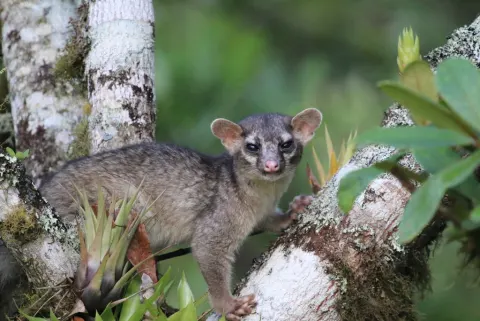
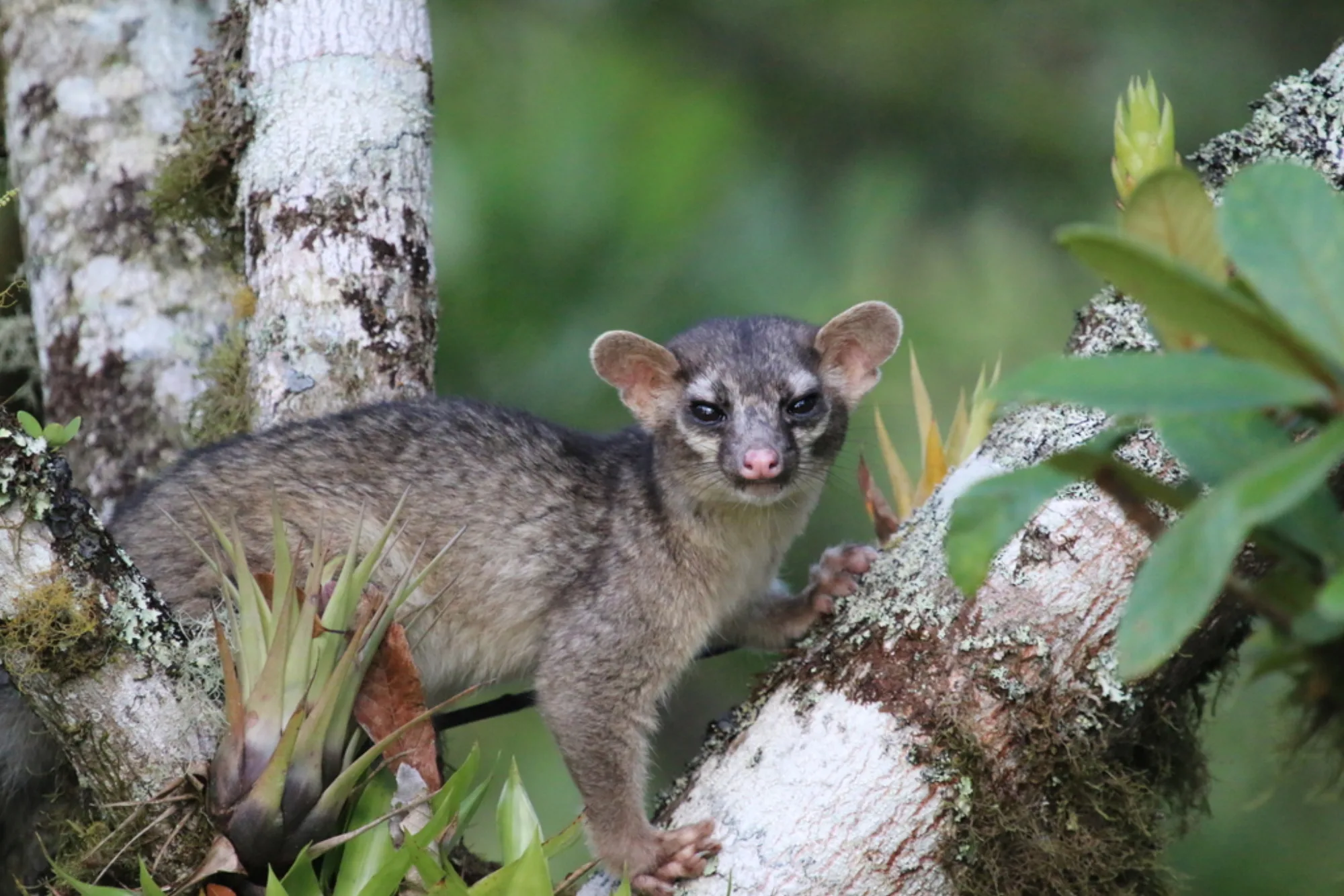
A pointed pair of ears and a long, striped tail help distinguish the Cacomistle, a secretive relative of raccoons, coatis and kinkajous. Its fur is usually grey or light brownish, while its tail carries black and white bands that fade towards a black tip. The body measures around 38 to 47 cm, with a tail that can be longer still, at roughly 39 to 53 cm. Usually active at night and at home in trees, it is an uncommon animal to see across much of its range.
That range extends from southern Mexico to western Panama, though in Costa Rica it occupies only a very small area. Depending on location, it favours humid tropical evergreen jungle or mountain cloud forest, and may enter drier deciduous forest in some seasons. Look for it among the branches of the middle and upper canopy, where it is typically seen. Individuals live largely alone, with each using an area of 20 hectares or more. Habitat preferences vary: in Mexico it tends to avoid oak forest, secondary forest and overgrown pasture, while in Costa Rica it favours those same habitats.
Its varied diet changes with the seasons and includes fruit, flowers, nectar and invertebrates, as well as small vertebrates such as lizards, frogs and rodents. Bromeliads can provide food high in the canopy, collecting rainwater that attracts insects and other small animals. Cacomistles come together briefly during the mating season; after roughly two months, the female gives birth to one cub. The cub is weaned at three months and learns hunting and survival skills from its mother before establishing its own territory. Its dependence on trees and dense vegetation makes deforestation a particular threat.
Written from the English Wikipedia article Cacomistle (CC BY-SA 4.0).
- Records
- 50
- Countries
- 5
No atlas park has a record of the Cacomistle in or around it yet.
These are open occurrence records, so they show where people looked for and recorded the Cacomistle as much as where it lives. Cells are up to 25 km across, and every location is generalised to its cell.
Generalised encounter areas, not exact locations. Each shape is a grid cell coloured by how likely the species is there.
- Very likelyMexico25 km zone · medium confidence · 45 records · updated 81 days ago
- PossiblePanama25 km zone · medium confidence · 4 records · updated 81 days ago
- UncommonGuatemala25 km zone · medium confidence · 1 record · updated 81 days ago
- UncommonEl Salvador25 km zone · low confidence · 0 records · updated 81 days ago
- RareCosta Rica25 km zone · low confidence · 0 records · updated 81 days ago
Conservation status not assessed here yet, so every location is generalised to its grid cell.