Ringtail
Bassariscus astutus
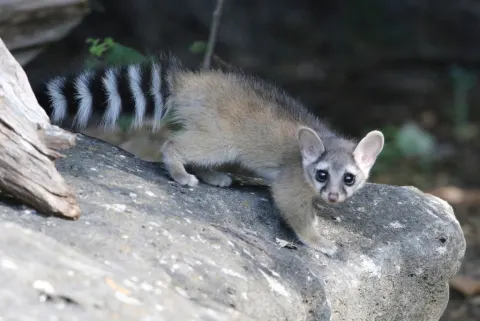
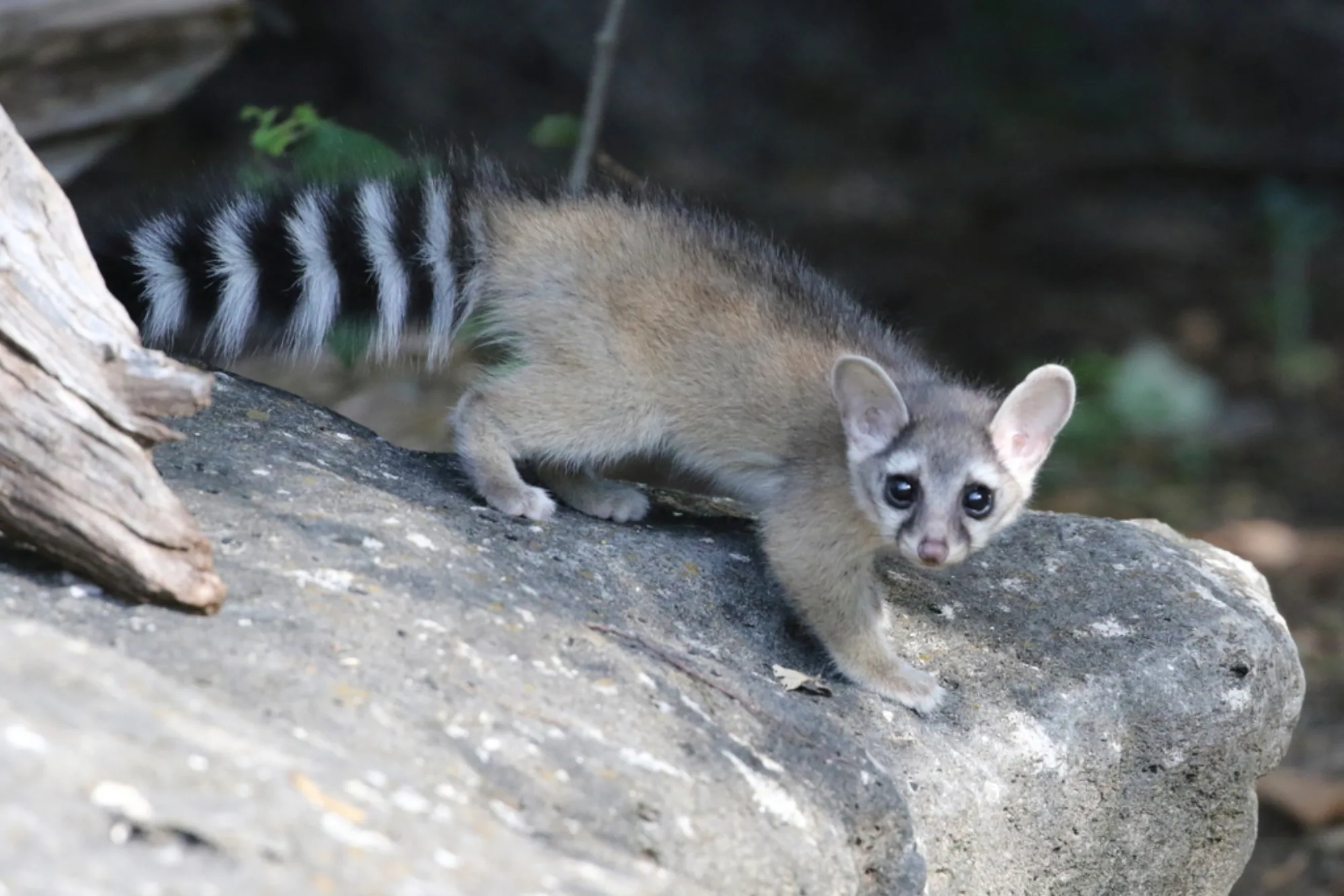
Smaller than a house cat, the Ringtail is a raccoon relative with a pointed, whiskered muzzle and a catlike body. Its coat ranges from black to dark brown, with pale underparts and dark markings around the eyes that give its face a masked appearance. Its long black and white tail is about as long as its body and has 14 to 16 stripes.
Native to arid North America, the Ringtail ranges across parts of the southwestern United States and Mexico, from Baja California to Oaxaca. It is often found in rocky desert country, including the Great Basin, Sonoran and Chihuahuan deserts. It also favours rocky places near water, such as canyons, caves and mine shafts, and nests in hollow trees or abandoned wooden structures. Mostly active at night, it uses its large eyes and upright ears to navigate and find food in darkness. A skilled climber, it balances with its tail on narrow ledges and branches. Adults usually live alone, although they may share a den or groom one another.
The Ringtail eats both plants and animals, with berries and insects important throughout the year. In spring and summer, these foods and other fruit become especially prominent, while small vertebrates are important in winter. It can go for long periods without drinking, obtaining water from its food. Breeding takes place in spring, and a litter contains 2 to 4 kits. The young open their eyes after one month and hunt for themselves after four months. Great horned owls and red-tailed hawks are its main predators, while foxes, coyotes and other animals also take ringtails, especially young ones. People have trapped and hunted ringtails for their fur, although trapping has slowed considerably and how many remain or how quickly their populations are growing is uncertain.
Written from the English Wikipedia article Ringtail (CC BY-SA 4.0).
- Records
- 431
- Countries
- 2
- Atlas places
- 4
These are open occurrence records, so they show where people looked for and recorded the Ringtail as much as where it lives. Cells are up to 25 km across, and every location is generalised to its cell.
Generalised encounter areas, not exact locations. Each shape is a grid cell coloured by how likely the species is there.
- Very likelyUnited States25 km zone · medium confidence · 298 records · updated 80 days ago
- Very likelyMexico25 km zone · medium confidence · 133 records · updated 80 days ago
Conservation status not assessed here yet, so every location is generalised to its grid cell.