Olinguito
Bassaricyon neblina
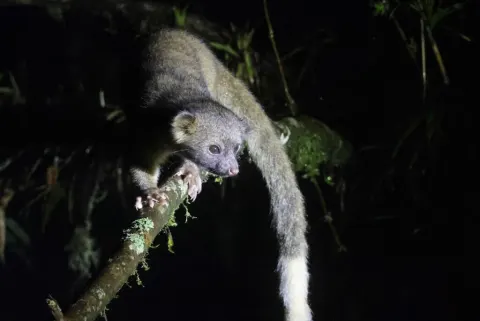
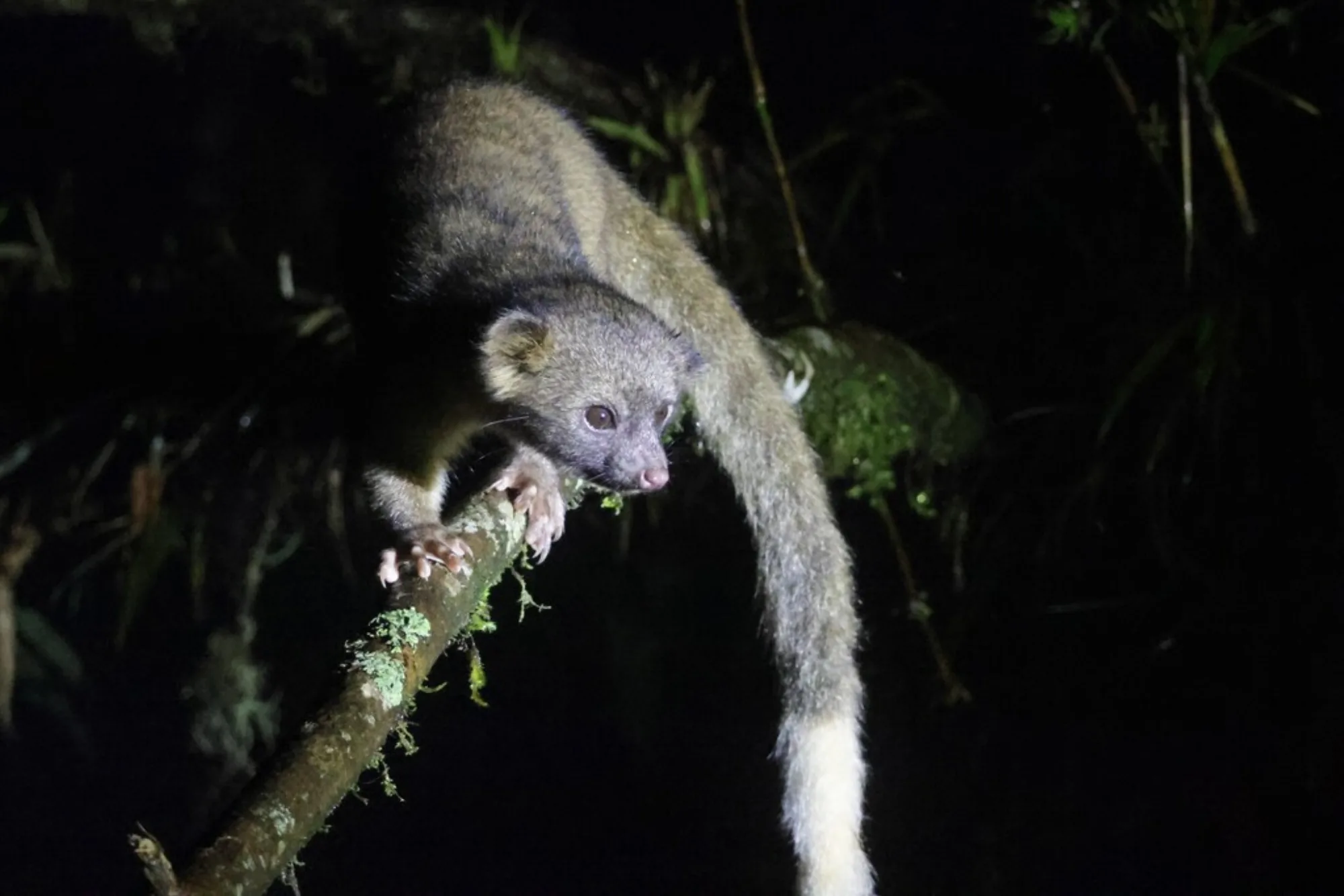
In the cloud forests of the western Colombian and Ecuadorian Andes, the Olinguito lives among the trees. This small member of the raccoon family weighs an average of 900 grams. Its body measures approximately 355 mm from head to rump, with a tail 335 to 424 mm long. Compared with other olingos, it is smaller and much furrier, with smaller ears and a shorter tail. Kinkajous share characteristics with it and have been mistaken for it.
Olinguitos appear to spend their lives in trees, keeping largely to themselves and coming out at night. Fruit makes up most of their diet, including figs, although they also eat insects and nectar. They probably have a single offspring at a time. Specimens identified in Andean cloud forest came from sites between 1,500 and 3,000 metres in elevation. Another account places the animal in the northern Andes between 1,500 and 2,750 metres above sea level. These forests lie higher than the habitats occupied by other olingos.
Deforestation and urbanisation may put the Olinguito at risk. The team behind its discovery estimated that farming and urban development had replaced 42% of its suitable historic habitat, while a further 21% was still natural but mostly without forest. More than 40 percent of its potential range is estimated to have been deforested. Protecting the high elevation cloud forest would improve its chances of survival, but no strict efforts to reduce habitat destruction are known to be in place.
Written from the English Wikipedia article Olinguito (CC BY-SA 4.0).
- Records
- 9
- Countries
- 2
No atlas park has a record of the Olinguito in or around it yet.
These are open occurrence records, so they show where people looked for and recorded the Olinguito as much as where it lives. Cells are up to 25 km across, and every location is generalised to its cell.
Generalised encounter areas, not exact locations. Each shape is a grid cell coloured by how likely the species is there.
- Very likelyEcuador25 km zone · medium confidence · 8 records · updated 80 days ago
- PossibleColombia25 km zone · medium confidence · 1 record · updated 80 days ago
Conservation status not assessed here yet, so every location is generalised to its grid cell.