Green Basilisk
Basiliscus plumifrons
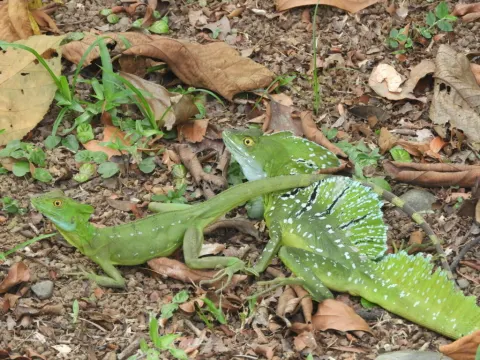
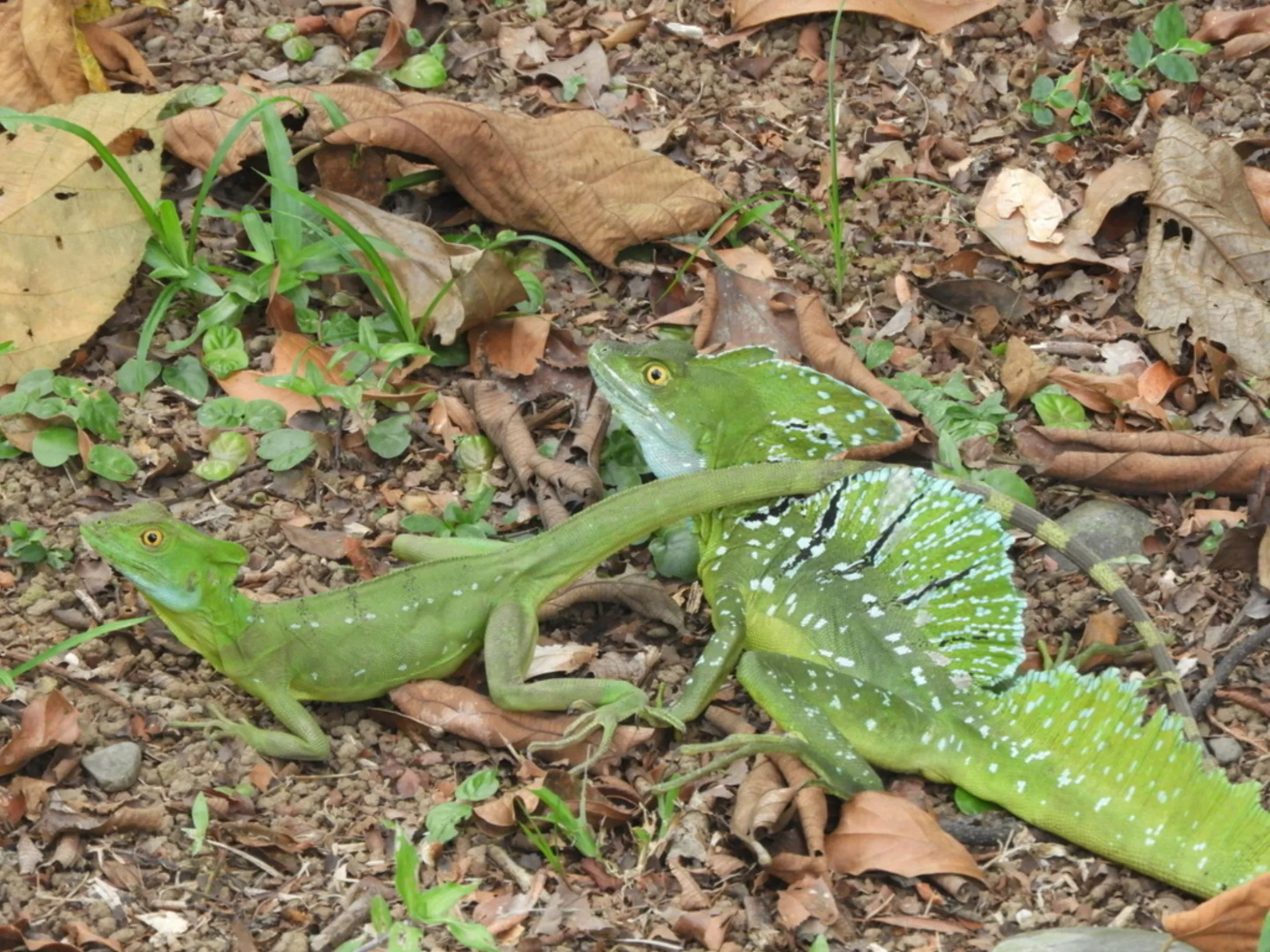
Bright green colouring, yellow eyes and a crested profile make the Green Basilisk, Basiliscus plumifrons, a distinctive rainforest lizard. Adults can reach 91 cm from snout to tail, while juveniles are less conspicuously coloured and lack the characteristic crests. Males have prominent plumes on their heads and crests along the back and tail; females usually have a much smaller head crest. Black and white streaks can run along the neck and back, and the underside is generally a paler green.
Native to Central America, this lizard lives in hot, humid rainforest close to running water, favouring moist lowlands of mature forest. Its range includes southern Mexico and northern Colombia, with evidence of its presence from eastern Honduras to western Panama and sightings in southwestern Costa Rica. Active by day, it spends time in trees and can also be found on boulders beside water. It occurs around rivers, streams, ponds and lakes, as well as on beaches and seashores. When threatened, it can escape by running short distances across water, and it can also swim and remain underwater for up to an hour.
The Green Basilisk eats both animals and plants, though it most often searches for insects. Its varied diet can also include worms, small fish, amphibians, fruit, seeds, flowers and leaves. Females lay eggs in warm, damp sand or soil, and the young are independent when they hatch after eight to ten weeks. Females may produce several clutches in a breeding season. Birds of prey, opossums, coatis and snakes are among its predators; preserving the species also depends on agroforestry systems that integrate trees.
Written from the English Wikipedia article Plumed basilisk (CC BY-SA 4.0).
- Records
- 551
- Countries
- 4
- Atlas places
- 4
These are open occurrence records, so they show where people looked for and recorded the Green Basilisk as much as where it lives. Cells are up to 25 km across, and every location is generalised to its cell.
Generalised encounter areas, not exact locations. Each shape is a grid cell coloured by how likely the species is there.
- Very likelyCosta Rica25 km zone · medium confidence · 476 records · updated 81 days ago
- Very likelyNicaragua25 km zone · medium confidence · 20 records · updated 81 days ago
- LikelyHonduras25 km zone · medium confidence · 32 records · updated 81 days ago
- LikelyPanama25 km zone · medium confidence · 23 records · updated 81 days ago
Conservation status not assessed here yet, so every location is generalised to its grid cell.