Australian Ringneck
Barnardius zonarius
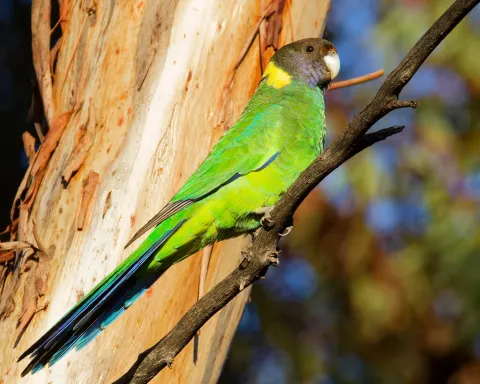
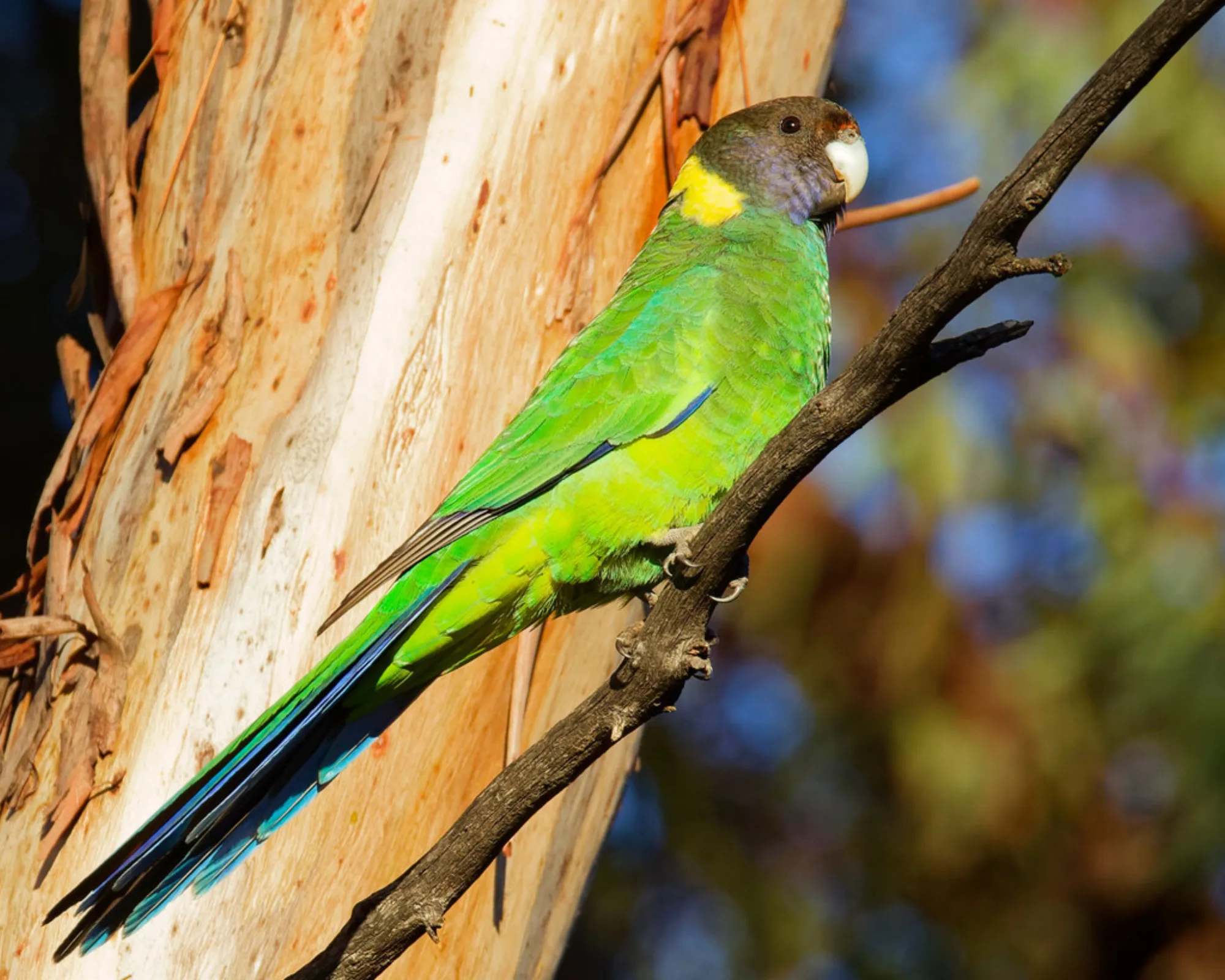
Across much of Australia, the Australian Ringneck brings green plumage and a yellow collar to eucalypt country. This medium-sized parrot is around 33 cm long, with green and blue in its wings and tail. Its four subspecies differ considerably in colour, but all share the yellow ring at the back of the neck. Some have dull black heads, while others have bright green crowns and pinkish cheek patches. Depending on the form, a bird may also show a red or crimson forehead band, or yellow across its belly. Calls vary too: some ringnecks sound strident, while others have ringing calls. The Twenty-eight parrot takes its name from a call that sounds like its name.
Active during the day, ringnecks gather in eucalypt woodlands and along watercourses lined with eucalypts. They are sociable birds and may stay in one area or move around, depending on conditions. Their varied diet includes nectar, insects, seeds, fruit and both native and introduced bulbs. They also eat orchard fruit, which sometimes puts them at odds with farmers. In northern populations, breeding begins in June or July; farther south and in central areas, it runs from August to December, though poor climatic conditions can delay it. A hollow in a tree trunk provides the nest site, where a female generally lays four or five white oval eggs.
In Western Australia, introduced rainbow lorikeets compete aggressively for nesting places and locally displace the Twenty-eight subspecies. Psittacine beak and feather disease can affect ringnecks and kills many nestlings in captivity.
Written from the English Wikipedia article Australian ringneck (CC BY-SA 4.0).
- Records
- 96,111
- Countries
- 1
No atlas park has a record of the Australian Ringneck in or around it yet.
These are open occurrence records, so they show where people looked for and recorded the Australian Ringneck as much as where it lives. Cells are up to 25 km across, and every location is generalised to its cell.
Generalised encounter areas, not exact locations. Each shape is a grid cell coloured by how likely the species is there.
- Very likelyAustralia25 km zone · high confidence · 96111 records · updated 81 days ago
Conservation status not assessed here yet, so every location is generalised to its grid cell.