Grey Crowned Crane
Balearica regulorum
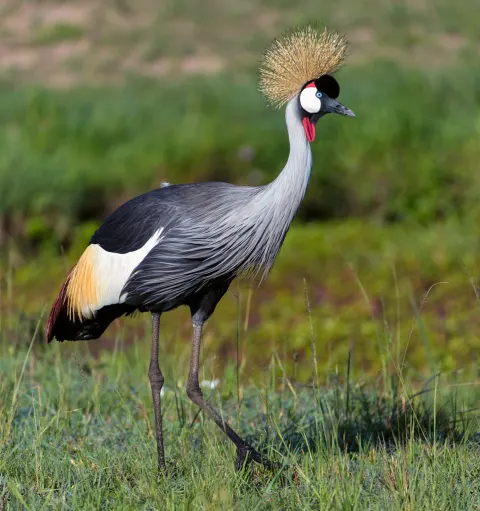
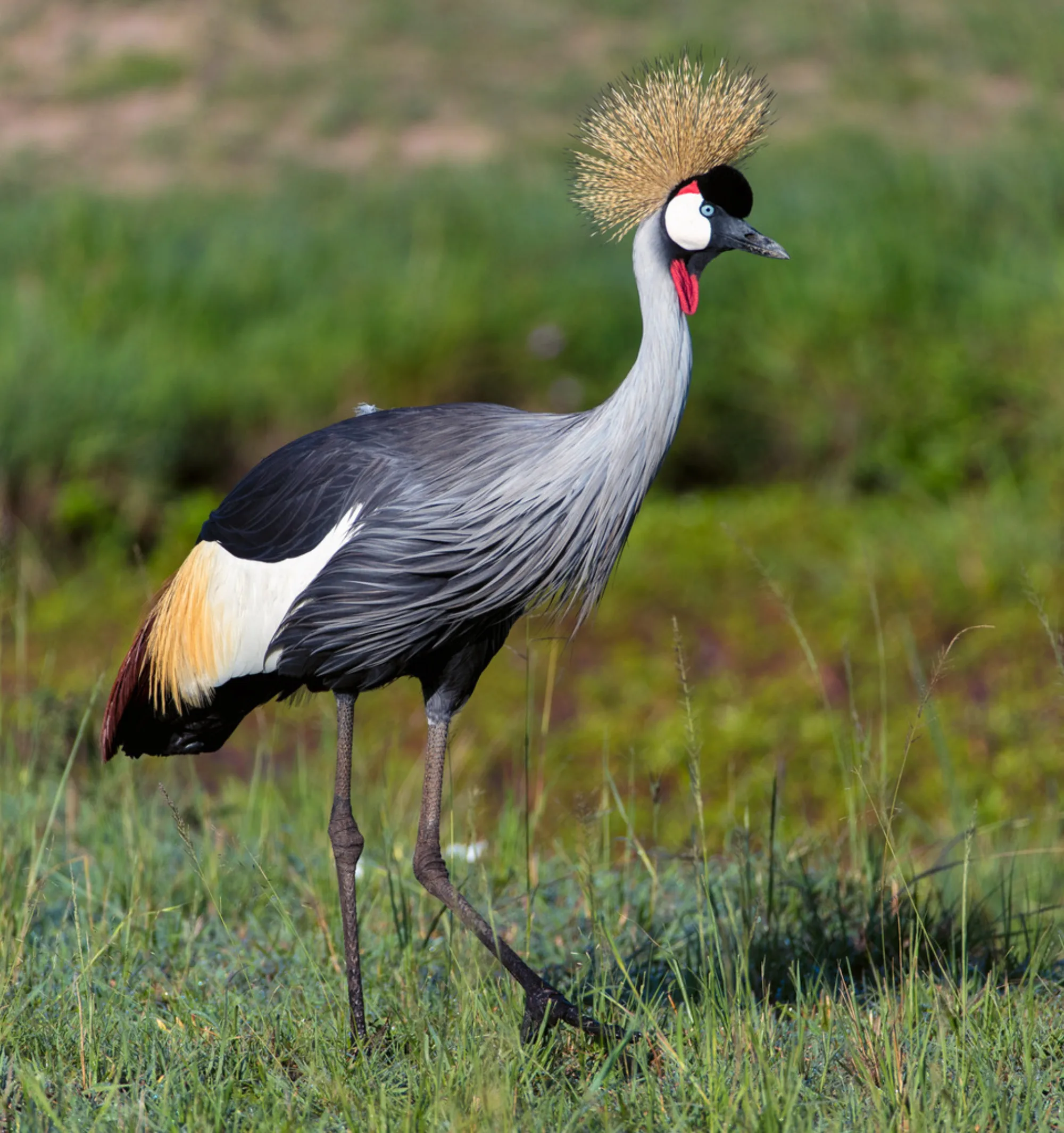
A stiff crown of golden feathers gives the Grey Crowned Crane a striking silhouette in the grasslands of Sub-Saharan Africa. This large crane has mostly grey body feathers, white cheeks and a bright red throat pouch. Its wings have a golden yellow patch among areas of white, dark grey and dark red, and its long legs are black. Adults stand approximately 1 m tall, and their wings span 2 m. Younger birds are greyer, with buff feathers on the face.
Look for these cranes in dry savannah, marshes, cultivated land and grassy flats near rivers and lakes, from Uganda and Kenya south to South Africa. They nest in wetter places and can spend the night resting and sleeping in trees. Birds near the tropics generally stay in one area, while those in drier regions may make local seasonal movements. Flocks of 30 to 150 are not uncommon, and both adults and immature birds take part in dancing. The display includes bows and jumps, and can be seen throughout the year. Listen, too, for a booming call or a honk. The cranes spend the day searching for food, stamping as they walk to flush insects from the ground. Their varied diet also includes seeds, grain, frogs, worms, snakes, small fish and eggs of aquatic animals.
Breeding is timed around rainfall, with regional differences: in East Africa it occurs year-round, most often during drier periods. In Southern Africa, breeding coincides with the rains. Pairs build a platform of grass and other plants among tall wetland vegetation, and both parents incubate the eggs. Habitat is threatened by drainage, overgrazing and pesticide pollution.
Written from the English Wikipedia article Grey crowned crane (CC BY-SA 4.0).
- Records
- 46,581
- Countries
- 20
- Atlas places
- 33
- uKhahlamba-Drakensberg Park· South Africa
- Ngorongoro Conservation Area· Tanzania
- Serengeti National Park· Tanzania
- Aberdare National Park· Kenya
- Maasai Mara National Reserve· Kenya
- Bwindi Impenetrable National Park· Uganda
- Hwange National Park· Zimbabwe
- Lake Manyara National Park· Tanzania
- Murchison Falls National Park· Uganda
- Queen Elizabeth National Park· Uganda
- Kibale National Park· Uganda
- Nairobi National Park· Kenya
- Akagera National Park· Rwanda
- Amboseli National Park· Kenya
- Mount Kenya National Park· Kenya
- Rwenzori Mountains National Park· Uganda
- Samburu National Reserve· Kenya
- South Luangwa National Park· Zambia
- Tarangire National Park· Tanzania
- Volcanoes National Park· Rwanda
- Kafue National Park· Zambia
- Kilimanjaro National Park· Tanzania
- Lake Mburo National Park· Uganda
- Ruaha National Park· Tanzania
- Arusha National Park· Tanzania
- Chobe National Park· Botswana
- Hell's Gate National Park· Kenya
- Lake Nakuru National Park· Kenya
- Liuwa Plain National Park· Zambia
- Okavango Delta· Botswana
- Semuliki National Park· Uganda
- Tsavo East National Park· Kenya
- Tsavo West National Park· Kenya
These are open occurrence records, so they show where people looked for and recorded the Grey Crowned Crane as much as where it lives. Cells are up to 25 km across, and every location is generalised to its cell.
Generalised encounter areas, not exact locations. Each shape is a grid cell coloured by how likely the species is there.
- Very likelySouth Africa25 km zone · high confidence · 17134 records · updated 86 days ago
- Very likelyKenya25 km zone · high confidence · 12509 records · updated 86 days ago
- Very likelyUganda25 km zone · high confidence · 6842 records · updated 86 days ago
- Very likelyTanzania25 km zone · high confidence · 5362 records · updated 86 days ago
- Very likelyZambia25 km zone · high confidence · 1037 records · updated 86 days ago
- Very likelyRwanda25 km zone · high confidence · 957 records · updated 86 days ago
- Very likelyCongo - Kinshasa25 km zone · high confidence · 599 records · updated 86 days ago
- Very likelyZimbabwe25 km zone · high confidence · 594 records · updated 86 days ago
- Very likelyUnited Arab Emirates25 km zone · high confidence · 520 records · updated 86 days ago
- Very likelyLesotho25 km zone · high confidence · 461 records · updated 86 days ago
Conservation status not assessed here yet, so every location is generalised to its grid cell.