Gulf Of Mexico Whale
Balaenoptera ricei
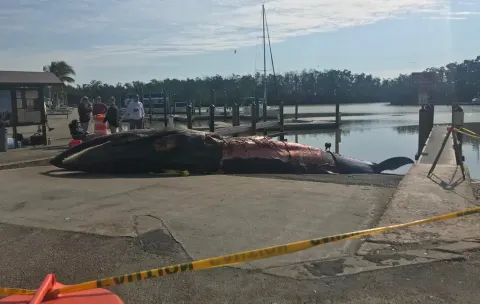
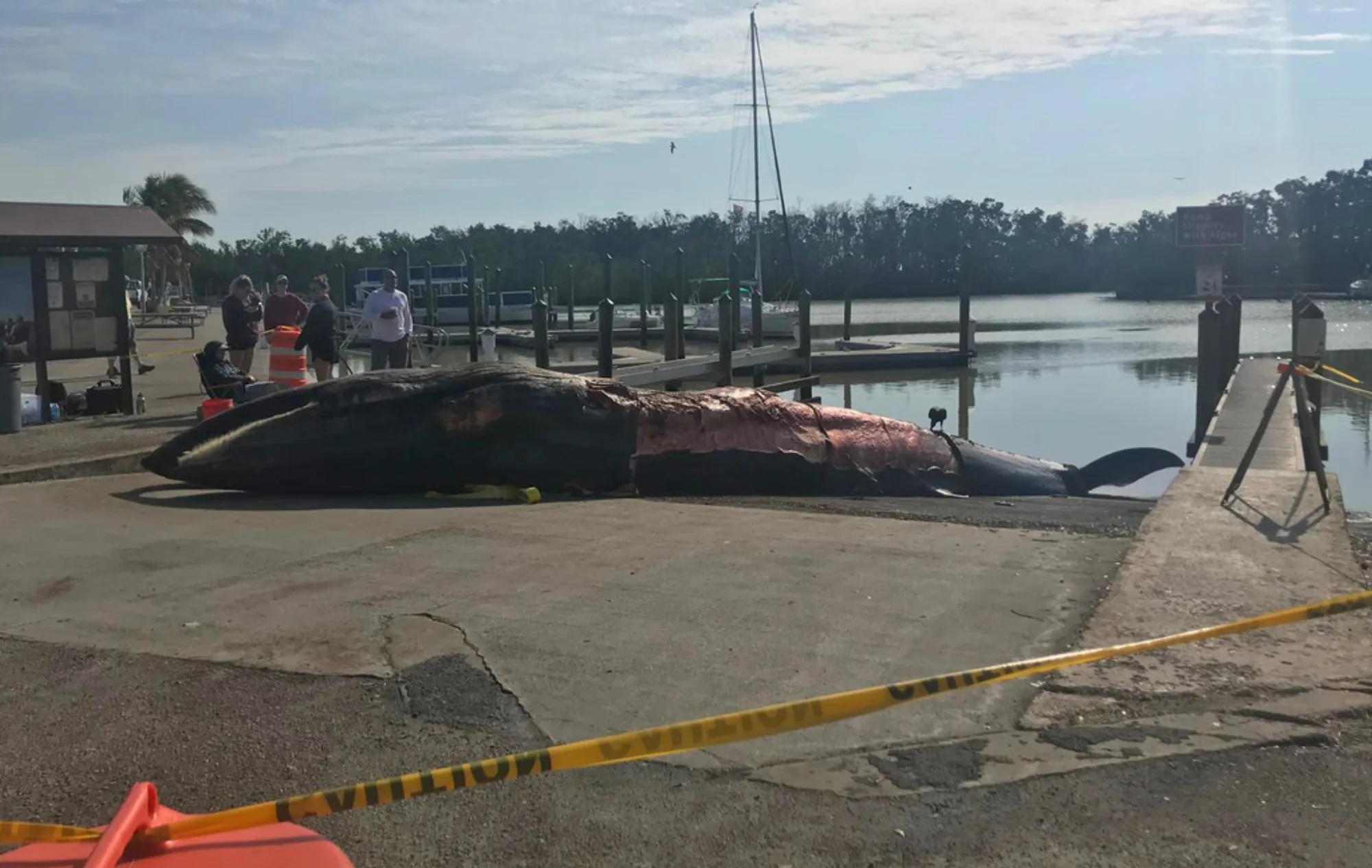
A sleek baleen whale with a dark charcoal-grey back and a pale to pinkish underside, the Gulf Of Mexico Whale (Balaenoptera ricei) belongs to the northern Gulf of Mexico. Its flat, somewhat pointed head carries three prominent ridges, a useful clue for whale watchers, although it looks almost identical to the Bryde's whale. A large, hook-shaped dorsal fin sits well back along its body, and the largest measured individual was 12.65 meters long.
Its core habitat lies along a stretch of continental slope in and near the De Soto Canyon, off western Florida, Alabama and eastern Louisiana, at depths of 150 to 410 meters. The whales stay in the Gulf year-round and are usually seen alone or in pairs, although they sometimes gather in larger, loose groups thought to be linked to feeding. During the day they dive towards the seafloor to feed, circling prey before lunging, while at night they spend much of their time close to the surface. Their full diet is still being investigated, but they appear to favour silver-rag driftfish, a schooling fish; other fish may also be eaten. Both males and females remain and breed in the Gulf.
The best estimate puts the population at 51 whales, possibly including just 26 mature animals, and numbers continue to fall. Oil pollution and ship strikes threaten them, as does noise beneath the water from vessels and seismic surveys. Their habit of spending much of the night near the surface makes them especially susceptible to collisions with ships. The 2010 Deepwater Horizon oil spill showed the impact a local disaster can have on this small population, killing nearly twenty percent of the whales.
Written from the English Wikipedia article Rice's whale (CC BY-SA 4.0).
- Records
- 44
- Countries
- 1
No atlas park has a record of the Gulf Of Mexico Whale in or around it yet.
These are open occurrence records, so they show where people looked for and recorded the Gulf Of Mexico Whale as much as where it lives. Cells are up to 25 km across, and every location is generalised to its cell.
Generalised encounter areas, not exact locations. Each shape is a grid cell coloured by how likely the species is there.
- Very likelyUnited States25 km zone · medium confidence · 44 records · updated 80 days ago
Conservation status not assessed here yet, so every location is generalised to its grid cell.