Fin Whale
Balaenoptera physalus
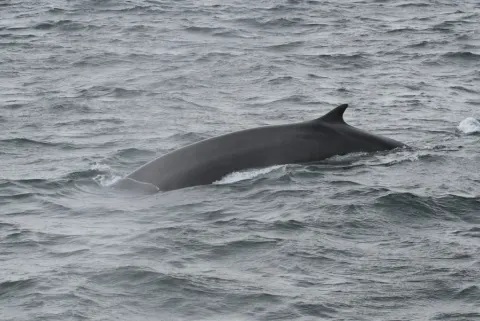
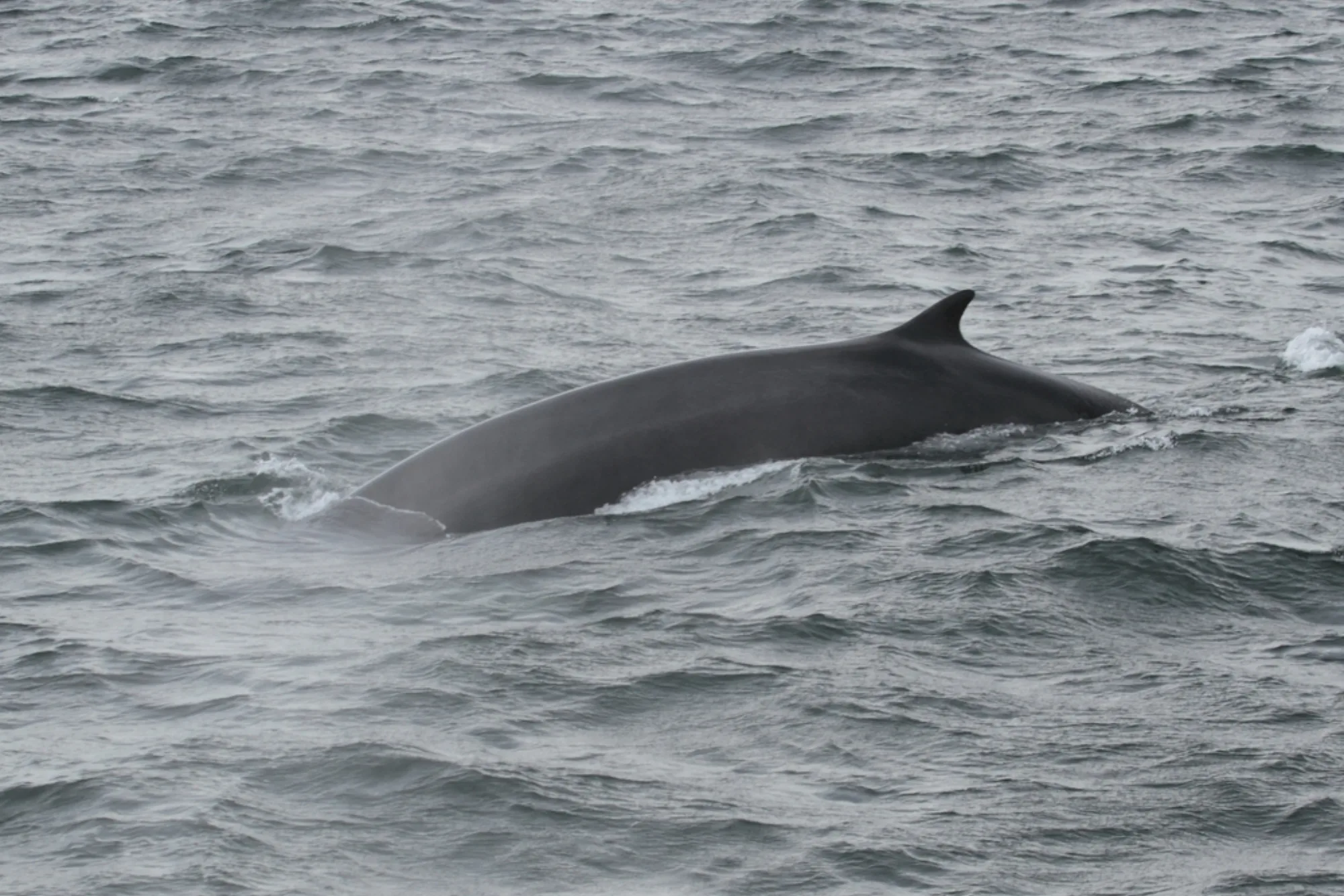
Long and slender, the Fin Whale is a baleen whale surpassed in size only by the blue whale. Its back ranges from brownish to grey, with a white underside and a large, hooked dorsal fin set well back on the body. Its head is dark grey on the left, but the lower jaw on the right is pale grey or white. Its blow can rise 4 to 6 m above the water, and it often arches its back high before a deep dive, rarely lifting its tail clear of the surface.
Fin whales inhabit every major ocean, from polar to tropical waters, but are most numerous in temperate and cool seas. They move seasonally into and out of high-latitude feeding areas, though their wider migration patterns remain poorly understood. Sightings are possible throughout the year around Monterey Bay and the Southern California Bight, peaking from November to March. They often travel in groups of 6 to 10, although feeding gatherings can be much larger. Their diet includes small schooling fish, squid and crustaceans such as krill, which they strain from the water through baleen. When hunting fish, they may circle a school at speed, bunching the fish together before turning sideways to engulf them. Calves stay with their mothers for about a year and accompany them to summer feeding areas.
Decades of whaling reduced fin whale numbers, and recovery has been slow in some oceans. Ship collisions are a major cause of death, while ocean noise may interfere with communication. Plastic debris overlaps with some Mediterranean feeding grounds, and fin whales can occasionally become entangled in fishing gear.
Written from the English Wikipedia article Fin whale (CC BY-SA 4.0).
- Records
- 11,817
- Countries
- 15
- Atlas places
- 6
These are open occurrence records, so they show where people looked for and recorded the Fin Whale as much as where it lives. Cells are up to 25 km across, and every location is generalised to its cell.
Generalised encounter areas, not exact locations. Each shape is a grid cell coloured by how likely the species is there.
- Very likelyCanada25 km zone · high confidence · 3971 records · updated 80 days ago
- Very likelyUnited States25 km zone · medium confidence · 3905 records · updated 80 days ago
- Very likelyIceland25 km zone · high confidence · 1449 records · updated 80 days ago
- Very likelyFrance25 km zone · medium confidence · 1046 records · updated 80 days ago
- Very likelySpain25 km zone · high confidence · 784 records · updated 80 days ago
- Very likelyMexico25 km zone · medium confidence · 297 records · updated 80 days ago
- Very likelyAntarctica25 km zone · medium confidence · 130 records · updated 80 days ago
- Very likelyPortugal25 km zone · medium confidence · 86 records · updated 80 days ago
- Very likelyNorway25 km zone · medium confidence · 42 records · updated 80 days ago
- Very likelySt. Pierre & Miquelon25 km zone · medium confidence · 39 records · updated 80 days ago
Conservation status not assessed here yet, so every location is generalised to its grid cell.