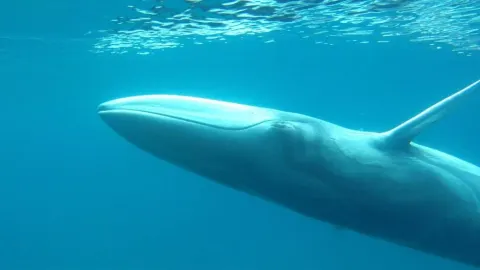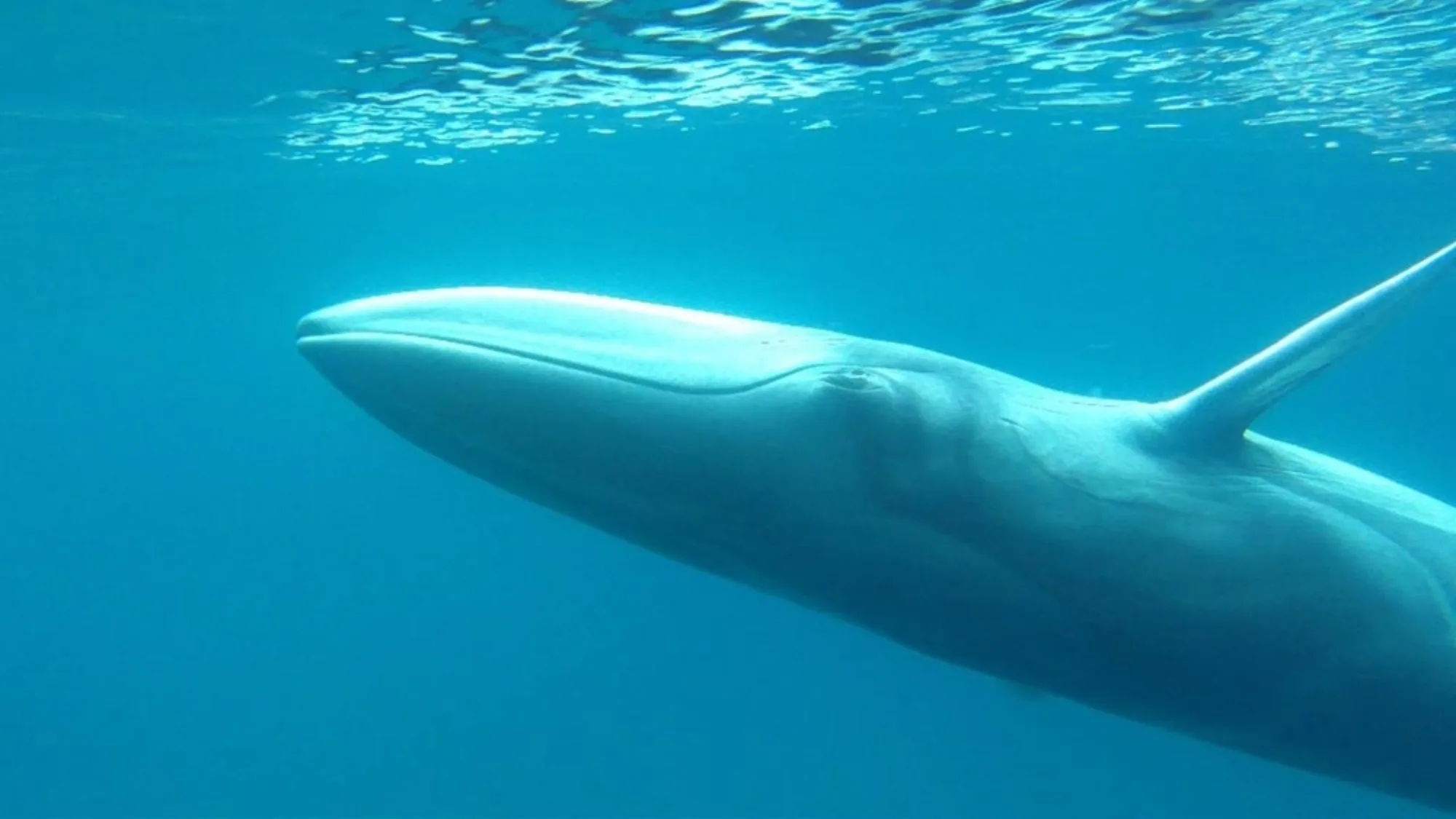
Omura’s Whale
Balaenoptera omurai
Small for a rorqual, the Omura’s Whale (Balaenoptera omurai) has a colour pattern that recalls the larger fin whale. Its lower jaw is dark on the left, while the right side has a white patch and blaze; a white chevron marks the back. Look, too, for a strongly curved dorsal fin and a low, diffuse blow. After the whale surfaces, its dorsal fin usually appears only after the head has gone under, and the tail flukes do not rise when it dives.
Omura’s whales occur in the Indian and Pacific oceans and the Atlantic, mostly over continental shelves in tropical waters. Records span places from southern Japan and the Philippines to Indonesia, northwestern Madagascar and Brazil. Off northwestern Madagascar, researchers observed them in open shelf waters rather than in bays or deeper water beyond the shelf break. There, whales were usually seen alone, although loose gatherings could contain as many as a dozen. They have been seen breaching and lunging for food off Madagascar and Komodo National Park. Krill have been found in their stomachs, and whales off Madagascar have been observed feeding on krill. Sightings of mothers and calves in different months off northwestern Madagascar suggest that births may occur over an extended season, though much remains unknown about breeding.
Fishing gear and ship strikes pose threats: whales have been caught as bycatch, and two individuals were recorded as victims of collisions with ships. Omura’s whales have also been hunted in the Bohol Sea and taken by Japanese scientific whaling. Scars on whales seen in several areas show that they have encountered cookiecutter sharks in deep water.
Written from the English Wikipedia article Omura's whale (CC BY-SA 4.0).
- Records
- 30
- Countries
- 5
No atlas park has a record of the Omura’s Whale in or around it yet.
These are open occurrence records, so they show where people looked for and recorded the Omura’s Whale as much as where it lives. Cells are up to 25 km across, and every location is generalised to its cell.
Generalised encounter areas, not exact locations. Each shape is a grid cell coloured by how likely the species is there.
- Very likelyMadagascar25 km zone · medium confidence · 11 records · updated 80 days ago
- Very likelyTaiwan25 km zone · medium confidence · 7 records · updated 80 days ago
- LikelyNew Caledonia25 km zone · medium confidence · 8 records · updated 80 days ago
- LikelyVietnam25 km zone · medium confidence · 3 records · updated 80 days ago
- PossibleIndonesia25 km zone · medium confidence · 1 record · updated 80 days ago
Conservation status not assessed here yet, so every location is generalised to its grid cell.