Blue Whale
Balaenoptera musculus
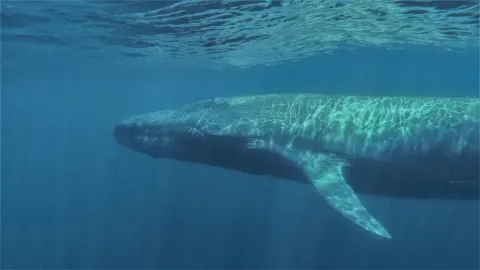
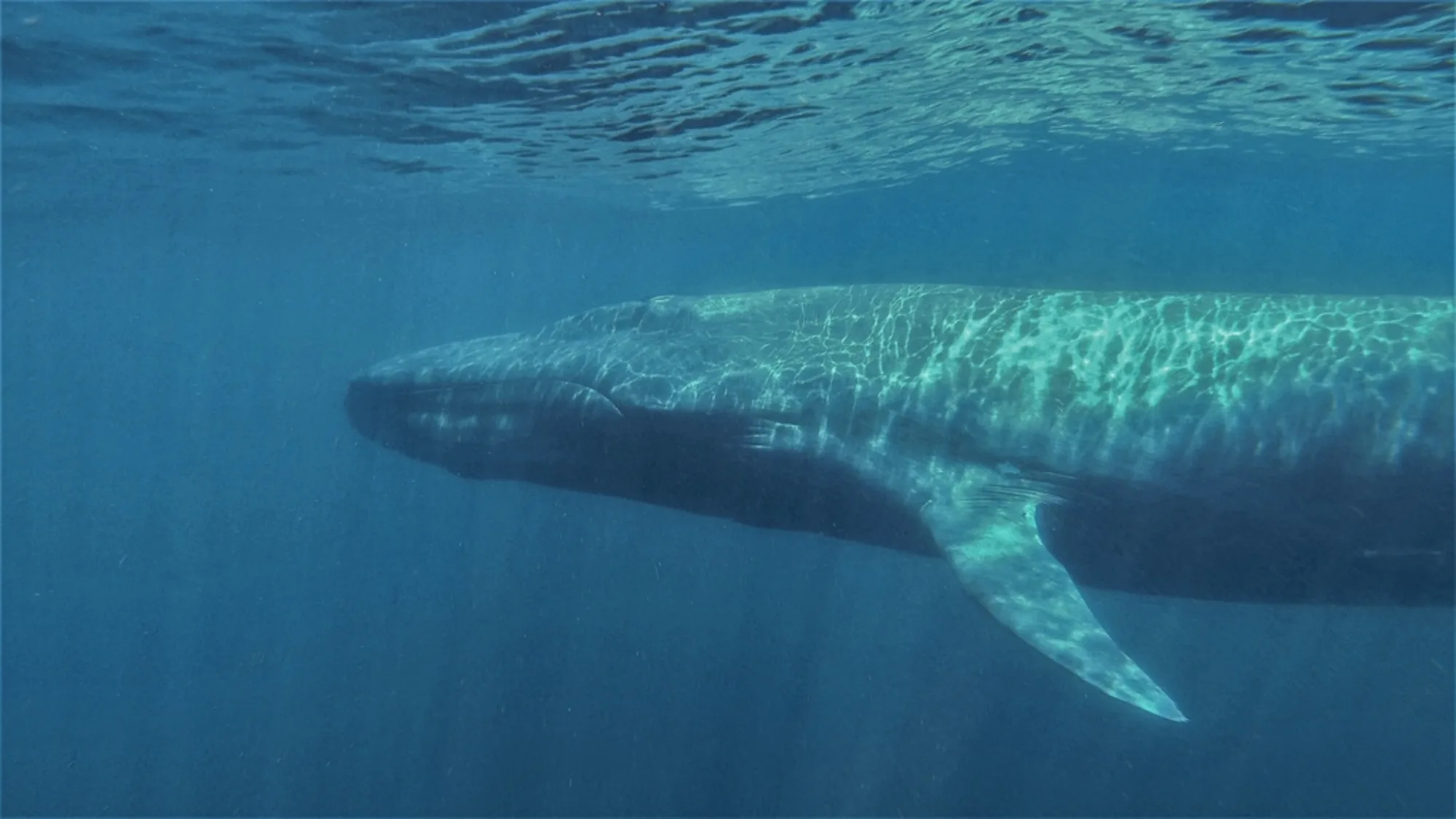
Long, slender and immense, the Blue Whale is the largest animal known to have existed. Its mottled skin is greyish-blue above and lighter underneath, sometimes with a yellowish cast from diatoms in the water. It has a broad, U-shaped head and a small, curved dorsal fin set close to the tail. Its blow can rise 9.1 to 12 m into the air.
Blue whales live across the world's oceans, though sightings are rare in the Arctic Ocean and several seas, including the Mediterranean. Many travel between feeding grounds towards the poles in summer and breeding grounds closer to the tropics in winter, while some remain in an area year-round. Off California, they feed mainly from summer to autumn; in winter and spring, some move south to Mexican waters and the Costa Rica Dome, where they feed and breed. Usually alone or in pairs, they can gather in groups of more than 50 where food is plentiful. Their diet is almost entirely krill, which they engulf in lunges before pushing out the water and swallowing their prey. The Northern Indian Ocean subspecies instead feeds mainly on sergestid shrimp. Blue whales also produce low-frequency calls, and their songs differ between populations.
Much remains unknown about their breeding and birthing areas. Pregnancy may last 10 to 12 months, and calves measure 6 to 7 m at birth. Mothers and calves form bonds, though pairs are seldom observed. Whaling once brought blue whales close to extinction. Today, ship strikes, pollution, underwater noise and climate change continue to threaten them; collisions are a particular problem where whale habitat overlaps busy shipping routes.
Written from the English Wikipedia article Blue whale (CC BY-SA 4.0).
- Records
- 1,935
- Countries
- 17
- Atlas places
- 6
These are open occurrence records, so they show where people looked for and recorded the Blue Whale as much as where it lives. Cells are up to 25 km across, and every location is generalised to its cell.
Generalised encounter areas, not exact locations. Each shape is a grid cell coloured by how likely the species is there.
- Very likelyUnited States25 km zone · high confidence · 1219 records · updated 80 days ago
- Very likelyAustralia25 km zone · medium confidence · 278 records · updated 80 days ago
- Very likelyPortugal25 km zone · high confidence · 185 records · updated 80 days ago
- Very likelyCanada25 km zone · medium confidence · 152 records · updated 80 days ago
- Very likelySri Lanka25 km zone · medium confidence · 24 records · updated 80 days ago
- Very likelySt. Pierre & Miquelon25 km zone · medium confidence · 15 records · updated 80 days ago
- LikelySvalbard & Jan Mayen25 km zone · medium confidence · 26 records · updated 80 days ago
- LikelyMexico25 km zone · medium confidence · 18 records · updated 80 days ago
- LikelyAntarctica25 km zone · medium confidence · 12 records · updated 80 days ago
- LikelyChile25 km zone · medium confidence · 4 records · updated 80 days ago
Conservation status not assessed here yet, so every location is generalised to its grid cell.