Sei Whale
Balaenoptera borealis
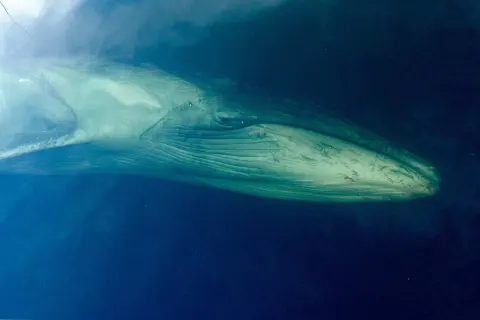
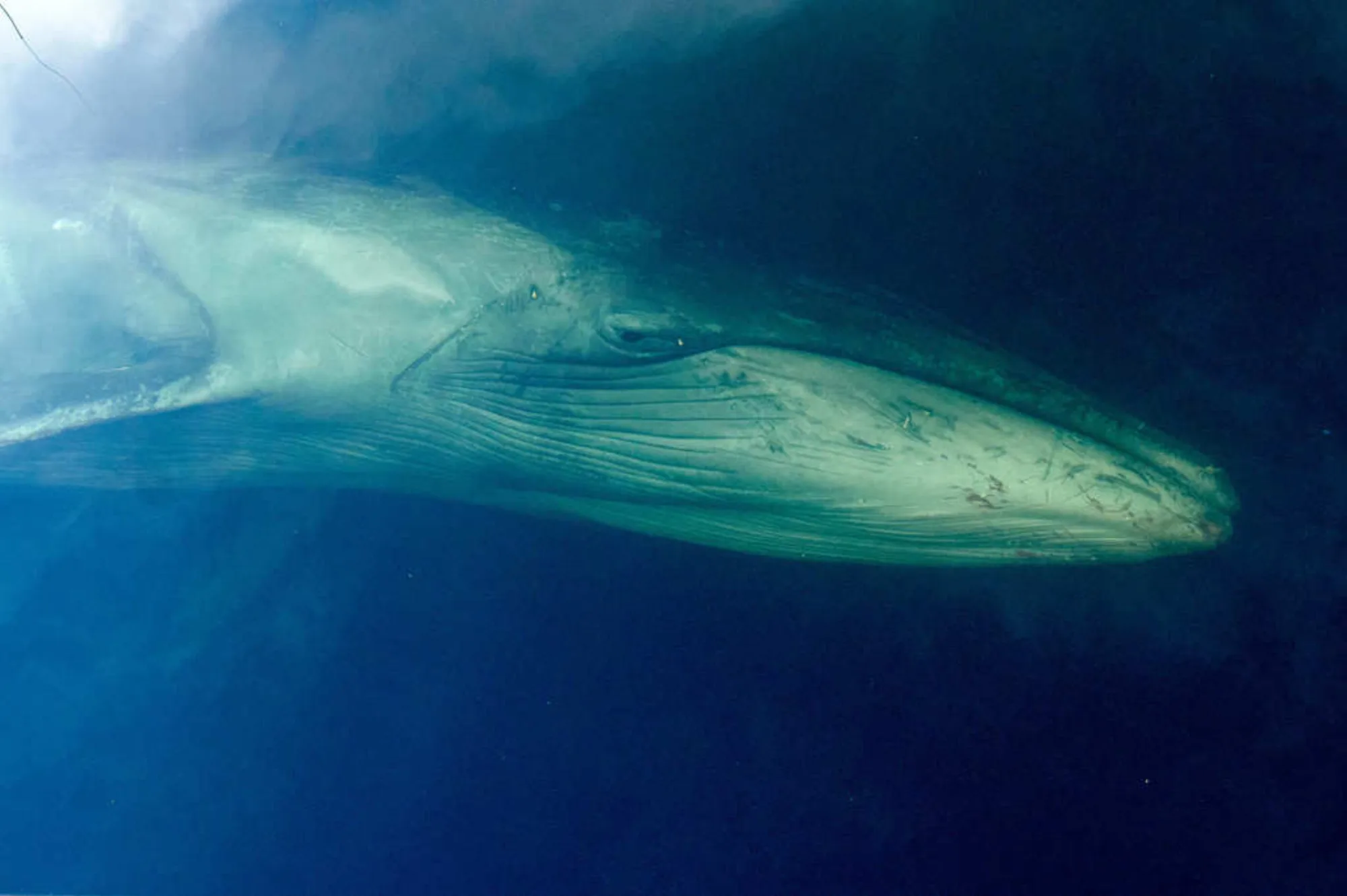
Dark steel grey and built for speed, the Sei Whale is a baleen whale that can reach 19.5 m in length. Its pointed head, relatively short flippers and tall, sickle-shaped dorsal fin help describe its outline, although it can be difficult to distinguish from other large whales at sea. Irregular pale markings appear on its lower body, and its skin often carries white scars from cookie-cutter shark bites. It lives in most oceans and adjoining seas, favouring deep offshore waters and generally avoiding polar and tropical regions. Each year it moves from cool, subpolar summer waters towards temperate and subtropical waters for winter. Around the eastern Falkland archipelago, however, a small population uses coastal waters and even ventures into large bays.
Sei whales travel alone or in small groups, although larger gatherings may form where food is abundant. They feed near the surface, sometimes swimming on their sides through swarms of prey and filtering food from the water. Copepods, krill and other zooplankton make up much of their diet, alongside small fish and squid. Between dives, a whale may remain visible for a few minutes in clear, calm water before sinking beneath the surface. Breeding takes place in temperate and subtropical seas in winter, and females usually have a single calf every 2 to 3 years. Calves are weaned at 6 to 9 months, on summer or autumn feeding grounds. Commercial whaling killed more than 255,000 sei whales during the late 19th and 20th centuries, and some were later killed under scientific research programmes. Mass deaths have also been recorded, with toxic algal blooms suggested as a possible cause of one event off southern Chile.
Written from the English Wikipedia article Sei whale (CC BY-SA 4.0).
- Records
- 1,196
- Countries
- 15
- Atlas places
- 1
These are open occurrence records, so they show where people looked for and recorded the Sei Whale as much as where it lives. Cells are up to 25 km across, and every location is generalised to its cell.
Generalised encounter areas, not exact locations. Each shape is a grid cell coloured by how likely the species is there.
- Very likelyIceland25 km zone · high confidence · 574 records · updated 80 days ago
- Very likelyUnited States25 km zone · high confidence · 284 records · updated 80 days ago
- Very likelyArgentina25 km zone · medium confidence · 130 records · updated 80 days ago
- Very likelyChile25 km zone · medium confidence · 71 records · updated 80 days ago
- Very likelyCanada25 km zone · medium confidence · 44 records · updated 80 days ago
- Very likelyFalkland Islands25 km zone · medium confidence · 41 records · updated 80 days ago
- Very likelyUnnamed area25 km zone · medium confidence · 24 records · updated 80 days ago
- Very likelyFaroe Islands25 km zone · medium confidence · 8 records · updated 80 days ago
- LikelyPortugal25 km zone · medium confidence · 8 records · updated 80 days ago
- LikelyAntarctica25 km zone · medium confidence · 5 records · updated 80 days ago
Conservation status not assessed here yet, so every location is generalised to its grid cell.