Bowhead Whale
Balaena mysticetus
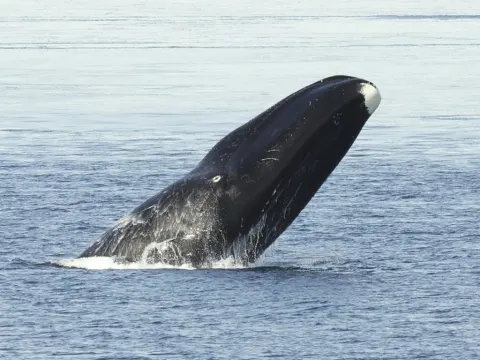
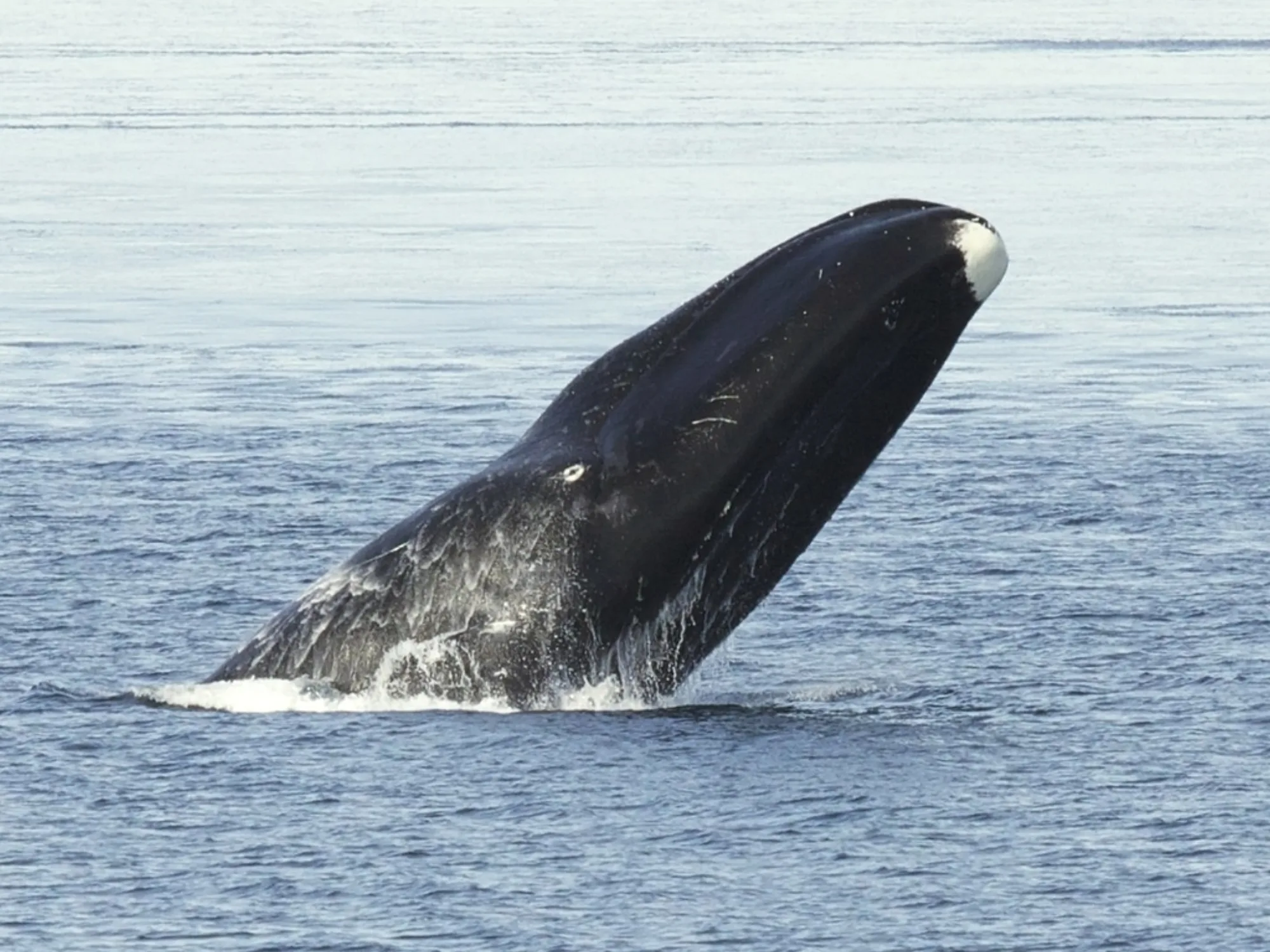
In icy northern waters, the Bowhead Whale is recognisable by its immense head, rounded body and strongly arched mouth. White markings stand out on its mostly black skin at the chin, eyes and tail, and its blow can reach 6.1 m into the air. Adults usually measure 14 to 18 m long, and the species can live for more than 200 years. Its massive, triangular skull helps it break through Arctic ice.
Bowheads spend their entire lives in Arctic and subarctic waters, with movements shaped by ice and climate. The Alaskan population winters in the southwestern Bering Sea, then follows openings in the ice north into the Chukchi and Beaufort seas in spring. Near the Shantar Islands in the Sea of Okhotsk, bowheads have been seen close to shore, and whale-watching trips are mostly land-based. They usually travel alone or in small groups of up to six, although feeding groups can be larger. A bowhead feeds by swimming with its mouth open, filtering mostly small drifting animals, including krill and other crustaceans, from the water. These whales use sounds while travelling, feeding and socialising, and produce long, complex songs during the breeding season. Females give birth to a calf roughly every three to four years, after a pregnancy lasting 13 to 14 months.
Commercial whaling was the main cause of the species' decline, and some Indigenous communities continue to hunt bowheads for subsistence. Orcas also prey on them, and bowheads seek shelter in ice or shallow water when threatened. As sea ice shrinks, whales could face more shipping traffic and have fewer places to shelter from orca attacks.
Written from the English Wikipedia article Bowhead whale (CC BY-SA 4.0).
- Records
- 271
- Countries
- 5
No atlas park has a record of the Bowhead Whale in or around it yet.
These are open occurrence records, so they show where people looked for and recorded the Bowhead Whale as much as where it lives. Cells are up to 25 km across, and every location is generalised to its cell.
Generalised encounter areas, not exact locations. Each shape is a grid cell coloured by how likely the species is there.
- Very likelyUnited States25 km zone · medium confidence · 214 records · updated 80 days ago
- Very likelyCanada25 km zone · medium confidence · 41 records · updated 80 days ago
- Very likelyGreenland25 km zone · medium confidence · 16 records · updated 80 days ago
- RareSvalbard & Jan Mayen25 km zone · low confidence · 0 records · updated 80 days ago
Conservation status not assessed here yet, so every location is generalised to its grid cell.