Canvasback
Aythya valisineria
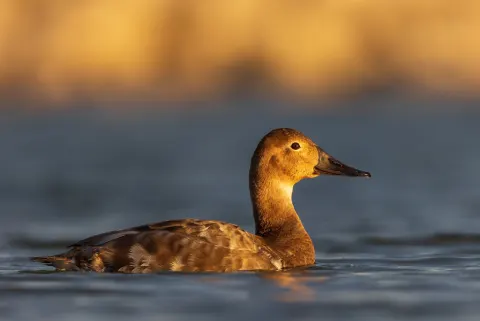
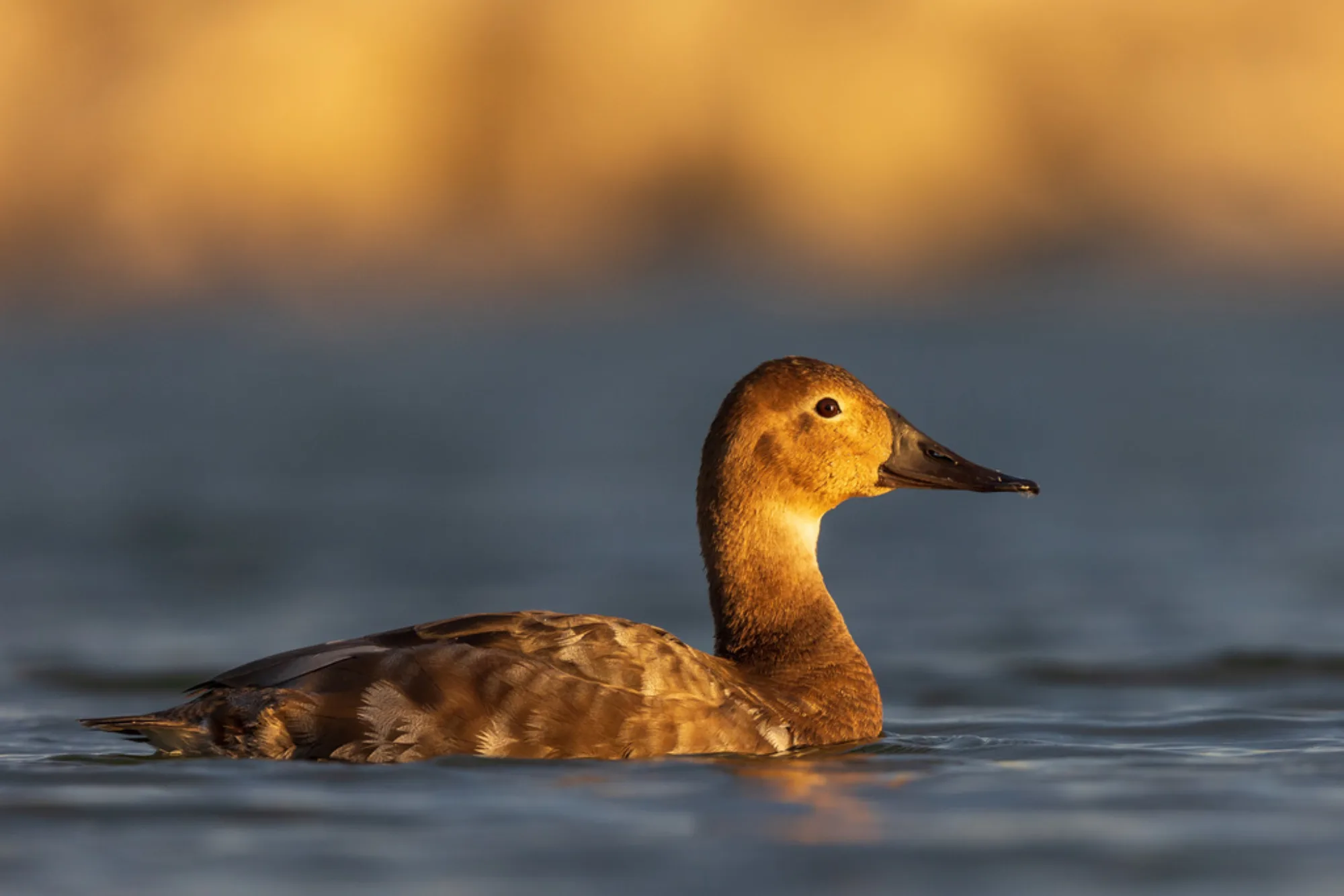
A long, sloping profile and wedge-shaped head give the Canvasback a distinctive outline among ducks. This diving duck is the largest in North America, measuring 48 to 56 cm long, with a heavier, more compact build than a mallard. Adult males have chestnut-red colouring on the head and neck, a dark breast and a pale back, while females have a light brown head and neck and a darker brown chest.
Canvasbacks breed in North American prairie potholes, as well as in Alaska's interior and the subarctic river deltas of Saskatchewan. They favour permanent prairie marshes, nesting over water among cattails and bulrushes that offer cover. Their bulky nests are made from vegetation and lined with down, and a clutch contains approximately 5 to 11 eggs. The down-covered chicks can leave the nest soon after hatching. For winter, the ducks migrate towards the mid-Atlantic United States, the Lower Mississippi Alluvial Valley or the California coast. Brackish bays and marshes rich in submerged plants and invertebrates provide ideal winter habitat.
Canvasbacks feed mainly by diving, taking plant material such as seeds, buds, leaves, tubers and roots, as well as snails and insect larvae. Wild celery and sago pondweed tubers are favoured foods, although birds in Chesapeake Bay have adapted to declining underwater vegetation by eating Baltic clams. Populations have declined as nesting places have disappeared, and the ducks are particularly vulnerable to prairie drought and wetland drainage. The loss of submerged vegetation in Chesapeake Bay has also shifted their winter range south towards the Lower Mississippi Alluvial Valley.
Written from the English Wikipedia article Canvasback (CC BY-SA 4.0).
- Records
- 434,388
- Countries
- 3
No atlas park has a record of the Canvasback in or around it yet.
These are open occurrence records, so they show where people looked for and recorded the Canvasback as much as where it lives. Cells are up to 25 km across, and every location is generalised to its cell.
Generalised encounter areas, not exact locations. Each shape is a grid cell coloured by how likely the species is there.
- Very likelyUnited States25 km zone · high confidence · 364681 records · updated 80 days ago
- Very likelyCanada25 km zone · high confidence · 67559 records · updated 80 days ago
- Very likelyMexico25 km zone · high confidence · 2148 records · updated 80 days ago
Conservation status not assessed here yet, so every location is generalised to its grid cell.