Tufted Duck
Aythya fuligula
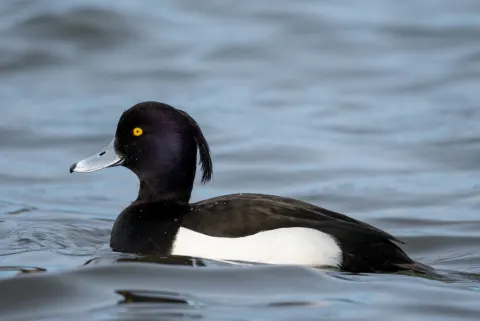
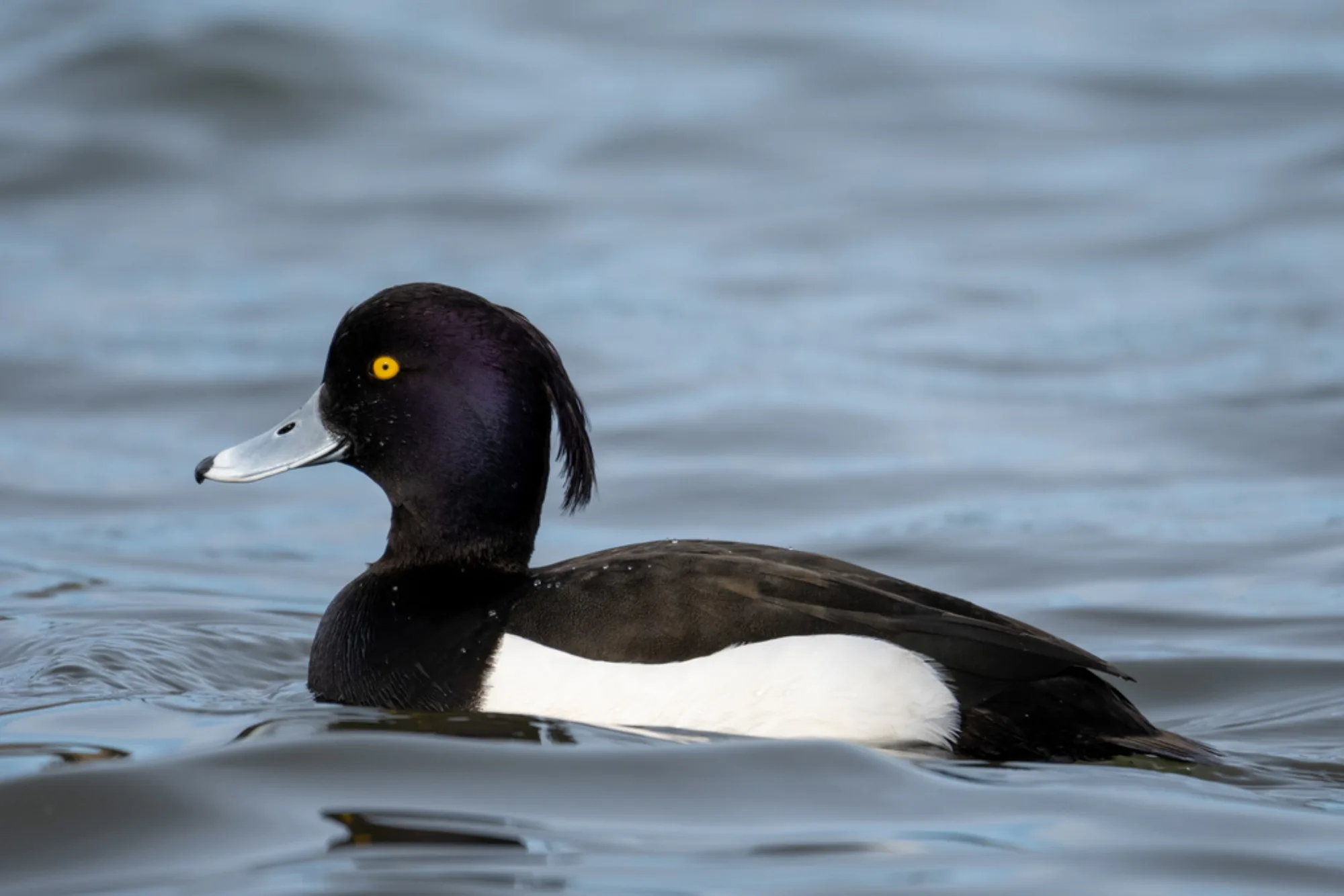
Look for a small diving duck with a distinctive tuft at the back of its head. The adult male Tufted Duck is black with white sides, a blue-grey bill and golden yellow eyes. Females are brown with paler sides, and some show white at the base of the bill. That marking can make them look like scaup, though scaup lack the tuft. A female may give a harsh, growling call in flight, while males are mostly quiet except for a whistle during courtship.
Tufted Ducks breed across temperate and northern Eurasia, near marshes and lakes where vegetation conceals their nests. They also use coastal lagoons, shorelines and sheltered ponds. In winter, large flocks gather on open water. Most populations migrate, spending the winter in milder parts of southern and western Europe or in southern Asia; the birds also occur year-round in the British Isles. They occasionally visit the coasts of the United States and Canada in winter. To feed, they usually dive for molluscs, aquatic insects and some plants, although they sometimes tip forward from the surface or feed at night.
In northern Europe, breeding takes place from mid May to the end of July. The female builds a grass, reed and down-lined nest in a hollow, usually beside water and preferably on an island. She lays 8 to 11 greenish-grey eggs and covers them with down when away. After the eggs hatch, the young can feed themselves, while the female cares for them. The ducks are hunted for sport in several countries and commercially in Iran. Their eggs have also been collected in Iceland, a practice that may continue.
Written from the English Wikipedia article Tufted duck (CC BY-SA 4.0).
- Records
- 937,473
- Countries
- 109
- Atlas places
- 4
These are open occurrence records, so they show where people looked for and recorded the Tufted Duck as much as where it lives. Cells are up to 25 km across, and every location is generalised to its cell.
Generalised encounter areas, not exact locations. Each shape is a grid cell coloured by how likely the species is there.
- Very likelyUnited Kingdom25 km zone · high confidence · 339981 records · updated 86 days ago
- Very likelyNorway25 km zone · high confidence · 161193 records · updated 86 days ago
- Very likelyBelgium25 km zone · high confidence · 152827 records · updated 86 days ago
- Very likelyNetherlands25 km zone · high confidence · 45664 records · updated 86 days ago
- Very likelyFrance25 km zone · high confidence · 34228 records · updated 86 days ago
- Very likelyTaiwan25 km zone · high confidence · 21266 records · updated 86 days ago
- Very likelyFinland25 km zone · high confidence · 17235 records · updated 86 days ago
- Very likelyIceland25 km zone · high confidence · 15114 records · updated 86 days ago
- Very likelyAustria25 km zone · high confidence · 12363 records · updated 86 days ago
- Very likelyGermany25 km zone · high confidence · 11898 records · updated 86 days ago
Conservation status not assessed here yet, so every location is generalised to its grid cell.