Common Pochard
Aythya ferina
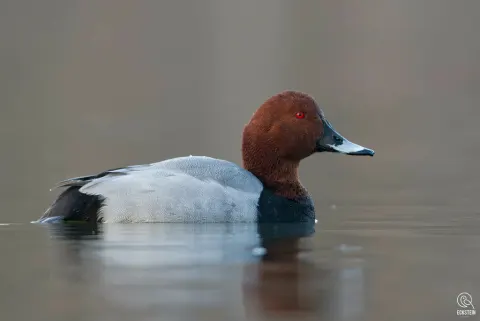
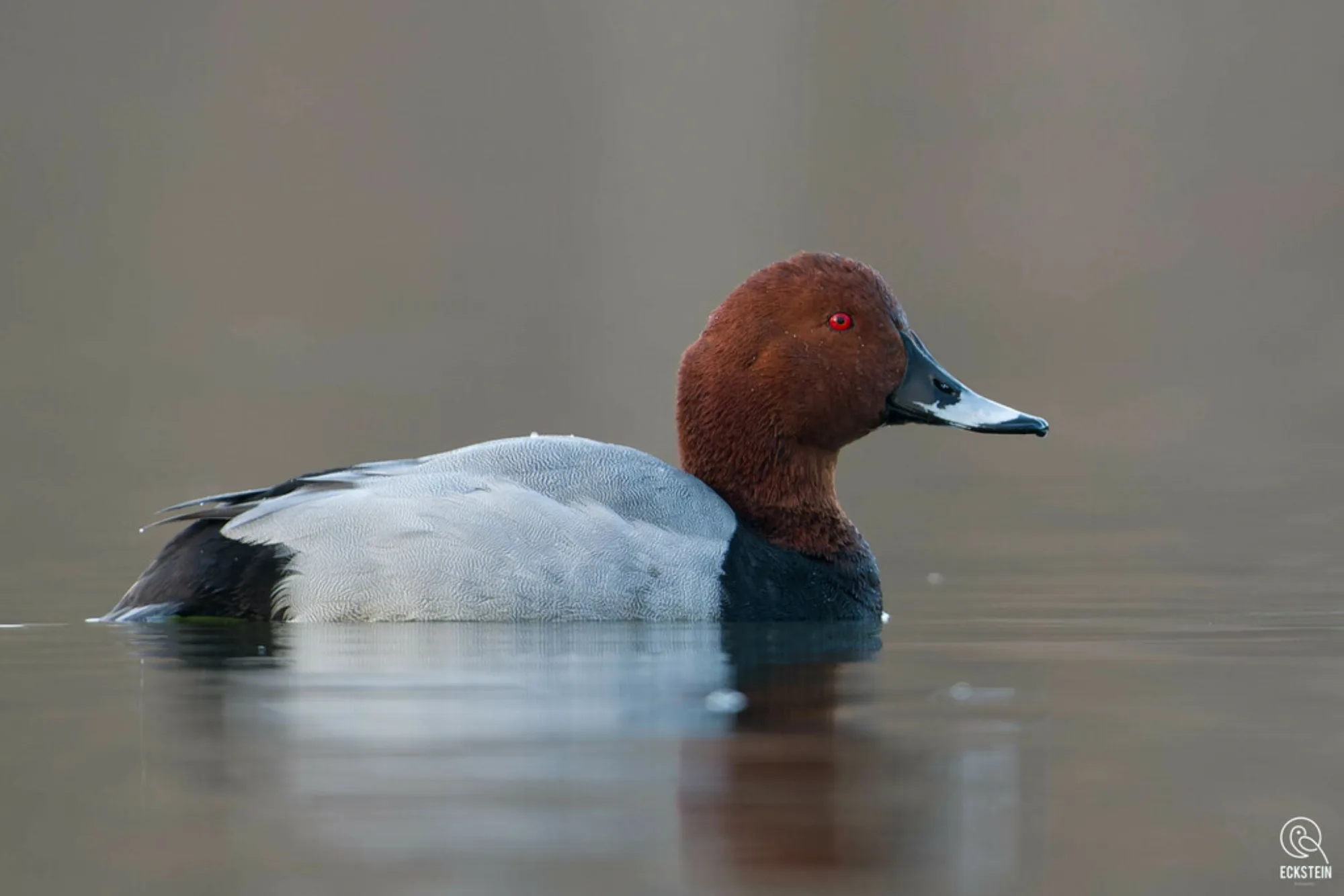
Look for the Common Pochard on marshes and lakes, where this stocky diving duck breeds in water at least a metre deep. It has a short tail, a sloping forehead and a relatively long bill, and measures 42 to 49 cm from end to end. The male's chestnut head and neck contrast with his pale grey body and the black on his breast and tail. His dark grey bill carries a broad blue-grey band, while his eyes range from yellow-orange to red and brighten in the breeding season. The female has brown eyes, sometimes with a yellowish tone.
Pochards breed across much of temperate and northern Europe and the wider Palearctic, with Scandinavia and the Siberian steppe among their main breeding areas. They migrate south and west for winter, when large numbers stay in Great Britain after leaving Russia and Scandinavia. At this time of year they gather in large flocks, often alongside other diving ducks. They feed mostly at night, diving for plant material and aquatic animals, including seeds, molluscs and small fish, though they also tip up and feed at the surface. Pochards often forage near Bewick's and whooper swans, picking up food released as the swans disturb underwater sediment. The female makes a plant platform in dense cover, either in the water or on the ground within 10 m of the edge. She usually lays 8 to 10 eggs, which hatch after around 25 days; the young can feed themselves and fly at 50 to 55 days.
Habitat transformation, urbanisation and overhunting have contributed to declines in some countries. Introduced American mink have severely affected some populations, while carrion crows and marsh harriers are important predators of nests.
Written from the English Wikipedia article Common pochard (CC BY-SA 4.0).
- Records
- 451,076
- Countries
- 26
No atlas park has a record of the Common Pochard in or around it yet.
These are open occurrence records, so they show where people looked for and recorded the Common Pochard as much as where it lives. Cells are up to 25 km across, and every location is generalised to its cell.
Generalised encounter areas, not exact locations. Each shape is a grid cell coloured by how likely the species is there.
- Very likelyUnited Kingdom25 km zone · high confidence · 146543 records · updated 80 days ago
- Very likelyBelgium25 km zone · high confidence · 101491 records · updated 80 days ago
- Very likelySpain25 km zone · high confidence · 72658 records · updated 80 days ago
- Very likelyFrance25 km zone · high confidence · 51315 records · updated 80 days ago
- Very likelyNorway25 km zone · high confidence · 9842 records · updated 80 days ago
- Very likelyCzechia25 km zone · high confidence · 9177 records · updated 80 days ago
- Very likelyPortugal25 km zone · high confidence · 7087 records · updated 80 days ago
- Very likelyJapan25 km zone · high confidence · 6925 records · updated 80 days ago
- Very likelySwitzerland25 km zone · high confidence · 6043 records · updated 80 days ago
- Very likelyNetherlands25 km zone · high confidence · 5981 records · updated 80 days ago
Conservation status not assessed here yet, so every location is generalised to its grid cell.