Redhead
Aythya americana
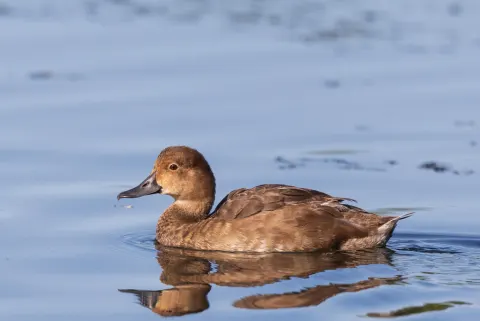
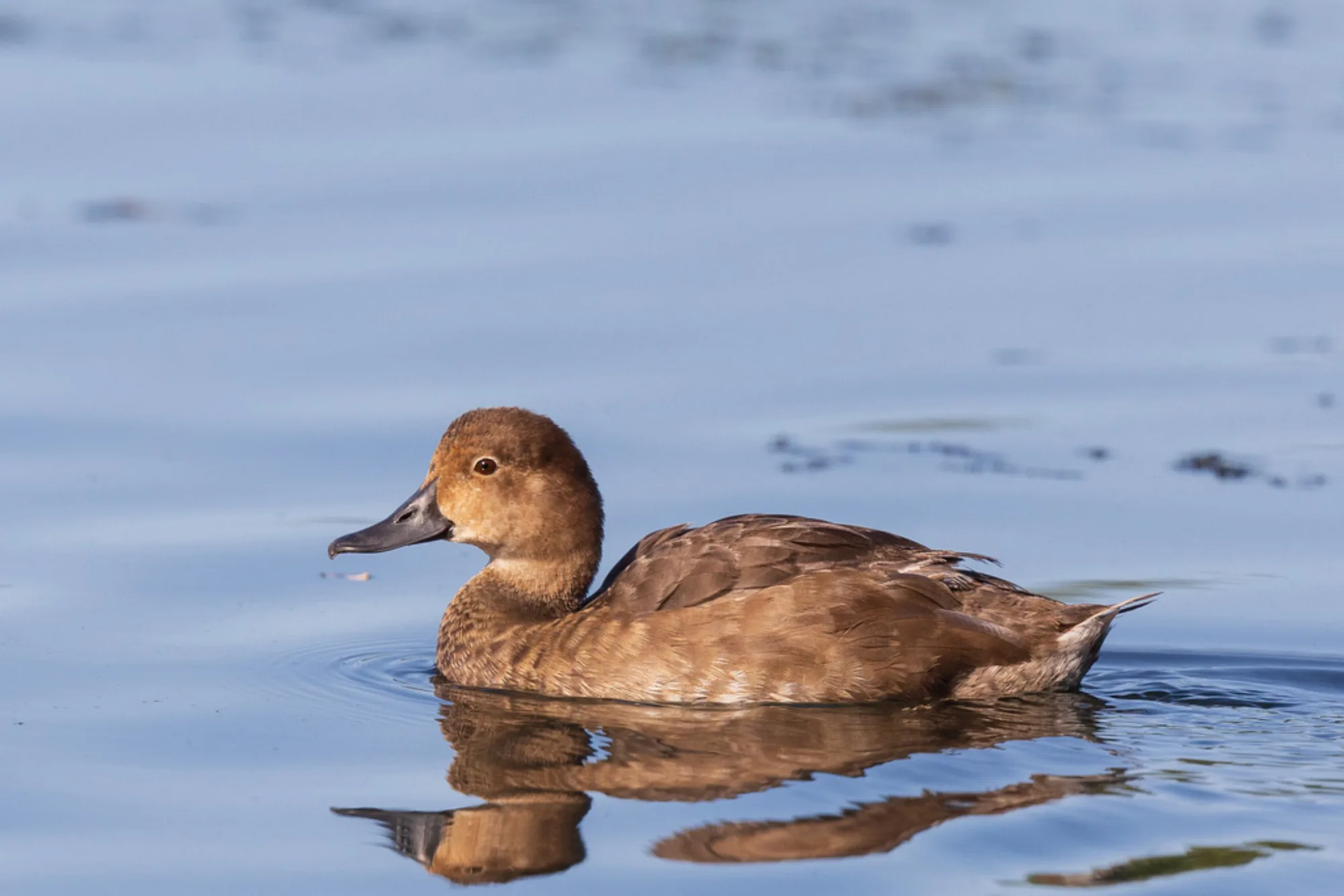
A medium-sized diving duck, the Redhead measures 40 to 56 cm long. In the breeding season, males have a copper head and neck, a black breast, grey back and sides, and a pale blue bill with a black tip. Their yellow eyes and rounded heads help distinguish them from the similar canvasback. Outside the breeding season, the male's head turns brown. Females have a yellow to brown head and neck, a brown breast and a grey to brown body; their colouring stays the same throughout the year.
Redheads breed across a wide range of North America, reaching northern Canada, and migrate south for winter. They favour wetlands, especially small, semi-permanent ones in open country with dense vegetation rising above the water for nesting. In winter, look for them on sheltered coastal waters, as well as lakes, reservoirs, marshes, estuaries and bays. Most spend the season along the Gulf of Mexico, although eastern populations also winter in South Carolina. Redheads gather in flocks on lakes and other waters, but paired birds migrate together. Unpaired birds travel in courting groups that can contain up to 25 individuals.
During breeding, they eat animal food including molluscs and insect larvae; farther south in winter, they switch mainly to plants such as pondweeds and wild celery. Females build nests from sturdy plant material among vegetation over or near standing water, though some lay eggs in the nests of other diving ducks. Broods have five to seven young, and mothers leave the chicks at 8 weeks, before they can fly. Disease and indirect human impacts are significant causes of death, while hunters also target Redheads. Eggs and ducklings face predators including skunks, mink, northern pike and snapping turtles.
Written from the English Wikipedia article Redhead (bird) (CC BY-SA 4.0).
- Records
- 652,707
- Countries
- 2
- Atlas places
- 2
These are open occurrence records, so they show where people looked for and recorded the Redhead as much as where it lives. Cells are up to 25 km across, and every location is generalised to its cell.
Generalised encounter areas, not exact locations. Each shape is a grid cell coloured by how likely the species is there.
- Very likelyUnited States25 km zone · high confidence · 500077 records · updated 80 days ago
- Very likelyCanada25 km zone · high confidence · 152630 records · updated 80 days ago
Conservation status not assessed here yet, so every location is generalised to its grid cell.