Axis Deer
Axis axis
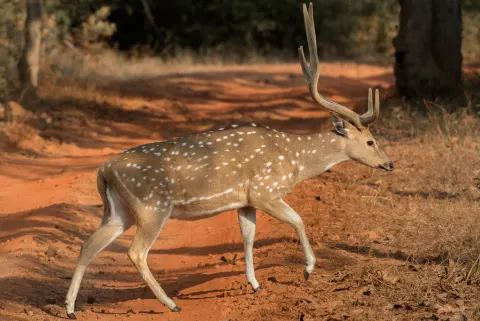
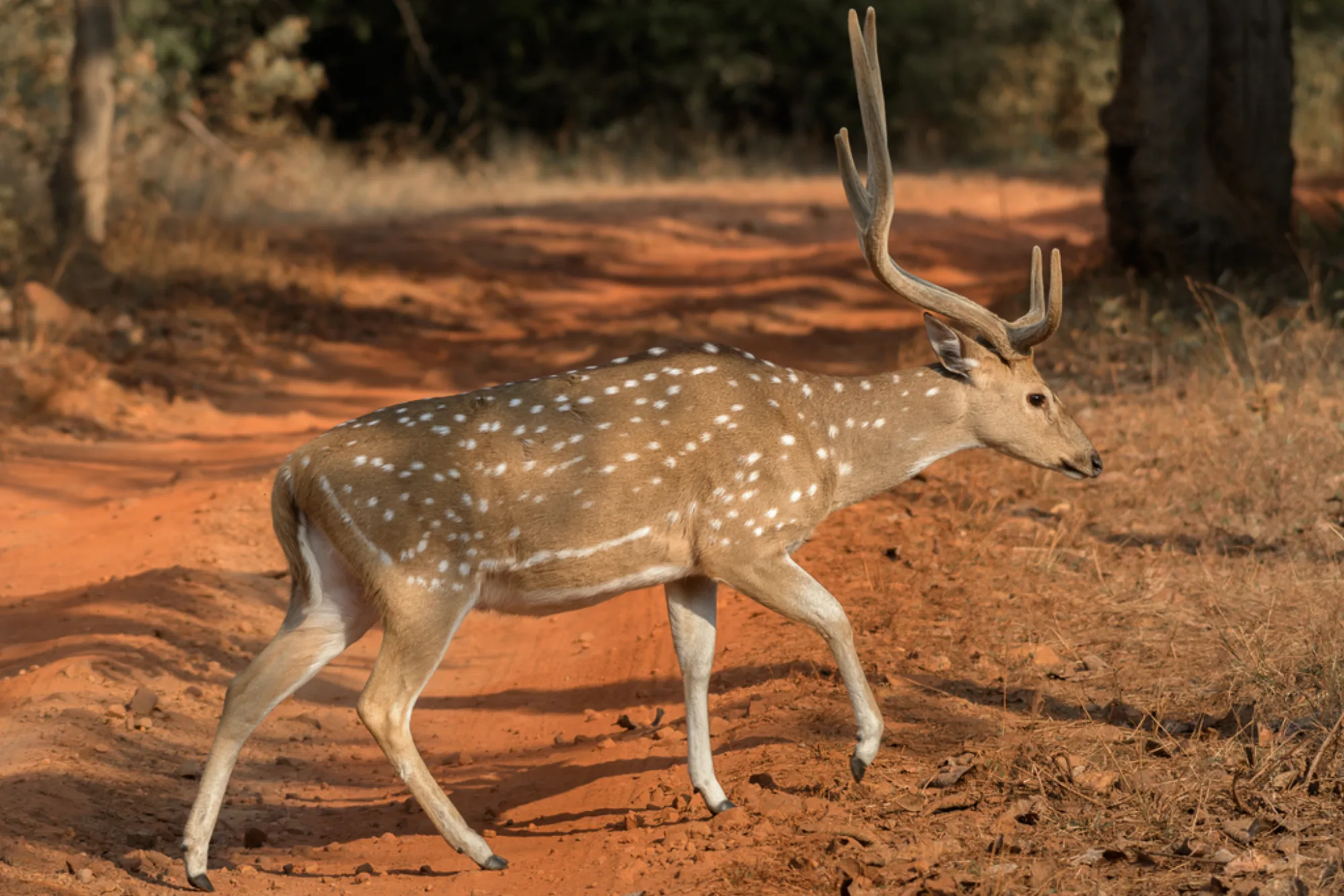
White spots scatter across the golden to rufous coat of the Axis Deer, also known as the chital. Its throat, rump, belly and the insides of its legs are white, while a dark stripe runs down its back. Males are larger than females and alone carry antlers, which have three points and can be nearly 1 m long. Native to the Indian subcontinent, this deer ranges from Nepal and Bhutan to India, Bangladesh and Sri Lanka. On the Indian peninsula, it inhabits deciduous and semi-evergreen forests as well as open grasslands.
Axis Deer are active throughout the day, though in summer they rest in the shade and become most active towards dusk. They often travel in single file when seeking food and water, and usually stay within 300 m of cover. Small herds are common, with an adult female and her young forming the core of a group. When alarmed, deer may flee together and hide in dense undergrowth, while females and young often bark persistently. They feed mainly on grasses, favouring young shoots, but also eat herbs, shrubs, foliage and fruit, particularly when winter grasses become less palatable. At water holes, they approach cautiously and drink nearly twice a day. Breeding can take place year-round, although its peaks vary by location, and mothers keep newborns concealed for their first week.
Tigers, leopards, Indian pythons and dholes prey on Axis Deer, while several smaller predators target the young. Hunting the deer for food has led to sharp population declines and the loss of some local populations, while competition with domestic livestock also limits numbers in many places.
Written from the English Wikipedia article Chital (CC BY-SA 4.0).
- Records
- 915
- Countries
- 10
- Atlas places
- 20
- Bandipur National Park· India
- Chitwan National Park· Nepal
- Jim Corbett National Park· India
- Bardiya National Park· Nepal
- Nagarhole National Park· India
- Yala National Park· Sri Lanka
- Kanha National Park· India
- Pench National Park· India
- Ranthambore National Park· India
- Bandhavgarh National Park· India
- Sundarbans National Park· India
- Wilpattu National Park· Sri Lanka
- Gir National Park· India
- Kumana National Park· Sri Lanka
- Eravikulam National Park· India
- Minneriya National Park· Sri Lanka
- Shuklaphanta National Park· Nepal
- Tadoba Andhari Tiger Reserve· India
- Udawalawe National Park· Sri Lanka
- Wasgamuwa National Park· Sri Lanka
These are open occurrence records, so they show where people looked for and recorded the Axis Deer as much as where it lives. Cells are up to 25 km across, and every location is generalised to its cell.
Generalised encounter areas, not exact locations. Each shape is a grid cell coloured by how likely the species is there.
- Very likelyIndia25 km zone · medium confidence · 507 records · updated 80 days ago
- Very likelyUnited States25 km zone · medium confidence · 152 records · updated 80 days ago
- Very likelySri Lanka25 km zone · medium confidence · 137 records · updated 80 days ago
- Very likelyNepal25 km zone · medium confidence · 73 records · updated 80 days ago
- Very likelyArgentina25 km zone · medium confidence · 20 records · updated 80 days ago
- LikelyAustralia25 km zone · medium confidence · 9 records · updated 80 days ago
- LikelyMalaysia25 km zone · medium confidence · 7 records · updated 80 days ago
- LikelyUruguay25 km zone · medium confidence · 4 records · updated 80 days ago
- LikelyBangladesh25 km zone · medium confidence · 3 records · updated 80 days ago
- LikelyGermany25 km zone · medium confidence · 3 records · updated 80 days ago
Conservation status not assessed here yet, so every location is generalised to its grid cell.