Laterallus Rogersi
Atlantisia rogersi
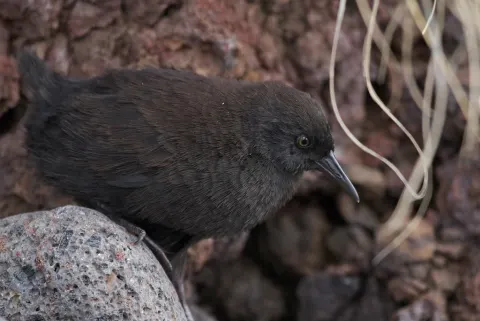
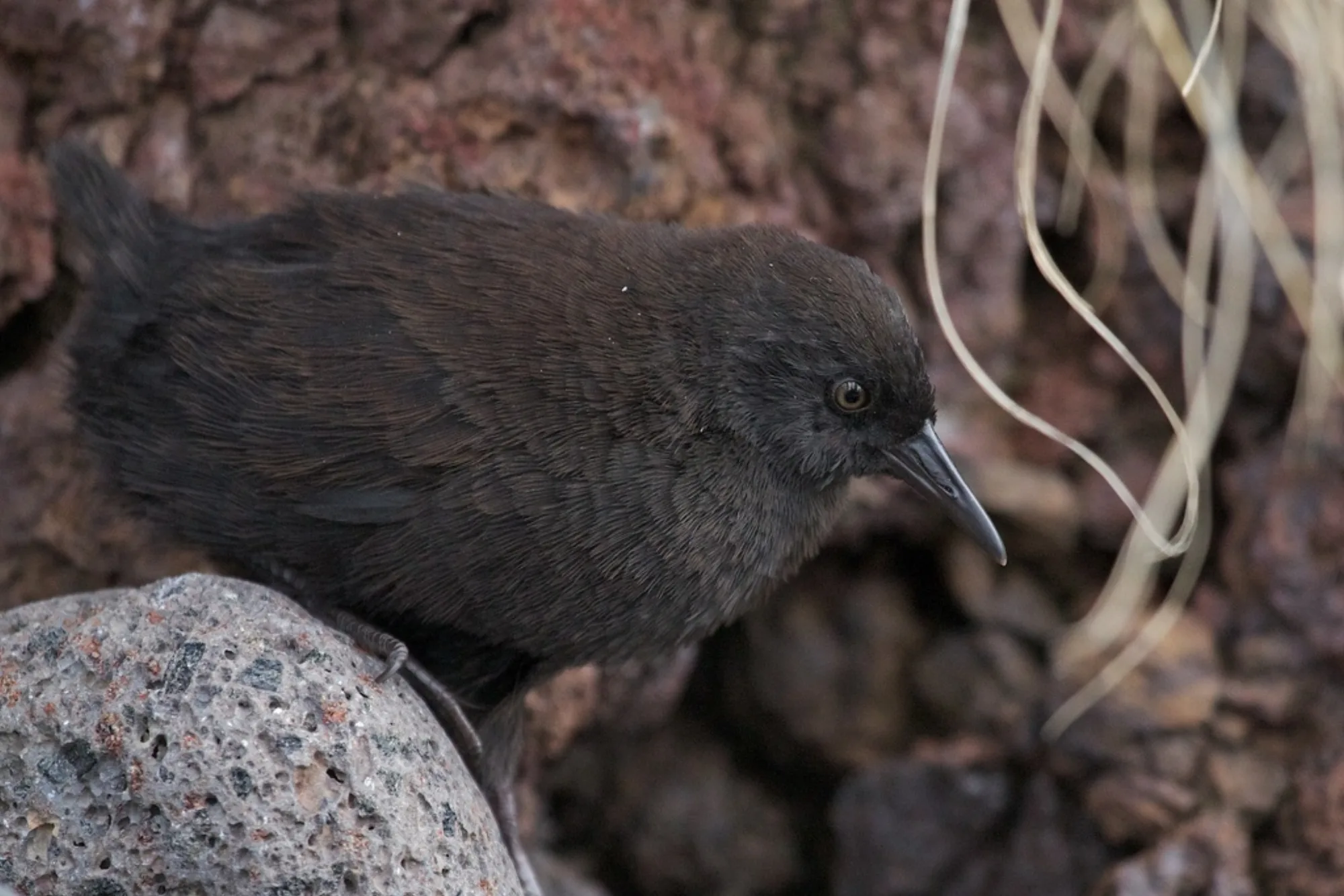
The Laterallus Rogersi is a tiny, ground-dwelling bird found only on Inaccessible Island in the south Atlantic. As the smallest flightless bird still in existence, it measures between 13 and 15.5 cm. Adults are recognized by their dark chestnut-brown upper bodies and grey heads, accented by striking red eyes and black bills. Their feathers appear ragged or hair-like because the parts do not fully interlock, a sign of their inability to fly.
These birds occupy nearly every corner of their remote home, from the rocky beaches to the high central plateau. They are most common in the thick fields of tussock grass and ferns surrounding the coast. Living in small, permanent pairs, they are highly vocal, using trills and rhythmic clicks to communicate through the dense vegetation. Their diet is varied; they move slowly like mice to hunt for earthworms, moths, beetles, and caterpillars, while also eating local berries and seeds.
Breeding occurs between October and January in domed nests hidden at the base of plants. Both parents share the duties of sitting on their two eggs and feeding the black, downy chicks. While the island is currently free of the mammalian predators that have wiped out other flightless rails, the species remains at risk. Its entire global population of approximately 5,600 adults lives in one location, meaning the accidental arrival of rats, cats, or mice from visiting boats could be devastating.
Written from the English Wikipedia article Inaccessible Island rail (CC BY-SA 4.0).
- Atlas places
- 0
These are open occurrence records, so they show where people looked for and recorded the Laterallus Rogersi as much as where it lives. Cells are up to 25 km across, and every location is generalised to its cell.
No encounter zones yet
Where and when you can expect to see Laterallus Rogersi is calculated from observation density. No zones have been computed for this species yet.
Conservation status not assessed here yet, so every location is generalised to its grid cell.