Little Owl
Athene noctua
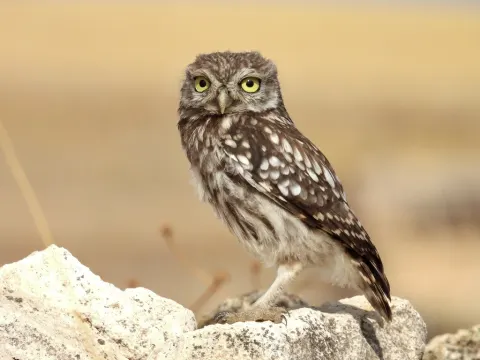
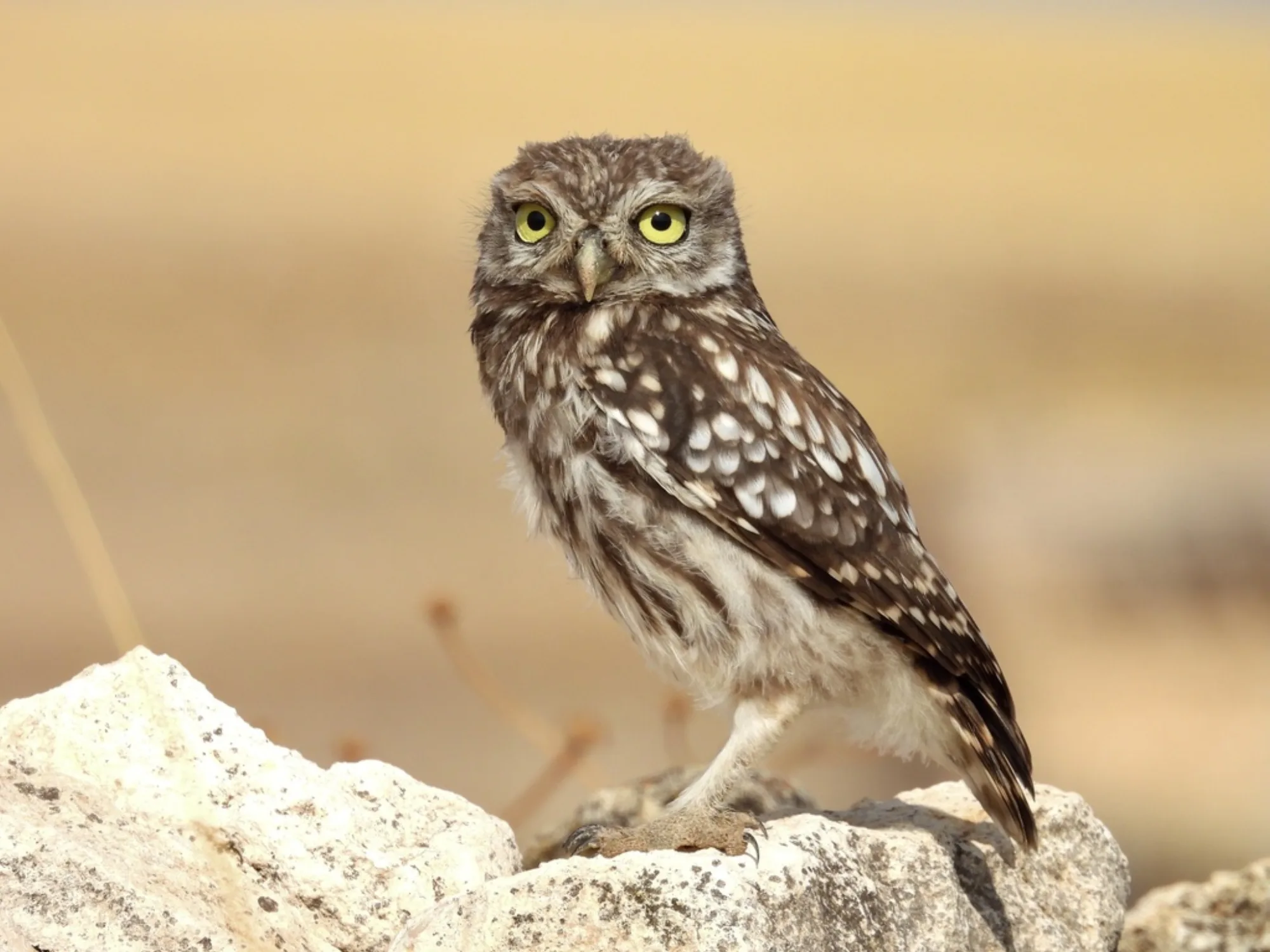
With its flat-topped head, compact body and short tail, the Little Owl (Athene noctua) has a distinctive silhouette. Its greyish-brown plumage is marked with white, while pale underparts carry darker streaks. Yellow eyes and white eyebrows give the adult a stern expression; young birds are duller and lack the white spots on the crown. Usually 22 cm long, it flies with a bounding motion like a woodpecker.
The species ranges across Europe, Asia and North Africa, and has been introduced to Britain and New Zealand's South Island. It lives in open countryside, from farmland with hedges and trees to orchards, parks, steppes and stony semi-deserts. Look for it around ruins, quarries and rocky outcrops, or even in villages and suburbs. Although mainly nocturnal, it is also active by day and often sits prominently on a perch, sometimes remaining in view when people are nearby.
From an elevated perch, the owl watches for small prey and swoops down, though it may also hunt on the ground. Its food includes insects and earthworms, along with small mammals, birds, reptiles and amphibians; surplus prey may be stored in hiding places. Males defend territories, and pairs often stay together throughout the year. In spring, the female lays about four eggs in a cavity, which might be a hole in a tree, an old building or a river bank. The male brings food while she incubates, and later both parents feed the chicks, which leave the nest at about seven weeks. Severe winters kill some birds, while others are struck by vehicles at night.
Written from the English Wikipedia article Little owl (CC BY-SA 4.0).
- Records
- 137,707
- Countries
- 22
No atlas park has a record of the Little Owl in or around it yet.
These are open occurrence records, so they show where people looked for and recorded the Little Owl as much as where it lives. Cells are up to 25 km across, and every location is generalised to its cell.
Generalised encounter areas, not exact locations. Each shape is a grid cell coloured by how likely the species is there.
- Very likelySpain25 km zone · high confidence · 38464 records · updated 80 days ago
- Very likelyBelgium25 km zone · high confidence · 26343 records · updated 80 days ago
- Very likelyPortugal25 km zone · high confidence · 21258 records · updated 80 days ago
- Very likelyFrance25 km zone · high confidence · 17091 records · updated 80 days ago
- Very likelyUnited Kingdom25 km zone · high confidence · 11762 records · updated 80 days ago
- Very likelyNetherlands25 km zone · high confidence · 4003 records · updated 80 days ago
- Very likelyUnited Arab Emirates25 km zone · high confidence · 2918 records · updated 80 days ago
- Very likelyIsrael25 km zone · high confidence · 2555 records · updated 80 days ago
- Very likelyGreece25 km zone · high confidence · 2261 records · updated 80 days ago
- Very likelyLuxembourg25 km zone · high confidence · 2258 records · updated 80 days ago
Conservation status not assessed here yet, so every location is generalised to its grid cell.