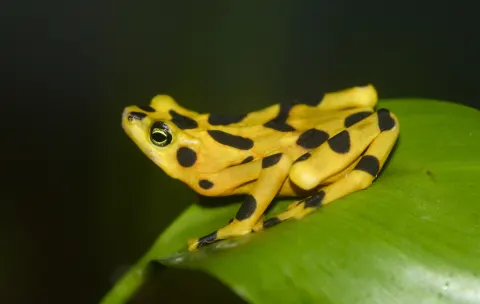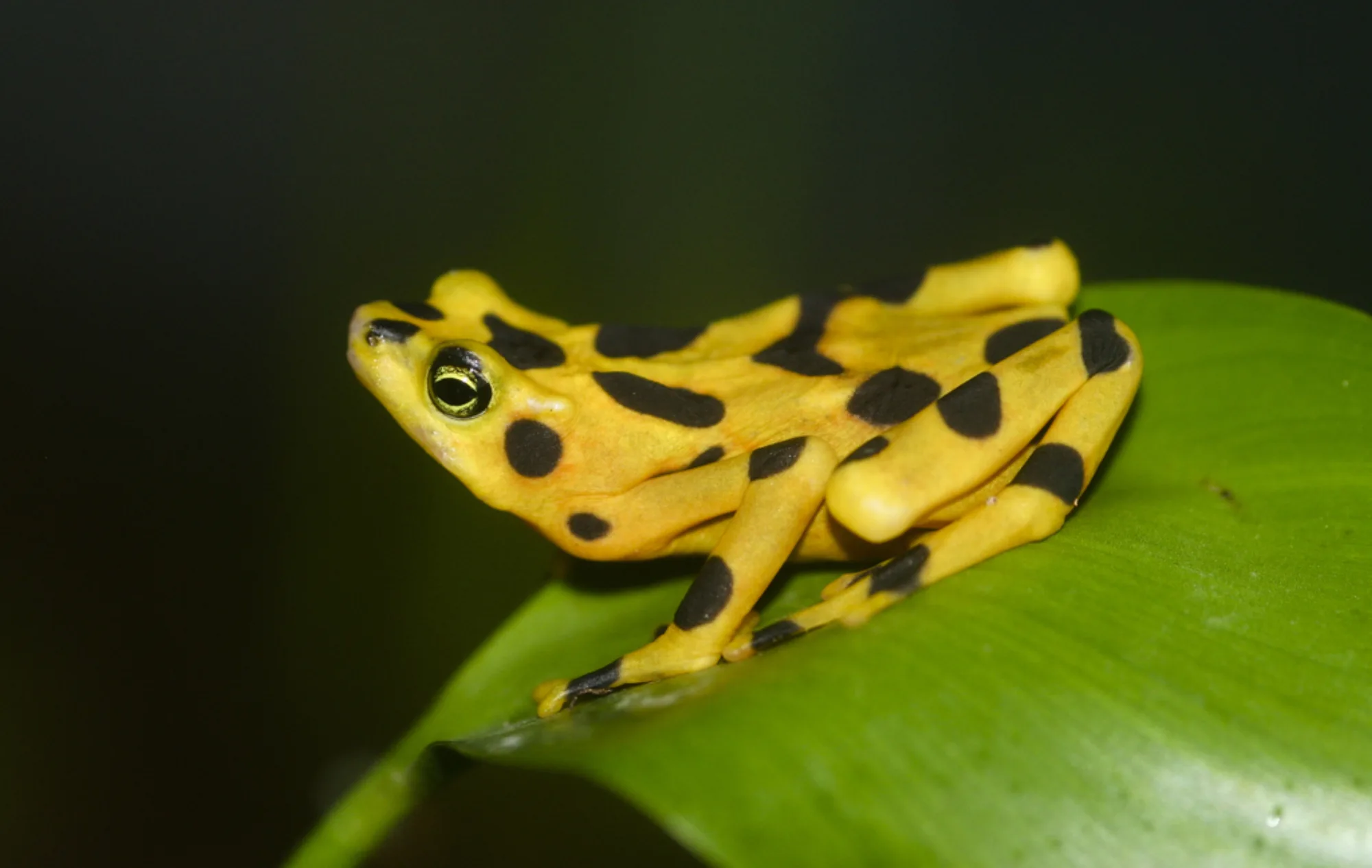
Panamanian Golden Frog
Atelopus zeteki
Against the streams and mossy rocks of Panama's mountain forests, the Panamanian Golden Frog can be recognised by skin ranging from pale yellow-green to bright gold, sometimes marked with black spots on its back and legs. Despite its name, it is a toad found only in Panama. Females are generally larger than males, measuring 45 to 63 mm long, while males measure 35 to 48 millimetres. Its skin contains toxins that protect it from most predators, and its colour warns approaching animals of that defence. Some snakes can nevertheless metabolise the poison.
In Coclé and Panamá provinces, the frog inhabits mountain stream habitats east of the Tabasará range. Males tend to remain near breeding streams, while females move into the forest outside the breeding season. Adult males are active on the ground by day and retreat into trees at night. They defend territories with calls and waves of their forefeet, and may behave aggressively towards intruding males. Hand-waving also plays a part in communication with prospective mates. Eggs are usually laid in shallow streams, and the tadpoles feed on algae as they grow. Young frogs stay close to streams, often beside pools where tadpoles gather.
A sighting in the wild may no longer be possible: the frog may have disappeared there since 2007, and it was last filmed in the wild in 2006. The fungal disease chytridiomycosis caused the population at El Copé to collapse rapidly in 2004. Habitat loss, pollution, the pet trade and aquaculture are also threats. Frogs are kept in captive-breeding programmes across North America and Panama, while the El Valle Amphibian Conservation Center has a display for visitors.
Written from the English Wikipedia article Panamanian golden frog (CC BY-SA 4.0).
- Records
- 66
- Countries
- 1
No atlas park has a record of the Panamanian Golden Frog in or around it yet.
These are open occurrence records, so they show where people looked for and recorded the Panamanian Golden Frog as much as where it lives. Cells are up to 25 km across, and every location is generalised to its cell.
Generalised encounter areas, not exact locations. Each shape is a grid cell coloured by how likely the species is there.
- Very likelyPanama25 km zone · medium confidence · 66 records · updated 80 days ago
Conservation status not assessed here yet, so every location is generalised to its grid cell.