Brown Spider Monkey
Ateles hybridus
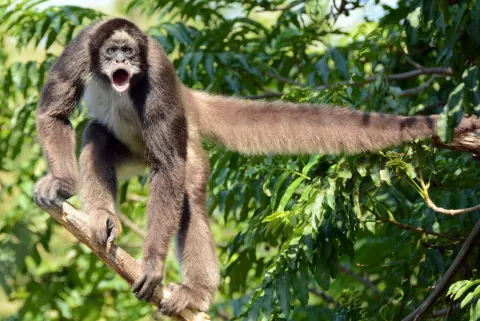
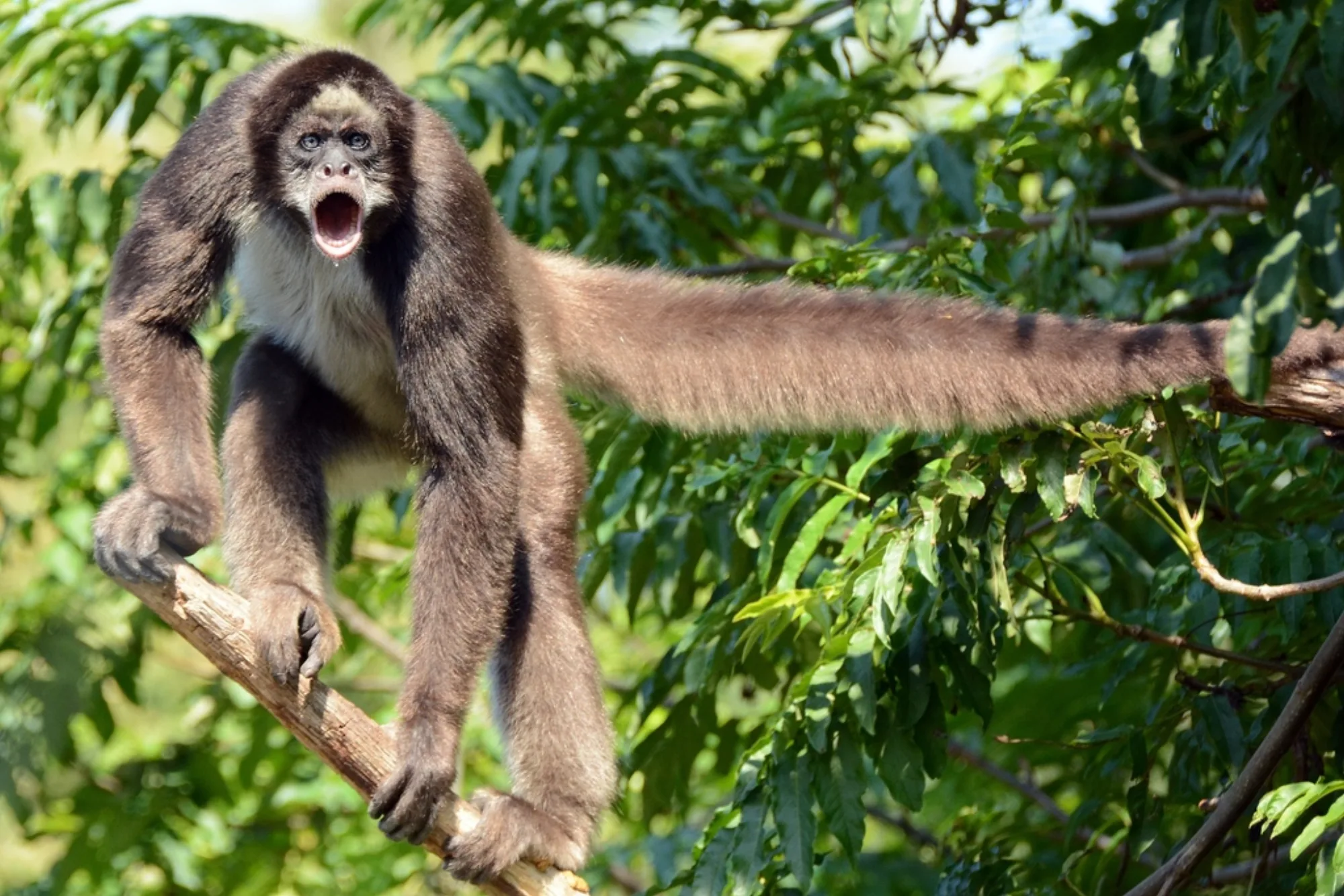
High in the forests of northern Colombia and northwestern Venezuela, the Brown Spider Monkey moves through the trees on long, slender limbs. Its thin, flexible tail can act as a fifth limb, helping it travel through the canopy without often coming down to the ground. Its upper parts range from light to dark brown, and its belly is whitish. Some individuals have a whitish triangular patch on the forehead, while a few have pale blue eyes. It favours undisturbed primary forest, where it forages high in the canopy, although it sometimes descends to drink water or eat soil.
Brown spider monkeys travel in small groups, swinging and climbing between trees. Ripe fruit is a mainstay of their diet, with lipid-rich fruits making up more than three quarters of what they eat. They feed on figs year round, but when fruit is scarcer in drier seasons, they also eat leaves, seeds, flowers, bark, honey and decaying wood, as well as occasional insects. The monkeys typically reproduce every 2 to 3 years, a slow rate that limits recovery after population losses. Jaguars, mountain lions and eagles are among their natural predators, and the monkeys may shake branches to ward off threats.
Habitat loss continues across their range, with logging and clearance for agriculture and cattle ranches among the causes. Mining, infrastructure and other industrial development are also diminishing inter-Andean forest. Hunting and capture for the pet trade add to the pressure, while fragmented habitat affects the monkeys' social behaviour and ranging patterns. An estimated 98% of their habitat has already disappeared, and some populations have been lost.
Written from the English Wikipedia article Brown spider monkey (CC BY-SA 4.0).
- Records
- 9
- Countries
- 1
No atlas park has a record of the Brown Spider Monkey in or around it yet.
These are open occurrence records, so they show where people looked for and recorded the Brown Spider Monkey as much as where it lives. Cells are up to 25 km across, and every location is generalised to its cell.
Generalised encounter areas, not exact locations. Each shape is a grid cell coloured by how likely the species is there.
- Very likelyColombia25 km zone · medium confidence · 9 records · updated 80 days ago
Conservation status not assessed here yet, so every location is generalised to its grid cell.