Mexican Tetra
Astyanax mexicanus
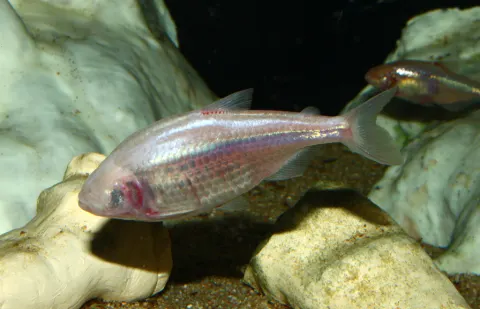
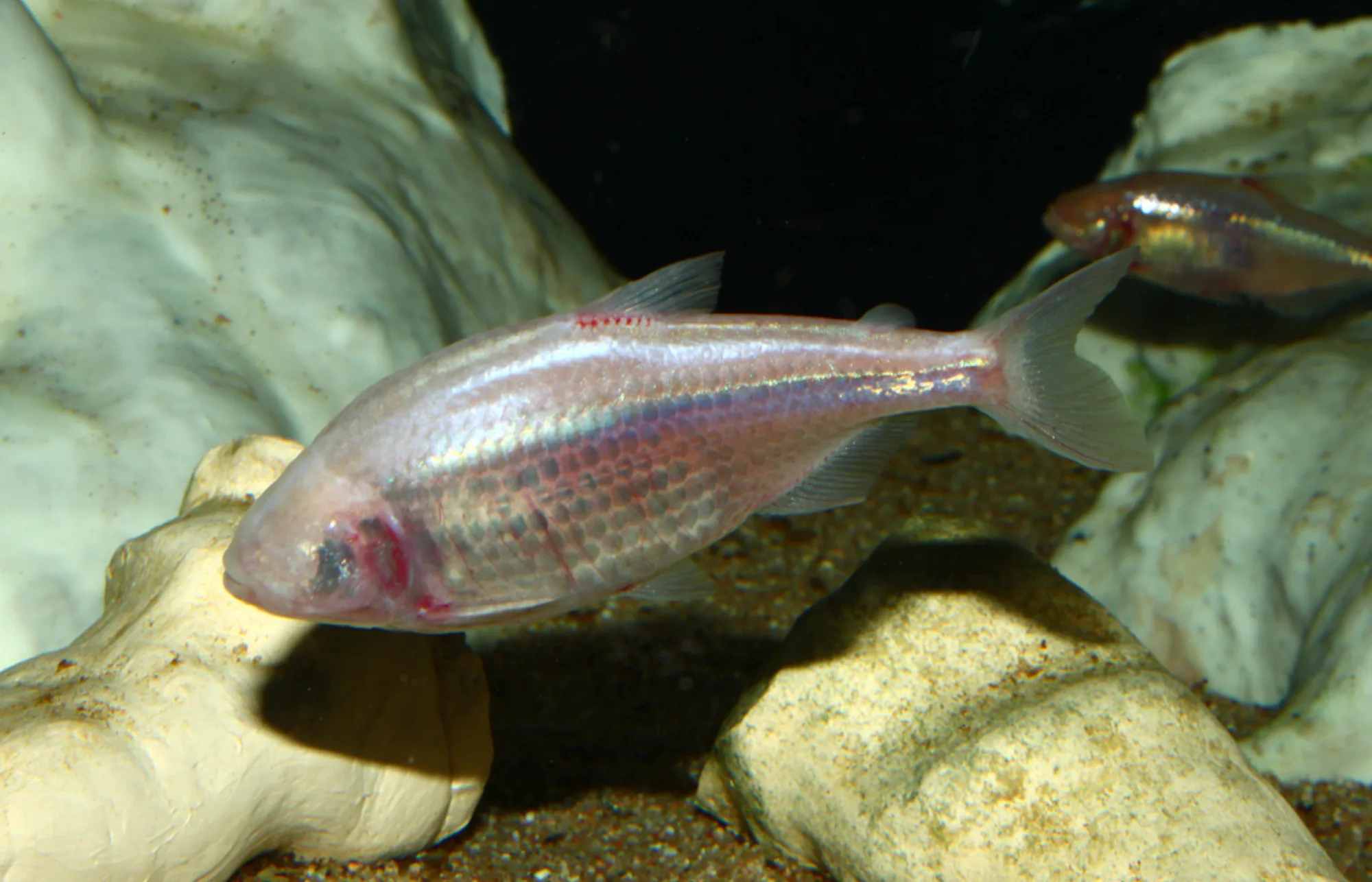
Silvery scales make the Mexican Tetra a subtle presence in the freshwater pools and streams of Texas and Mexico. It reaches about 12 cm in total length and has a typical characin shape. Its cave-dwelling forms look quite different: some are pinkish-white and lack functional eyes, while others retain limited sight. In the Pachón caves, the fish have no eyes at all, while those in the Micos cave can still see a little. In darkness, cave fish find their way by sensing changes in water pressure, and their senses of smell and touch are heightened.
In Texas, its range includes the Nueces and Pecos Rivers as well as the lower Rio Grande; farther south, it extends across Mexico's Central Plateau and eastern states. About 30 cave populations are known from a karst region in San Luis Potosí and far southern Tamaulipas in northeastern Mexico. In pools and the quiet backwaters of creeks and streams, these sociable fish swim in schools, spending much of their time above rocky or sandy bottoms. Some populations move to warmer water in winter.
Their natural diet includes crustaceans, worms, arthropods and larvae, with insects taken both from the water and from those that fall or land on its surface. They also eat algae and aquatic plants. Cave fish can face an irregular food supply, and the blind form can store more energy as fat than the surface form. Surface and cave fish can interbreed and produce fertile young. Some cave populations contain blind fish without pigment alongside fish with the usual surface form and others with intermediate features.
Written from the English Wikipedia article Mexican tetra (CC BY-SA 4.0).
- Records
- 3,426
- Countries
- 2
- Atlas places
- 1
These are open occurrence records, so they show where people looked for and recorded the Mexican Tetra as much as where it lives. Cells are up to 25 km across, and every location is generalised to its cell.
Generalised encounter areas, not exact locations. Each shape is a grid cell coloured by how likely the species is there.
- Very likelyUnited States25 km zone · medium confidence · 2263 records · updated 80 days ago
- Very likelyMexico25 km zone · medium confidence · 1163 records · updated 80 days ago
Conservation status not assessed here yet, so every location is generalised to its grid cell.