Astur gentilis
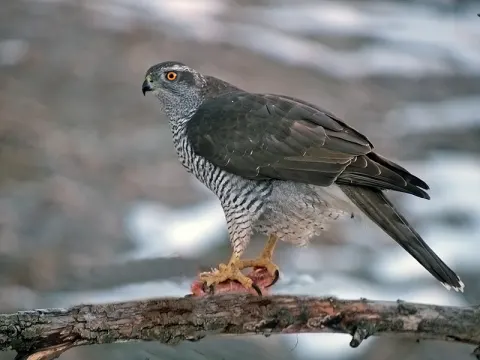
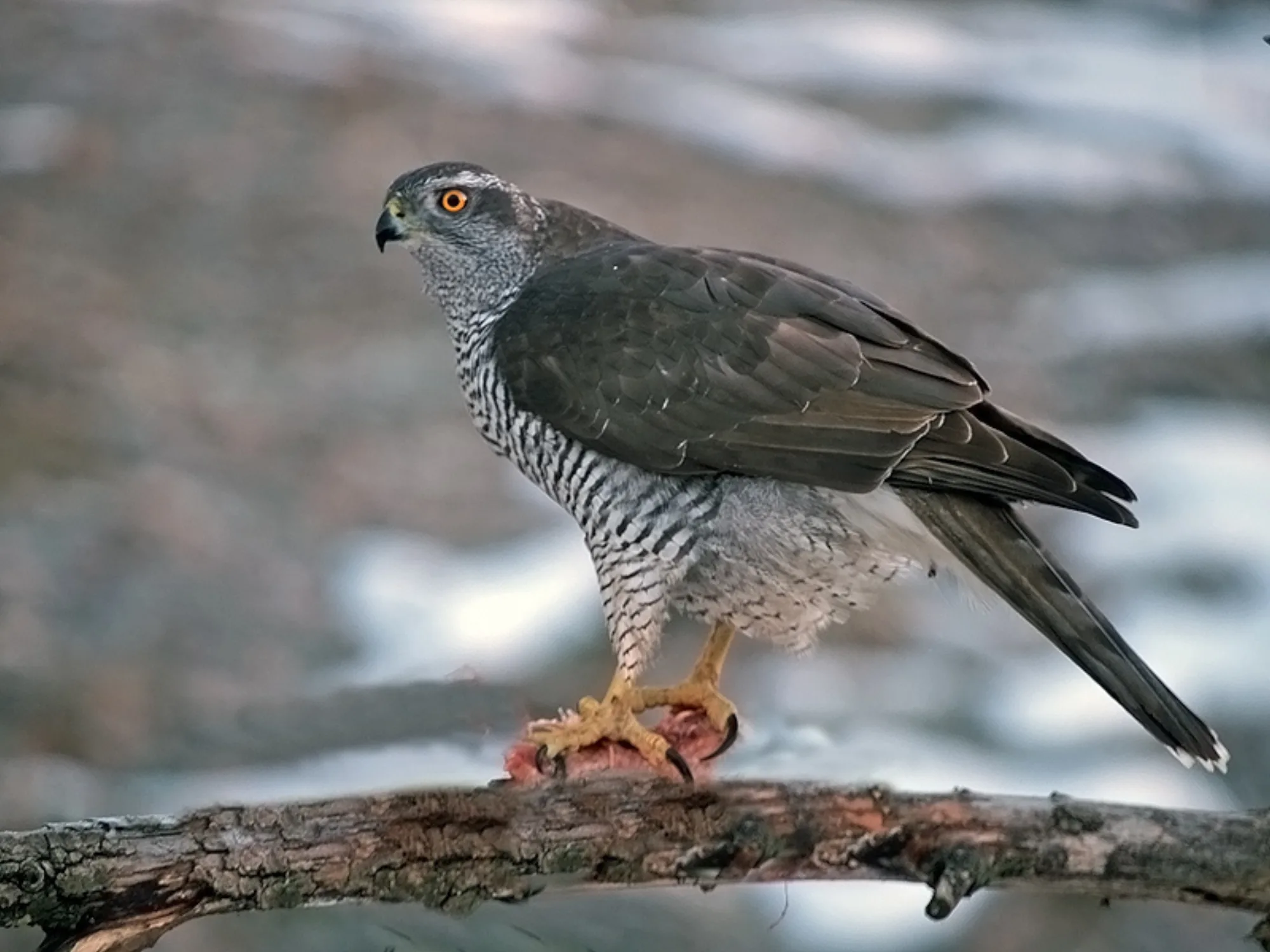
Across much of temperate Eurasia, Astur gentilis moves through woods on broad, relatively short wings, steering with a long tail. This medium-large bird of prey is usually blue-grey or brownish-grey above, with dark bars or streaks on a grey or white underside. Adult birds have a white stripe above the eye, while juveniles are generally brown above and can have broad brown stripes below. Females are substantially larger than males, and colour varies widely across the range, from almost white to nearly black above.
The Eurasian goshawk occurs across most of Europe and Russia, with a patchier distribution in western Europe, and its range reaches Japan. It inhabits both coniferous and deciduous forests, but can also live among small woods and isolated trees in cities, including Berlin and Hamburg. Most birds stay in their territories year-round, although some from colder regions travel south for winter. Usually seen alone or in pairs, goshawks defend territories with display flights that can include deep wingbeats, glides and undulations.
A hunting bird often scans from a perch, then makes a quick, low flight, using cover and speed to surprise prey. Its varied diet includes birds such as pigeons, grouse and crows, as well as squirrels, rabbits and hares. Pairs defend their nesting areas vigorously, and breeding birds may carry their catch to a low perch or use a familiar spot to dismantle it. Extensive lowland forests have become scarce across much of the goshawk's range, and the bird is now typically found at higher elevations. Territorial disputes can occasionally turn into physical fights in which birds die.
Written from the English Wikipedia article Eurasian goshawk (CC BY-SA 4.0).
- Records
- 163,356
- Countries
- 17
No atlas park has a record of the Astur gentilis in or around it yet.
These are open occurrence records, so they show where people looked for and recorded the Astur gentilis as much as where it lives. Cells are up to 25 km across, and every location is generalised to its cell.
Generalised encounter areas, not exact locations. Each shape is a grid cell coloured by how likely the species is there.
- Very likelyFinland25 km zone · high confidence · 57645 records · updated 80 days ago
- Very likelyNorway25 km zone · high confidence · 55409 records · updated 80 days ago
- Very likelyBelgium25 km zone · high confidence · 17577 records · updated 80 days ago
- Very likelySweden25 km zone · high confidence · 6652 records · updated 80 days ago
- Very likelyNetherlands25 km zone · high confidence · 5750 records · updated 80 days ago
- Very likelyUnited States25 km zone · high confidence · 5286 records · updated 80 days ago
- Very likelySpain25 km zone · high confidence · 4655 records · updated 80 days ago
- Very likelyPortugal25 km zone · high confidence · 3663 records · updated 80 days ago
- Very likelyGermany25 km zone · high confidence · 2935 records · updated 80 days ago
- Very likelyFrance25 km zone · high confidence · 1162 records · updated 80 days ago
Conservation status not assessed here yet, so every location is generalised to its grid cell.