Oscar
Astronotus ocellatus
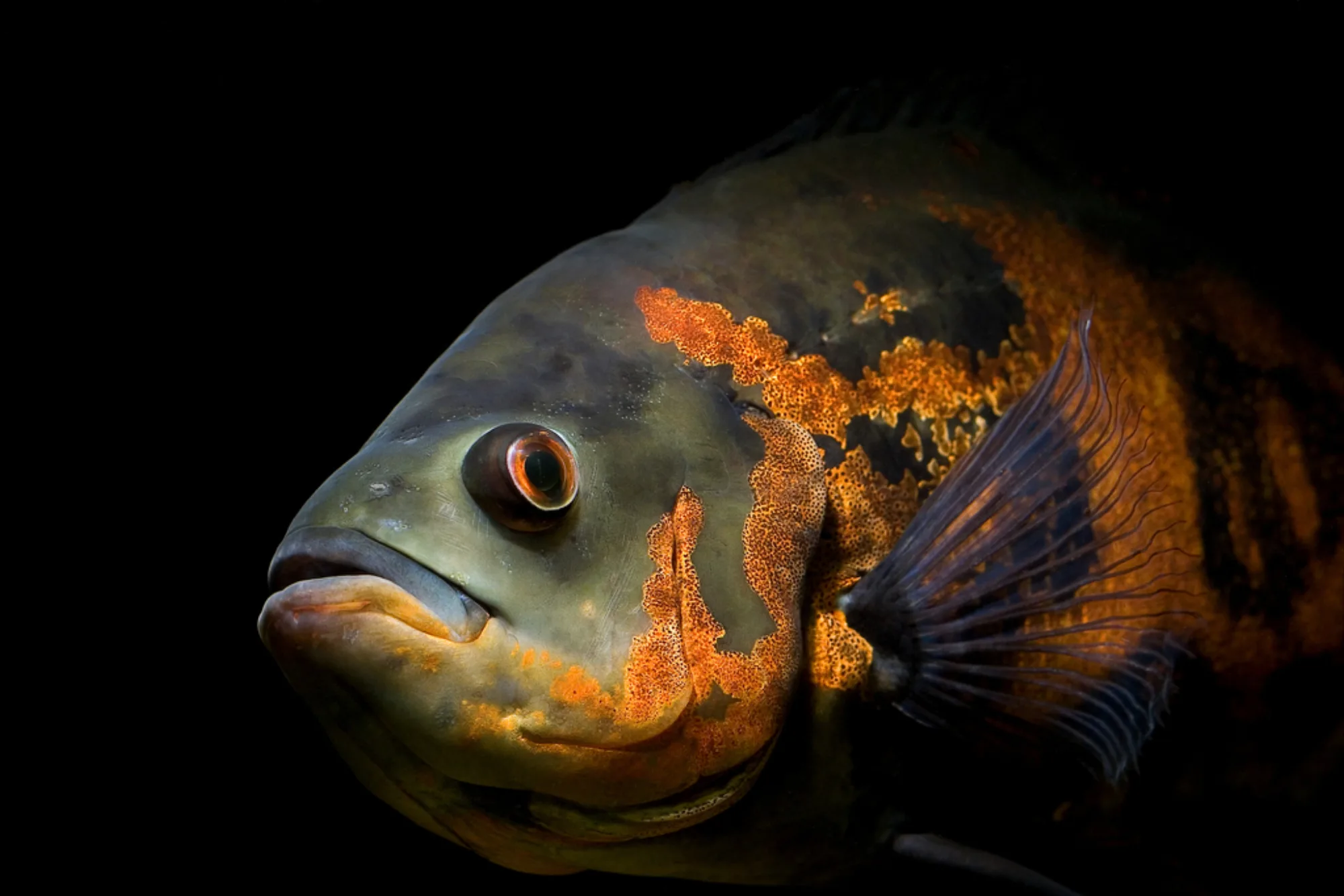
Dark colouring and yellow-ringed spots help distinguish wild Oscars, a South American member of the cichlid family. The spots appear near the tail and on the dorsal fin, while juveniles look different, with wavy white and orange stripes and spotted heads. Individuals can grow to about 70 cm long and weigh 9 kilograms. An Oscar can also change colour rapidly, a useful ability during territorial displays and confrontations with others of its kind.
The fish occurs across the Amazon basin and other river drainages, with a native range extending from Venezuela and the Guianas to Brazil, Peru, Ecuador and Colombia. In its natural habitat, it favours slow-moving white water, where it has been seen taking shelter under branches in the water. The ornamental fish trade has also led to feral populations in Florida, northern Australia and China. Cooler water limits its distribution, with a lower lethal temperature of 12.9 °C.
Oscars are omnivores, taking relatively sedentary catfish in the wild as well as shrimp, snails, insects and insect larvae. They also eat fruit and nuts seasonally, and use suction to capture prey. The fish has been reported to mimic death by lying on its side. Oscars defend territories by chasing other fish away, and both parents care for their brood. Spawning may be linked to rain, though details of breeding in the wild remain scarce. In captivity, pairs clean surfaces for their eggs, and females lay from around 300 to 3,000 eggs depending on their size. The species is sold as food in local markets in tropical South America and is also popular in the aquarium trade.
Written from the English Wikipedia article Oscar (fish) (CC BY-SA 4.0).
- Records
- 217
- Countries
- 12
- Atlas places
- 2
These are open occurrence records, so they show where people looked for and recorded the Oscar as much as where it lives. Cells are up to 25 km across, and every location is generalised to its cell.
Generalised encounter areas, not exact locations. Each shape is a grid cell coloured by how likely the species is there.
- Very likelyUnited States25 km zone · medium confidence · 154 records · updated 80 days ago
- Very likelyVenezuela25 km zone · medium confidence · 29 records · updated 80 days ago
- LikelyBrazil25 km zone · medium confidence · 12 records · updated 80 days ago
- LikelyPeru25 km zone · medium confidence · 10 records · updated 80 days ago
- LikelyIndia25 km zone · medium confidence · 5 records · updated 80 days ago
- PossibleBolivia25 km zone · medium confidence · 3 records · updated 80 days ago
- PossibleFrench Guiana25 km zone · medium confidence · 2 records · updated 80 days ago
- UncommonPanama25 km zone · medium confidence · 2 records · updated 80 days ago
- UncommonColombia25 km zone · low confidence · 0 records · updated 80 days ago
- RareHong Kong SAR China25 km zone · low confidence · 0 records · updated 80 days ago
Conservation status not assessed here yet, so every location is generalised to its grid cell.