Radiated Tortoise
Astrochelys radiata
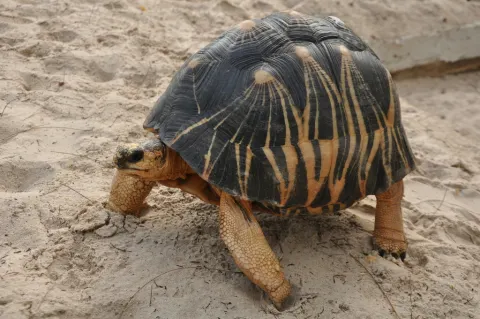
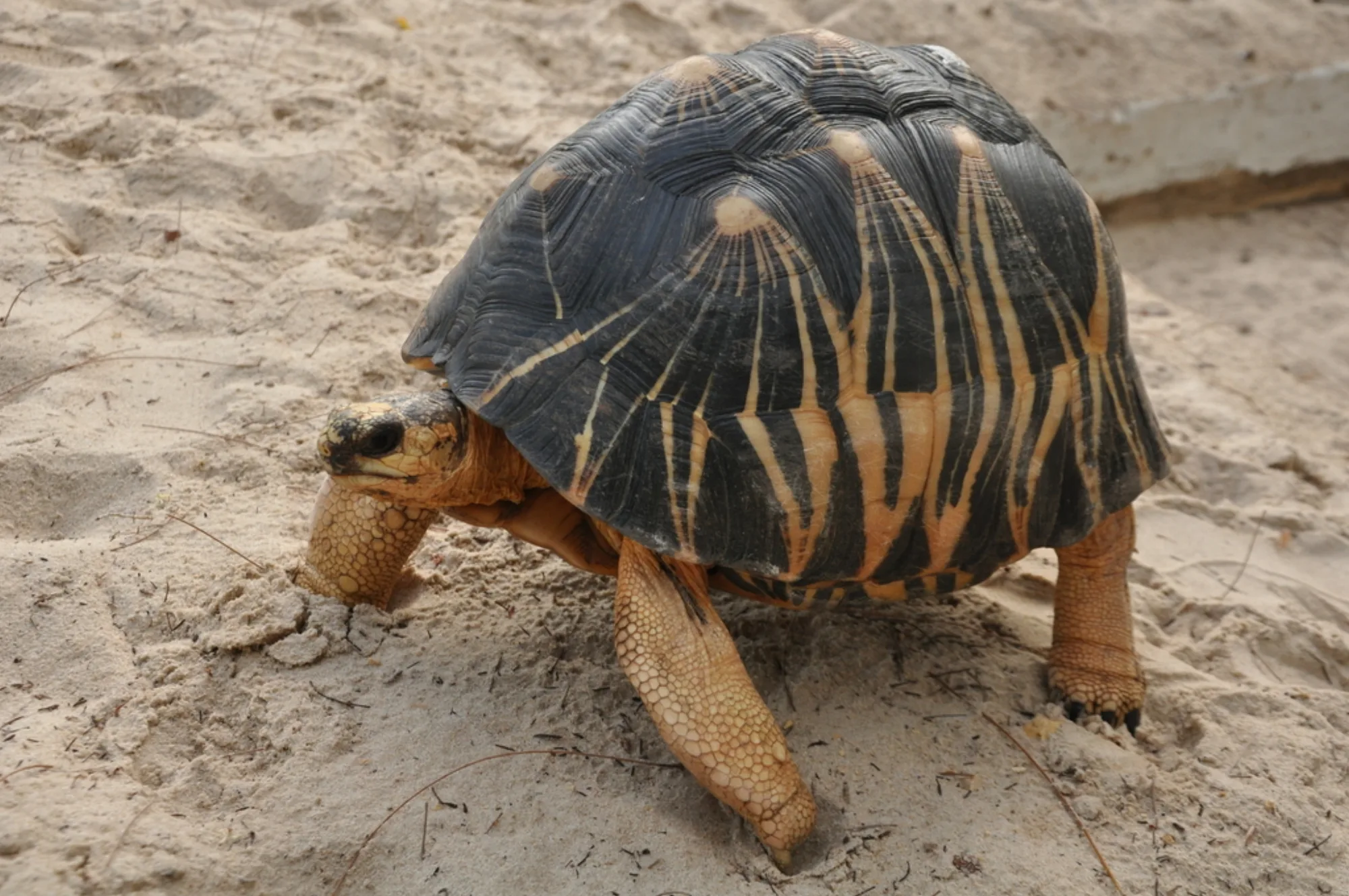
Look for a high-domed shell traced with yellow lines, spreading from the centre of each dark plate like the rays of a star. The Radiated Tortoise has a blunt head and sturdy, elephantine feet, with yellow colouring on its head and legs and a black patch on top of its head. Adults typically measure 26 to 38 centimetres along the shell, with a weight of 2.5 to 8.8 kilograms. The largest individuals tend to be males, although the differences between the sexes are slight. This is a long-lived tortoise: one individual reached an estimated 188 years.
Southern Madagascar is where the species is native and most abundant, with natural populations in the extreme south and southwest. It can also be found elsewhere on the island and has been introduced to Réunion and Mauritius. In southern Madagascar, it favours dry brush, thorn forests and woodland. These plant-eaters graze regularly in the same areas, keeping the vegetation closely trimmed. Grazing makes up 80 to 90% of their diet, supplemented by fruit and succulent plants, and they favour the Opuntia cactus in the wild. They appear to prefer fresh growth to mature vegetation. Females lay three to twelve eggs in a hole they have dug, then leave them behind. The eggs usually incubate for 5 to 8 months, and the young hatch with white to off-white colouring before developing a high-domed shell soon afterwards.
Habitat loss, poaching for food and overexploitation for the pet trade threaten the species. Wild numbers are declining, although no population estimates are available. Selling wild-caught tortoises is permitted only in exceptional licensed circumstances, but many laws are largely ignored.
Written from the English Wikipedia article Radiated tortoise (CC BY-SA 4.0).
- Records
- 8
- Countries
- 1
No atlas park has a record of the Radiated Tortoise in or around it yet.
These are open occurrence records, so they show where people looked for and recorded the Radiated Tortoise as much as where it lives. Cells are up to 25 km across, and every location is generalised to its cell.
Generalised encounter areas, not exact locations. Each shape is a grid cell coloured by how likely the species is there.
- Very likelyMadagascar25 km zone · medium confidence · 8 records · updated 80 days ago
Conservation status not assessed here yet, so every location is generalised to its grid cell.