Long-eared Owl
Asio otus
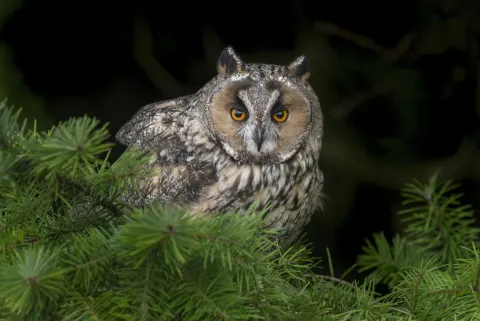
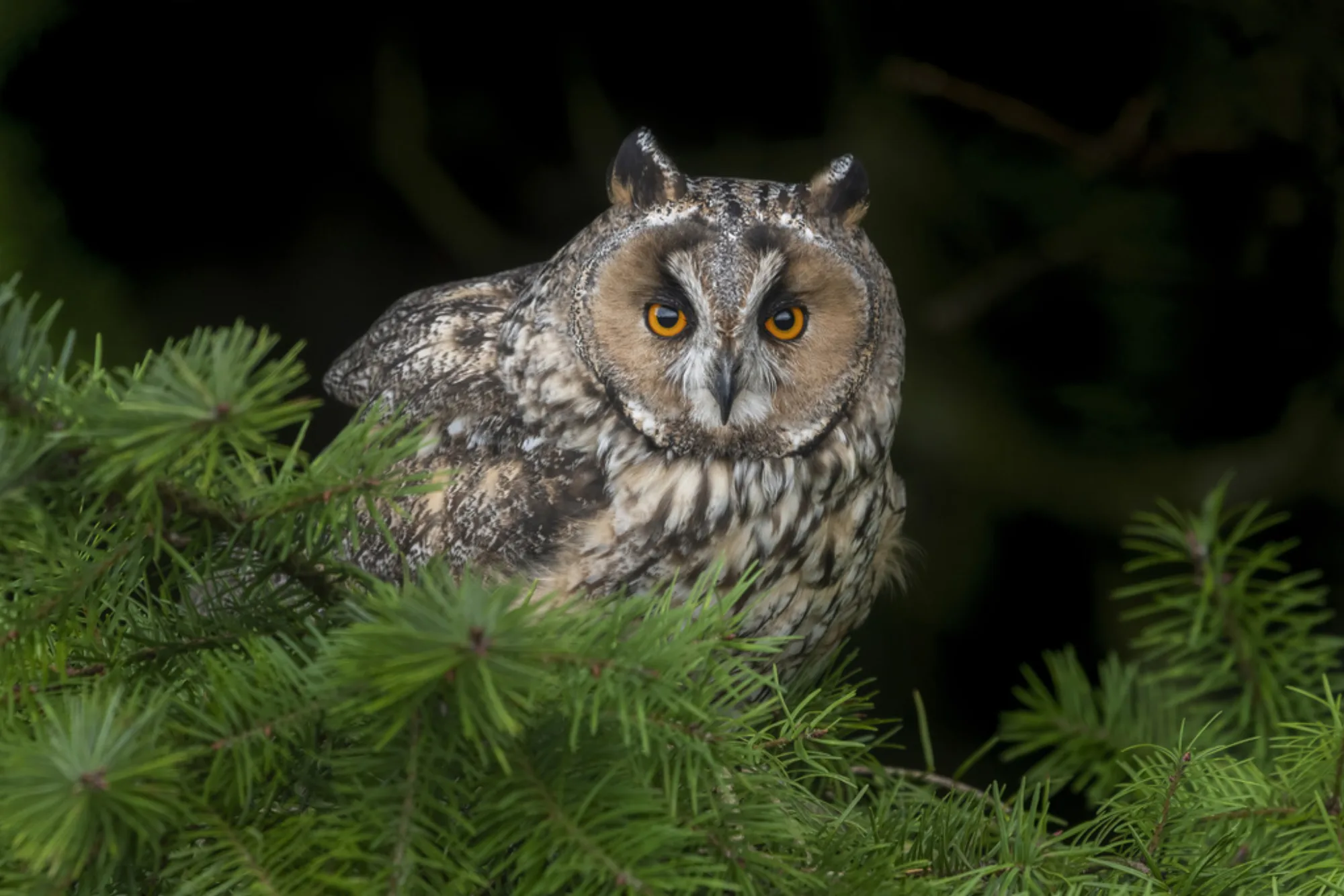
Slim, long-winged and marked in tawny and dark streaks, the Long-eared Owl has prominent ear tufts set close to the centre of its head. Its eyes range from yellowish-orange to orange-red, and its plumage varies from darker brown in forested regions to paler, washed-out colours in some desert landscapes. At rest, the tufts can help distinguish it from the short-eared owl, although they are sometimes held flat. Its flight has an erratic, buoyant quality, with flapping that can recall a moth.
This medium-sized owl breeds across Europe, the Palearctic and North America, with some populations moving south for winter. It favours semi-open country where dense trees offer cover for nesting and roosting, while nearby open ground provides hunting space. It lives along woodland edges and in pasture with trees, parks and gardens, and can also roost in desert oases. Usually active from dusk, it is nocturnal, though birds near the Arctic may have to forage by daylight in summer. Several owls may share a regular roost, a habit that sets them apart from many other owls. Small rodents, especially voles, are its main prey, but it also takes birds and insects when regular prey populations change or in arid, island and urban habitats.
Long-eared Owls use nests built by other animals, particularly corvids, and breeding success varies with prey populations and the risk of predation. Predators are one pressure, and collisions with cars and powerlines have also been recorded. In Oregon, clearing riverside vegetation, converting hunting areas to agricultural fields and reforesting open habitats reduced local numbers. Strong declines have been detected in several parts of the owl's range.
Written from the English Wikipedia article Long-eared owl (CC BY-SA 4.0).
- Records
- 67,948
- Countries
- 28
No atlas park has a record of the Long-eared Owl in or around it yet.
These are open occurrence records, so they show where people looked for and recorded the Long-eared Owl as much as where it lives. Cells are up to 25 km across, and every location is generalised to its cell.
Generalised encounter areas, not exact locations. Each shape is a grid cell coloured by how likely the species is there.
- Very likelyFinland25 km zone · high confidence · 15317 records · updated 80 days ago
- Very likelyBelgium25 km zone · high confidence · 13748 records · updated 80 days ago
- Very likelyCanada25 km zone · high confidence · 8686 records · updated 80 days ago
- Very likelyFrance25 km zone · high confidence · 5222 records · updated 80 days ago
- Very likelyNorway25 km zone · high confidence · 4684 records · updated 80 days ago
- Very likelySweden25 km zone · high confidence · 3630 records · updated 80 days ago
- Very likelyCzechia25 km zone · high confidence · 2571 records · updated 80 days ago
- Very likelySpain25 km zone · high confidence · 1905 records · updated 80 days ago
- Very likelyNetherlands25 km zone · high confidence · 1832 records · updated 80 days ago
- Very likelyGermany25 km zone · high confidence · 1734 records · updated 80 days ago
Conservation status not assessed here yet, so every location is generalised to its grid cell.