Short-eared Owl
Asio flammeus
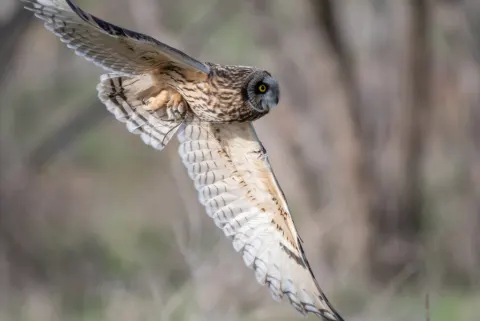
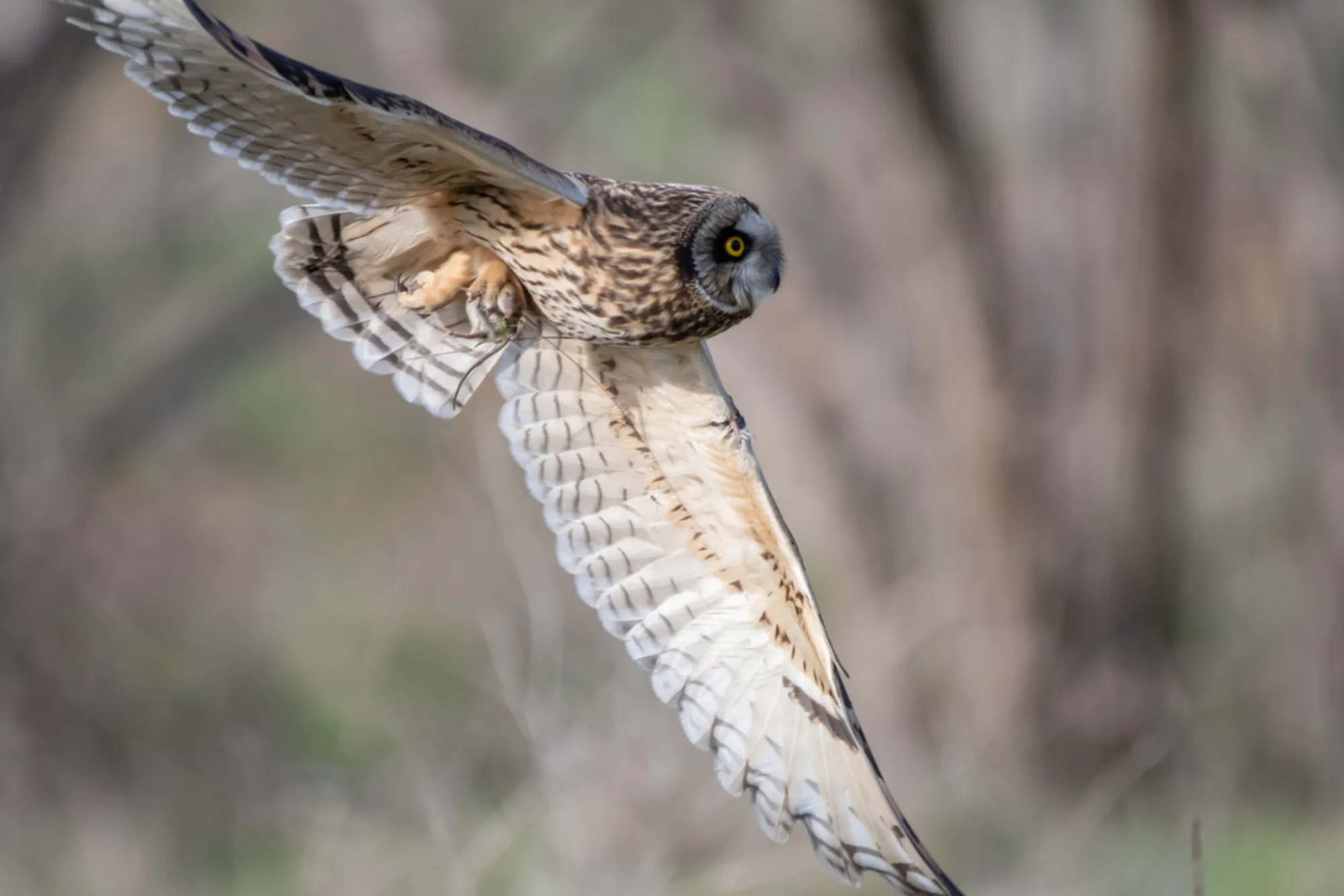
Over open grassland, the Short-eared Owl can be recognised by its broad wings and loose, irregular flight, sometimes likened to that of a moth or bat. This medium-sized owl has mottled tawny to brown plumage, barred wings and tail, and a streaked upper breast. Dark rings frame its yellow-orange eyes, which sit within pale, mask-like discs of feathers. Despite its name, the short ear tufts are usually hidden, though it can raise them in defence.
Found on every continent apart from Antarctica and Australia, the owl breeds across the Americas, Europe and Asia, as well as on islands including Hawaii and the Galápagos. It favours open country and may be seen hunting in the early morning or late in the day. Some birds move south for winter, while others shift to places with more rodents or wander in search of food when voles are scarce. Hunting mostly at night but also by day and around twilight, it flies low over fields and grasslands before dropping onto prey. Voles are a favourite, though the owl also takes other small mammals, birds and insects; a single stretch of open ground can attract multiple hunting owls.
In the northern hemisphere, breeding runs from March to June, with a peak in April. The nest lies on the ground in habitats such as prairie, tundra, savanna or meadow, hidden among low plants. A typical clutch contains 4 to 7 white eggs, and there is one brood each year. An adult may draw a predator away from the nest by pretending to have an injured wing. The owl is listed as declining in the southern part of its United States range, and a proposed airport redevelopment on Long Island has prompted an environmental permitting review.
Written from the English Wikipedia article Short-eared owl (CC BY-SA 4.0).
- Records
- 134,299
- Countries
- 18
- Atlas places
- 2
These are open occurrence records, so they show where people looked for and recorded the Short-eared Owl as much as where it lives. Cells are up to 25 km across, and every location is generalised to its cell.
Generalised encounter areas, not exact locations. Each shape is a grid cell coloured by how likely the species is there.
- Very likelyUnited States25 km zone · high confidence · 79024 records · updated 80 days ago
- Very likelyCanada25 km zone · high confidence · 16072 records · updated 80 days ago
- Very likelyUnited Kingdom25 km zone · high confidence · 9787 records · updated 80 days ago
- Very likelyNorway25 km zone · high confidence · 5995 records · updated 80 days ago
- Very likelyBelgium25 km zone · high confidence · 5848 records · updated 80 days ago
- Very likelyNetherlands25 km zone · high confidence · 4334 records · updated 80 days ago
- Very likelyFinland25 km zone · high confidence · 3365 records · updated 80 days ago
- Very likelySpain25 km zone · high confidence · 1837 records · updated 80 days ago
- Very likelyChile25 km zone · high confidence · 1624 records · updated 80 days ago
- Very likelyEcuador25 km zone · high confidence · 1576 records · updated 80 days ago
Conservation status not assessed here yet, so every location is generalised to its grid cell.