Eurasian Water Vole
Arvicola amphibius
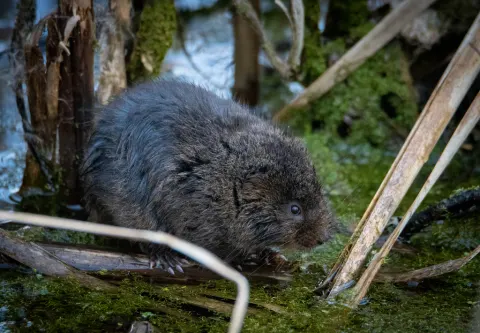
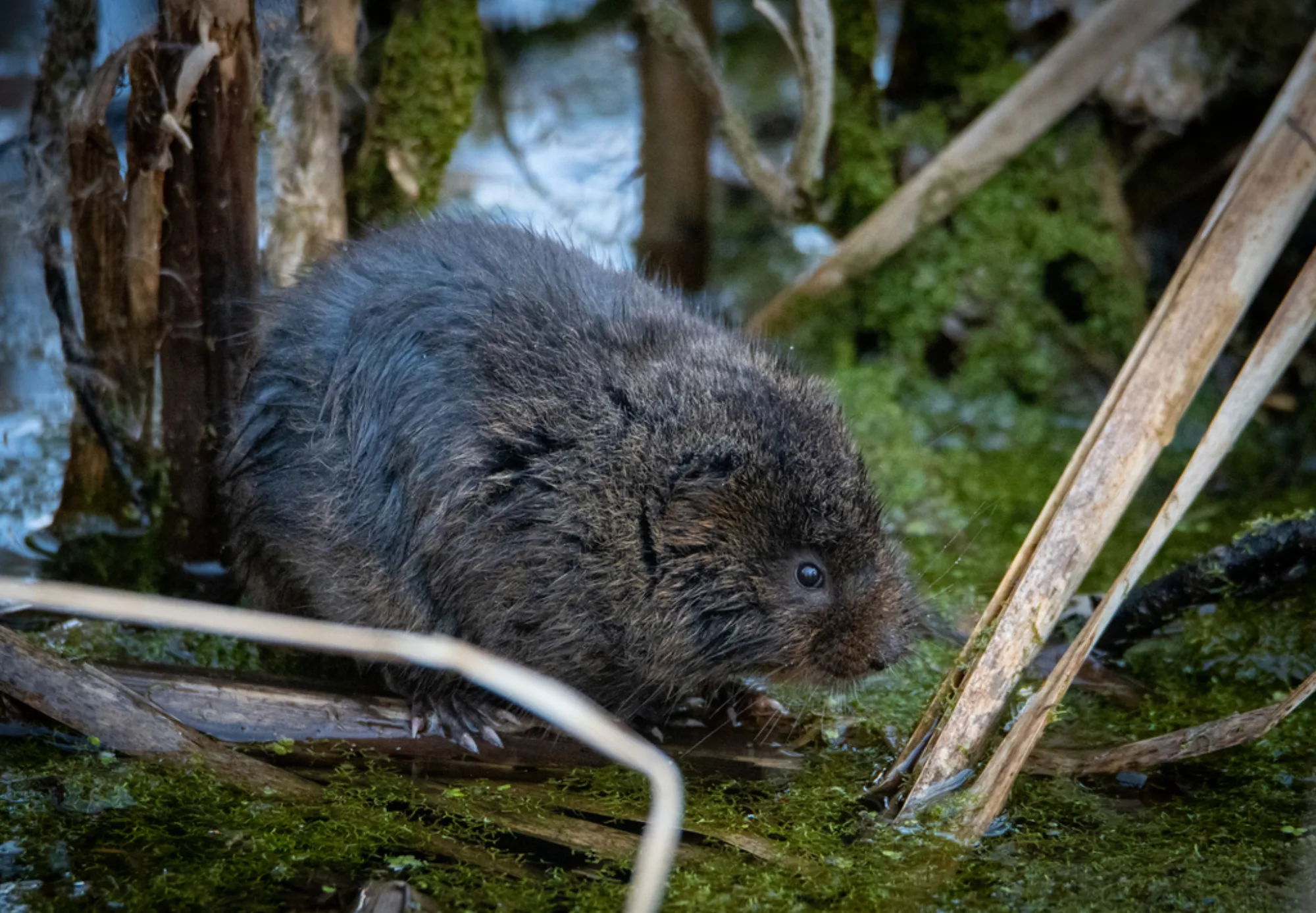
With its rounded nose, chubby face and short, furry ears, the Eurasian Water Vole has a softer look than a rat. This semi-aquatic rodent has thick, dark brown fur, slightly paler underneath, and even its tail is hairy. Its body measures 14 to 22 centimetres, with a tail about half as long again. Its dark colour helps it blend into dense vegetation.
Its range extends from much of Europe through Russia to West Asia and Kazakhstan. In Britain, look for its burrows beside ponds, streams, rivers and ditches, usually near calm, slow-moving water. Where reed beds lack suitable banks, water voles weave rounded nests above ground instead. They favour lush waterside plants for cover and generally avoid banks that have been heavily grazed or trampled. They also occupy upland peatlands, using small waterways and lochs among moorland as high as 1,000 m.
Water voles are skilled swimmers and divers, and adults usually hold individual territories rather than gathering in large groups. They mark these areas with latrines near their nests, burrows or favoured places at the water's edge, and may attack an intruding vole. Their diet is mainly waterside vegetation, including grasses, sedges, rushes and herbs, with fruit, seeds, roots and other plant parts when available. In some parts of England they occasionally eat water snails, freshwater mussels, other molluscs, frogs and tadpoles. Breeding runs from March into late autumn, and a female can give birth to up to 8 young after a pregnancy of approximately 21 days. Predators include foxes, birds of prey, weasels and mink; introduced American mink have reportedly contributed to the vole's decline in Britain. Woodland and scrub along the water can also displace voles, which favour more open wetlands.
Written from the English Wikipedia article European water vole (CC BY-SA 4.0).
- Records
- 33,479
- Countries
- 9
No atlas park has a record of the Eurasian Water Vole in or around it yet.
These are open occurrence records, so they show where people looked for and recorded the Eurasian Water Vole as much as where it lives. Cells are up to 25 km across, and every location is generalised to its cell.
Generalised encounter areas, not exact locations. Each shape is a grid cell coloured by how likely the species is there.
- Very likelySwitzerland25 km zone · high confidence · 22401 records · updated 80 days ago
- Very likelyUnited Kingdom25 km zone · medium confidence · 5664 records · updated 80 days ago
- Very likelyFrance25 km zone · high confidence · 4033 records · updated 80 days ago
- Very likelyNorway25 km zone · medium confidence · 716 records · updated 80 days ago
- Very likelyAustria25 km zone · high confidence · 223 records · updated 80 days ago
- Very likelyFinland25 km zone · medium confidence · 194 records · updated 80 days ago
- Very likelyLiechtenstein25 km zone · high confidence · 109 records · updated 80 days ago
- LikelyEstonia25 km zone · medium confidence · 123 records · updated 80 days ago
- LikelyDenmark25 km zone · medium confidence · 16 records · updated 80 days ago
Conservation status not assessed here yet, so every location is generalised to its grid cell.