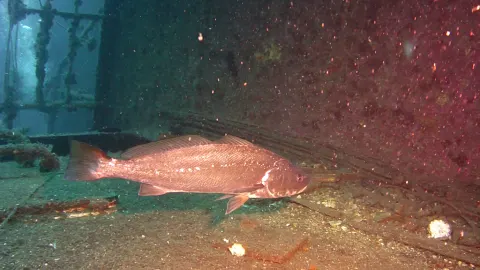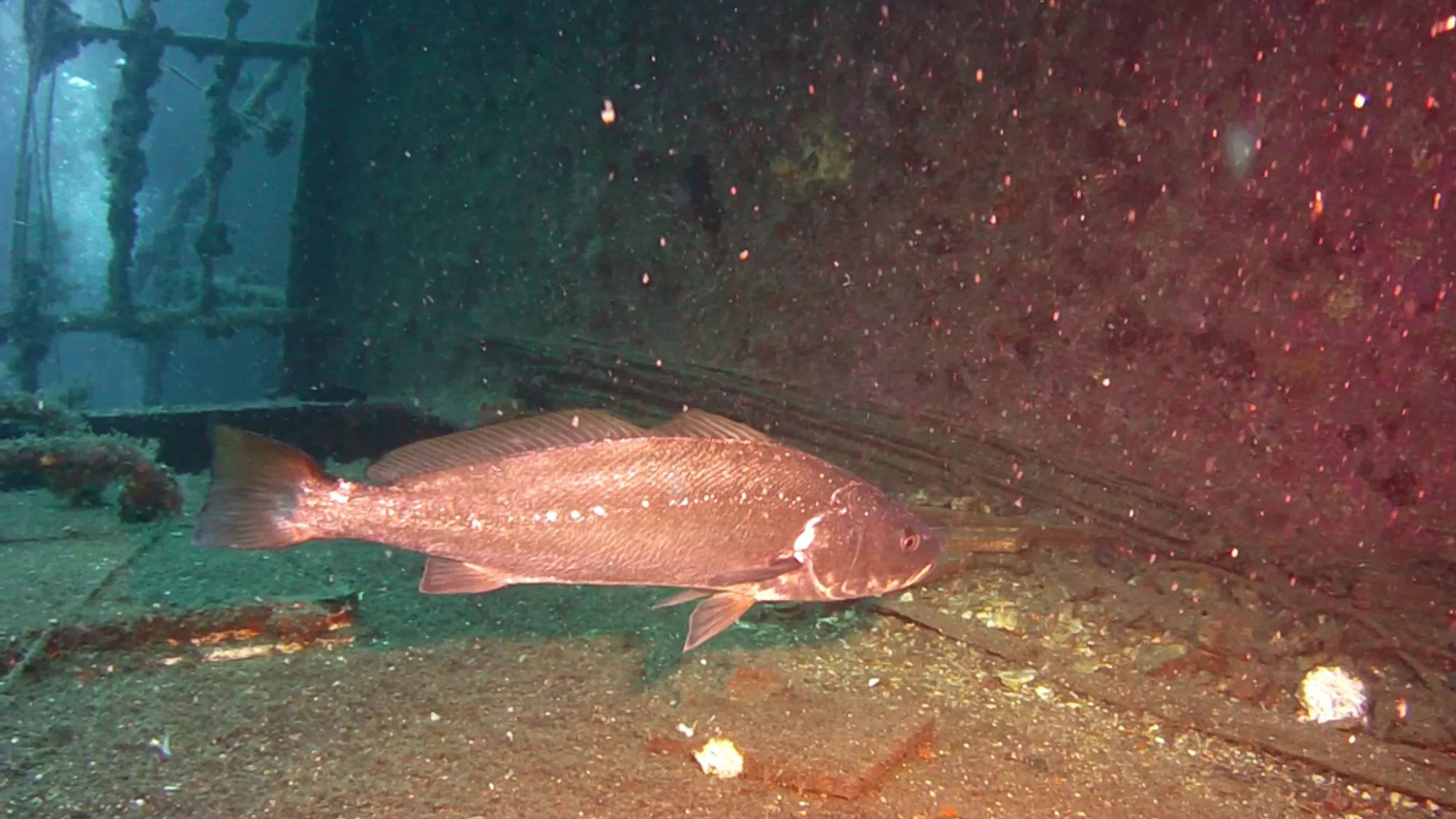
Meagre
Argyrosomus regius
Pearly silver with bronze tones along its back, the Meagre is a large, elongated fish with a sizeable head and small eyes. Its mouth is yellow-gold or salmon pink inside, and its fin bases are reddish brown. It can reach 2.3 m in length and weigh 103 kg. Native to the eastern Atlantic, it ranges between Norway and DR Congo and occurs in both the Mediterranean and Black Seas. It has also reached the Red Sea through the Suez Canal, though it is rare in the colder far north of its range, including around the British Isles and Scandinavia.
Meagre live in inshore waters and over the continental shelf, from near the bottom to mid-water and the surface. They mostly occur over sand near rocks, commonly at depths of 15 to 100 m, and large schools gather around deliberately sunk wrecks. Adults actively chase fish such as grey mullet and sardines in open water, while younger fish eat small bottom-dwelling fish and crustaceans. As they grow, the young switch to fish living in open water and cephalopods. At all ages, Meagre migrate along the shore or between offshore and inshore waters as temperatures change. Feeding falls sharply when water temperatures drop below 13 to 15 °C.
Adults gather inshore to spawn in spring and summer. Between May and July, large numbers congregate at the Gironde estuary, Lévrier Bay and the Nile Delta. Males produce grunts during the spawning season that can be heard up to 30 m away. Young fish favour estuaries and coastal lagoons, and the availability of these habitats may affect how many reach the adult population. Meagre are caught commercially by trawls and lines and are also pursued by sport fishers.
Written from the English Wikipedia article Argyrosomus regius (CC BY-SA 4.0).
- Records
- 4
- Countries
- 4
No atlas park has a record of the Meagre in or around it yet.
These are open occurrence records, so they show where people looked for and recorded the Meagre as much as where it lives. Cells are up to 25 km across, and every location is generalised to its cell.
Generalised encounter areas, not exact locations. Each shape is a grid cell coloured by how likely the species is there.
- Very likelyFrance25 km zone · medium confidence · 4 records · updated 80 days ago
- LikelyAlgeria25 km zone · low confidence · 0 records · updated 80 days ago
- PossibleSenegal25 km zone · low confidence · 0 records · updated 80 days ago
- UncommonEgypt25 km zone · low confidence · 0 records · updated 80 days ago
Conservation status not assessed here yet, so every location is generalised to its grid cell.