Japanese Meagre
Argyrosomus japonicus
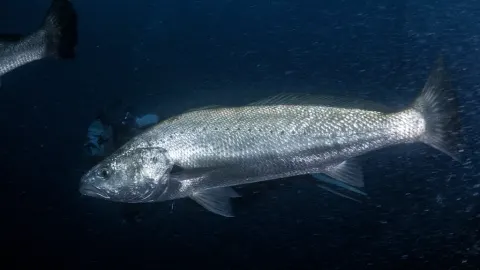
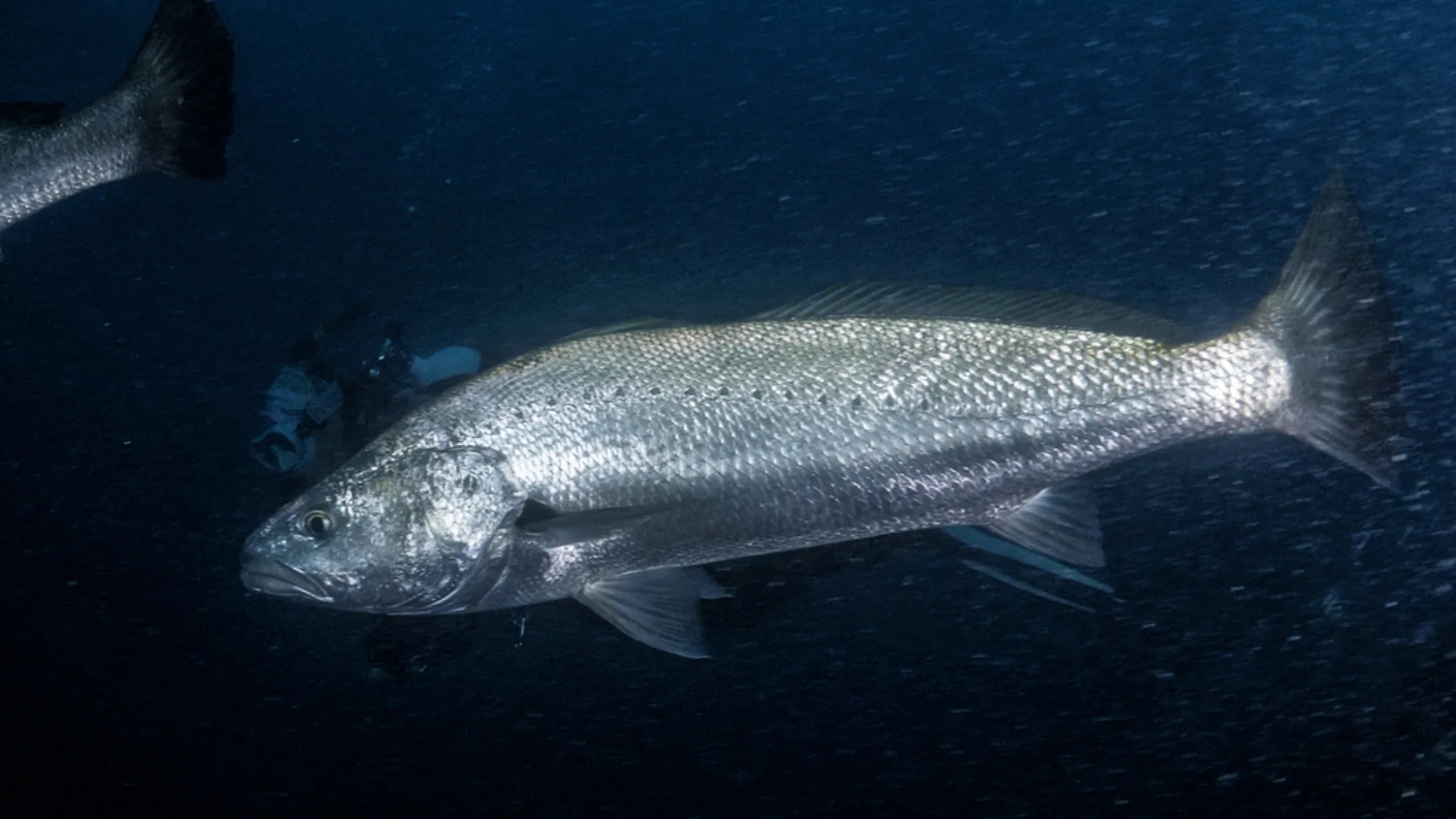
Silvery flanks, a copper-coloured head and a line of white spots help distinguish the Japanese Meagre, a large, slender saltwater fish. Its back has a bronze-green cast, its belly is paler, and its tail becomes rounder as the fish grows. It can grow to 2 m and reach a weight of 82 kg, although fish caught in Australia have been smaller. The species goes by several local names, including mulloway and jewfish in Australia and dusky kob in South Africa.
Its coastal range spans the Indo-Pacific, from waters around Africa and India to those near Japan, China, Pakistan and Australia. Adults gather in groups over soft bottoms, usually beyond the surf, though they sometimes come inshore. Young fish live in shallow seas and can enter estuaries, where the water is brackish. In Australia, the fish also shelter near structures such as deep-water marinas, bridges, jetties, shelving rocks and caves. Around southern Africa, juveniles rely heavily on estuaries before moving towards the neighbouring surf zone as they grow.
Japanese Meagre can feed throughout the water column, with their diet changing as they get bigger. Small juveniles eat mysid shrimp, then add small fish, followed by larger fish, squid and other cephalopods. Adults from South Africa's Western Cape and Eastern Cape migrate to KwaZulu-Natal to spawn during winter and spring. Fishing is a major pressure: the species is sought by recreational, subsistence and commercial line fisheries, and stocks in New South Wales were still overfished despite recovery efforts. Catch limits have been introduced in New South Wales and South Africa to help manage fishing.
Written from the English Wikipedia article Argyrosomus japonicus (CC BY-SA 4.0).
- Records
- 32,784
- Countries
- 4
- Atlas places
- 3
These are open occurrence records, so they show where people looked for and recorded the Japanese Meagre as much as where it lives. Cells are up to 25 km across, and every location is generalised to its cell.
Generalised encounter areas, not exact locations. Each shape is a grid cell coloured by how likely the species is there.
- Very likelyAustralia25 km zone · high confidence · 32671 records · updated 80 days ago
- LikelySouth Africa25 km zone · medium confidence · 79 records · updated 80 days ago
- LikelyJapan25 km zone · medium confidence · 31 records · updated 80 days ago
- PossibleTaiwan25 km zone · medium confidence · 3 records · updated 80 days ago
Conservation status not assessed here yet, so every location is generalised to its grid cell.