Great Indian Bustard
Ardeotis nigriceps
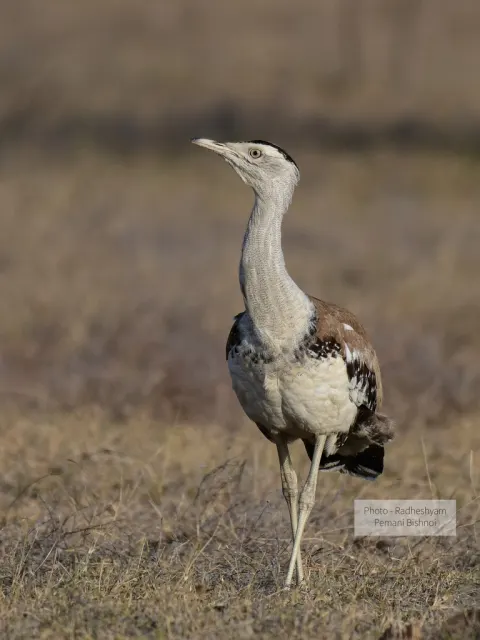
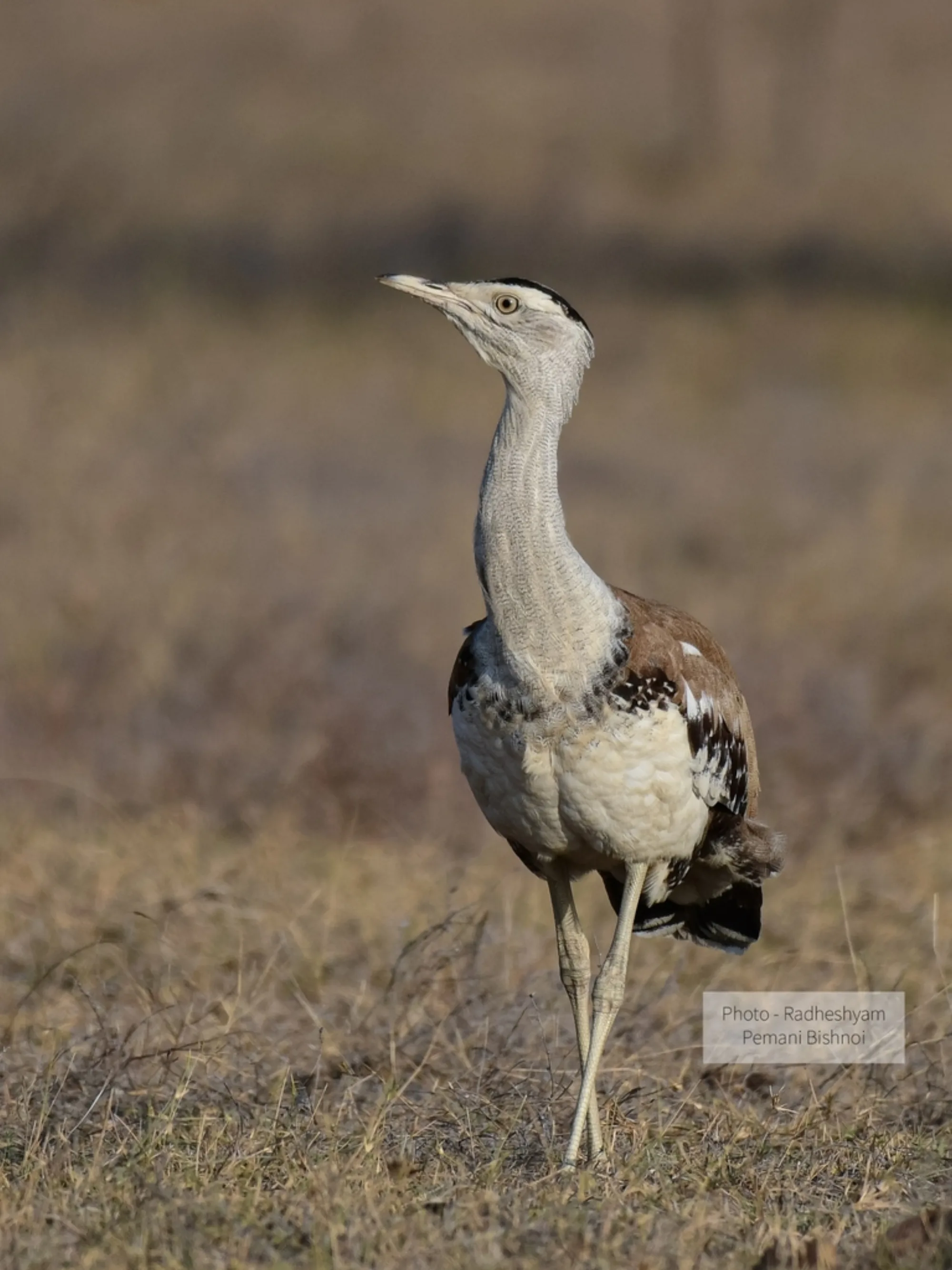
Standing about one metre tall, the Great Indian Bustard is a large ground bird with a long neck, bare legs and a horizontal body. Its black cap contrasts with its pale head and neck, while its brownish body has a black patch spotted with white. Males are deep sandy buff, with a black breast band in the breeding season; females are smaller and have a less distinct or absent band. A displaying male gives a deep, booming call that can carry for nearly 500 m.
The bird now survives in isolated pockets of India, including Rajasthan, Gujarat, Karnataka, Maharashtra, Madhya Pradesh and Andhra Pradesh. Populations live in Desert National Park by Jaisalmer, as well as on the Kutch coast in Gujarat. It favours dry grasslands and thorny scrub, as well as tall grass among cultivated fields, but avoids irrigated land. Although local movements are poorly understood, flocks disperse after the monsoon, and birds gather in small flocks in winter. Its varied diet includes insects, grass seeds, berries, rodents and reptiles, as well as crops such as groundnuts and millets. Breeding takes place from March to September, when the female deposits one egg in a bare scrape on the ground. She alone incubates the egg and cares for the young.
Hunting and habitat loss are major threats, and poaching may continue. Irrigation has expanded farming and altered habitat in parts of Rajasthan, while roads and power transmission lines can cause fatal collisions. Proposed solar development over large areas of desert and grassland threatens further habitat loss.
Written from the English Wikipedia article Great Indian bustard (CC BY-SA 4.0).
- Records
- 6
- Countries
- 1
No atlas park has a record of the Great Indian Bustard in or around it yet.
These are open occurrence records, so they show where people looked for and recorded the Great Indian Bustard as much as where it lives. Cells are up to 25 km across, and every location is generalised to its cell.
Generalised encounter areas, not exact locations. Each shape is a grid cell coloured by how likely the species is there.
- Very likelyIndia25 km zone · medium confidence · 6 records · updated 80 days ago
Conservation status not assessed here yet, so every location is generalised to its grid cell.