Kori Bustard
Ardeotis kori
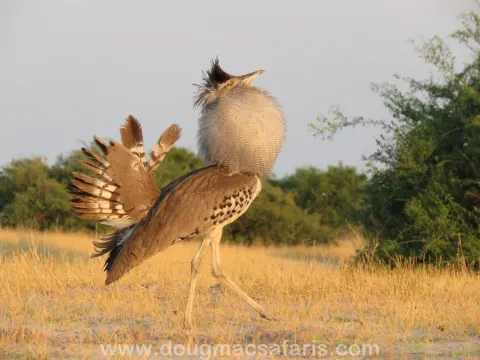
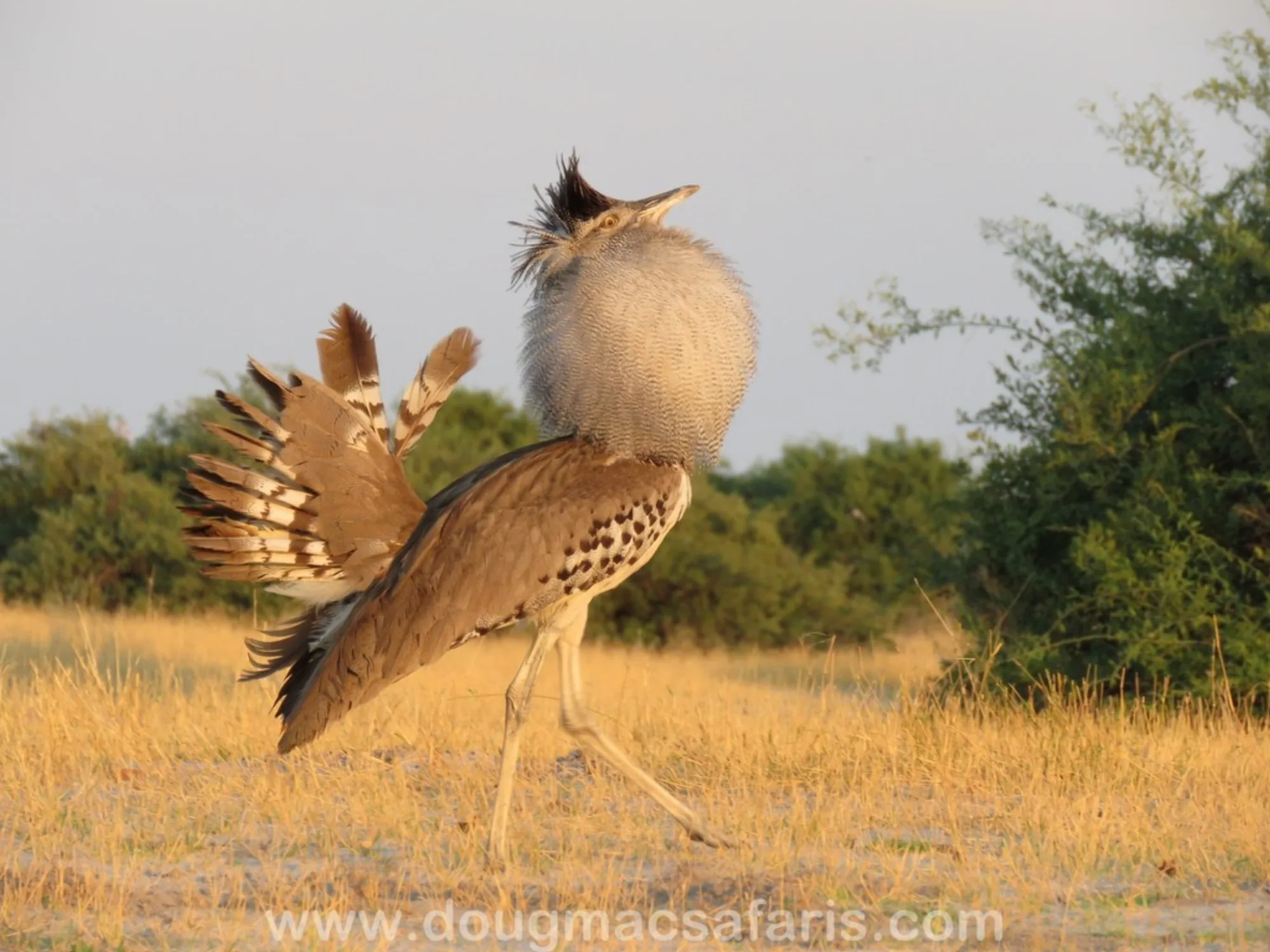
Africa's largest native flying bird, the Kori Bustard spends much of its life on the ground. Its grey and brown plumage is finely patterned in black and white, with a dark crest, a white stripe above the eye and long, yellowish legs. Males are much larger than females and can weigh more than twice as much. Look for them across southern Africa and in a separate population in northeastern Africa, from open grassland and lightly wooded savanna to arid scrub and semi-desert. They favour short grass, often near scattered trees or bushes, and need open space to take flight.
Watchful and often shy, a Kori Bustard may run or crouch when danger appears, taking flight with heavy wingbeats if pressed. It usually feeds in the morning and evening, walking slowly and picking food from the ground. Its varied diet includes grasshoppers, beetles and other insects, as well as small animals, seeds, berries and leaves. Bustards sometimes follow large grazing animals to catch insects disturbed by their movement. Away from breeding, they may gather in small groups or congregate at water and plentiful food sources.
Breeding is tied to rainfall and can be reduced or absent in drought years. The female usually lays two eggs in a shallow hollow on the ground, often close to a tree, shrub, termite mound or rocks. She cares for the young without help from the male, and the chicks can follow her within hours of hatching. Hunting has reduced their numbers, while habitat destruction, agricultural development and woody plants spreading into grassland also pose problems. Locust-control poisons may affect them, and collisions with overhead power lines regularly kill birds.
Written from the English Wikipedia article Kori bustard (CC BY-SA 4.0).
- Records
- 34,153
- Countries
- 9
- Atlas places
- 32
- Kruger National Park· South Africa
- Kgalagadi Transfrontier Park· South Africa
- Serengeti National Park· Tanzania
- Etosha National Park· Namibia
- Ngorongoro Conservation Area· Tanzania
- Chobe National Park· Botswana
- Okavango Delta· Botswana
- Maasai Mara National Reserve· Kenya
- Tsavo East National Park· Kenya
- Tsavo West National Park· Kenya
- Central Kalahari Game Reserve· Botswana
- Hwange National Park· Zimbabwe
- Amboseli National Park· Kenya
- Mapungubwe National Park· South Africa
- Samburu National Reserve· Kenya
- Karoo National Park· South Africa
- Lake Manyara National Park· Tanzania
- Madikwe Game Reserve· South Africa
- Nairobi National Park· Kenya
- Nkasa Rupara National Park· Namibia
- Pilanesberg National Park· South Africa
- Waterberg Plateau Park· Namibia
- Aberdare National Park· Kenya
- Gonarezhou National Park· Zimbabwe
- Hell's Gate National Park· Kenya
- Kilimanjaro National Park· Tanzania
- Kunene / Kaokoveld· Namibia
- Makgadikgadi Pans National Park· Botswana
- Meru National Park· Kenya
- Mount Kenya National Park· Kenya
- Tarangire National Park· Tanzania
- Zambezi National Park· Zimbabwe
These are open occurrence records, so they show where people looked for and recorded the Kori Bustard as much as where it lives. Cells are up to 25 km across, and every location is generalised to its cell.
Generalised encounter areas, not exact locations. Each shape is a grid cell coloured by how likely the species is there.
- Very likelySouth Africa25 km zone · high confidence · 12354 records · updated 86 days ago
- Very likelyTanzania25 km zone · high confidence · 5769 records · updated 86 days ago
- Very likelyKenya25 km zone · high confidence · 5413 records · updated 86 days ago
- Very likelyNamibia25 km zone · high confidence · 4997 records · updated 86 days ago
- Very likelyBotswana25 km zone · high confidence · 4069 records · updated 86 days ago
- Very likelyZimbabwe25 km zone · high confidence · 586 records · updated 86 days ago
- Very likelyEthiopia25 km zone · high confidence · 578 records · updated 86 days ago
- Very likelyZambia25 km zone · high confidence · 305 records · updated 86 days ago
- LikelyMozambique25 km zone · medium confidence · 82 records · updated 86 days ago
Conservation status not assessed here yet, so every location is generalised to its grid cell.