Australian Bustard
Ardeotis australis
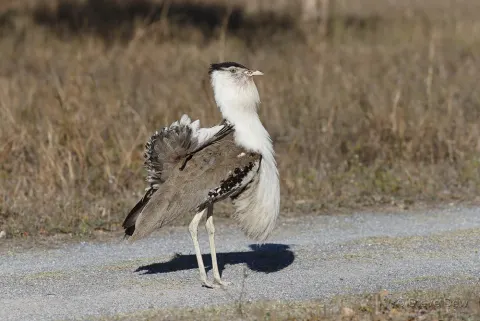
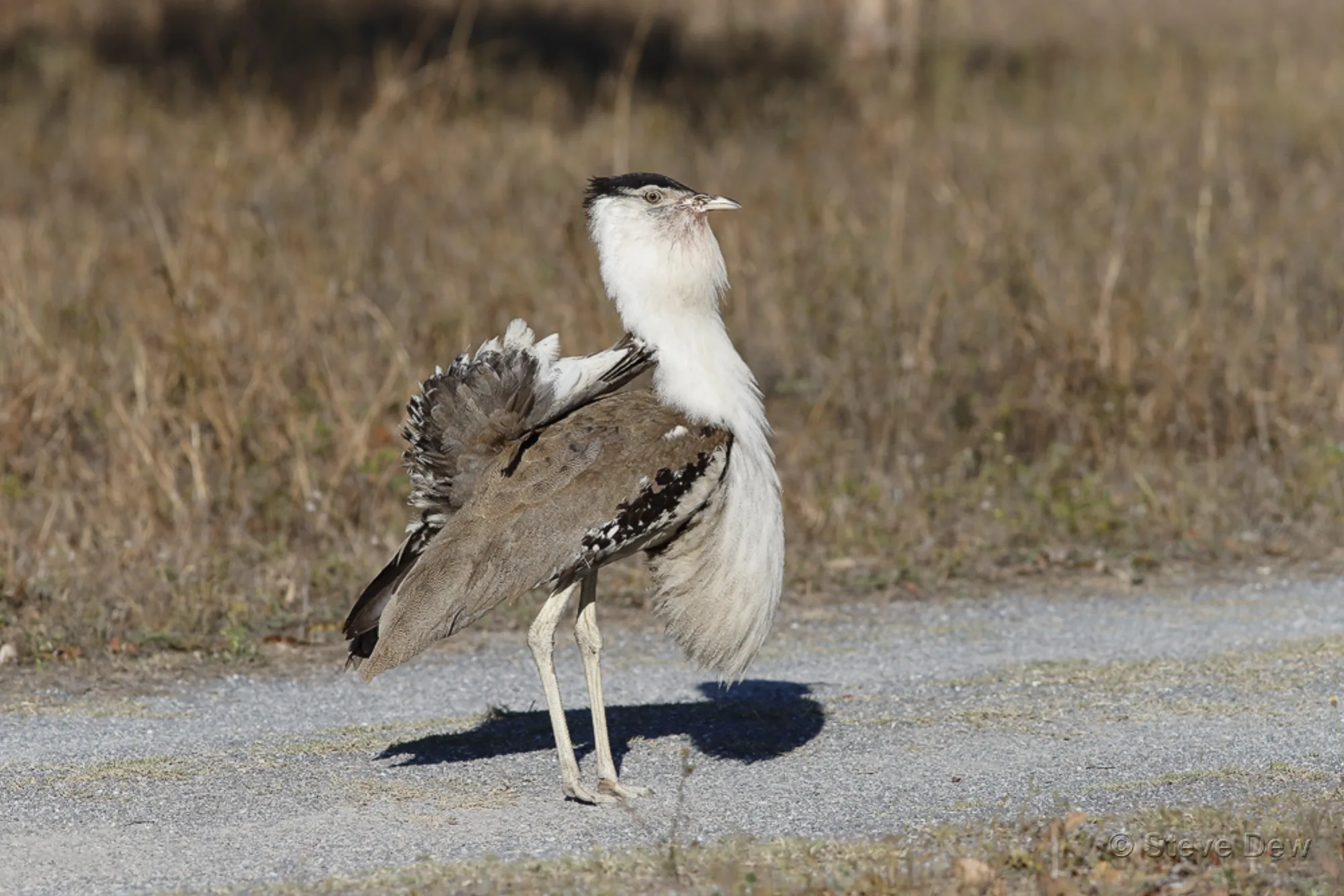
Often seen striding slowly across open plains, the Australian Bustard is a large ground-dwelling bird with long, pale yellow to cream legs. It stands about one metre high, with a wingspan around twice its height. Look for a black crown and nape, a pale grey neck, brown upperparts and wings, and a white belly set off by a black band. Black and white patches on the wings can be seen when the bird rests and are especially visible in flight. Females look much like males but are smaller.
The bird remains widespread across much of northern Australia, and its range sometimes reaches southern New Guinea and Indonesia. It favours open grasslands, spinifex plains and low shrublands, and can also be found on farmland and cleared areas such as golf courses. Usually alone or in pairs, it walks slowly and tends to be shy of disturbance. If alarmed, it may slip away or run before taking flight with heavy wingbeats. It can travel long distances, moving to places where food is plentiful. Its varied diet includes plant shoots, roots, seeds and fruit, as well as insects, lizards, young birds and small rodents.
During the breeding season, males give conspicuous displays accompanied by loud booming. The female lays usually one egg, sometimes two, on bare ground near a small shrub or bush, without building a nest. She incubates the egg, and the chick leaves the site after hatching, relying on its mottled down and stillness to avoid detection. The bustard's range has contracted in southeastern Australia, possibly because of hunting, habitat destruction and introduced predators such as pigs and foxes. Disturbance by people, cattle or sheep at breeding sites can also cause the birds to leave an area.
Written from the English Wikipedia article Australian bustard (CC BY-SA 4.0).
- Records
- 15,602
- Countries
- 1
- Atlas places
- 3
These are open occurrence records, so they show where people looked for and recorded the Australian Bustard as much as where it lives. Cells are up to 25 km across, and every location is generalised to its cell.
Generalised encounter areas, not exact locations. Each shape is a grid cell coloured by how likely the species is there.
- Very likelyAustralia25 km zone · medium confidence · 15602 records · updated 80 days ago
Conservation status not assessed here yet, so every location is generalised to its grid cell.