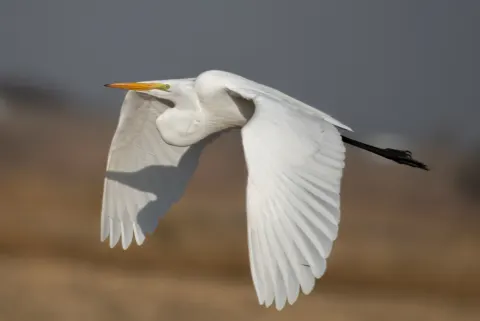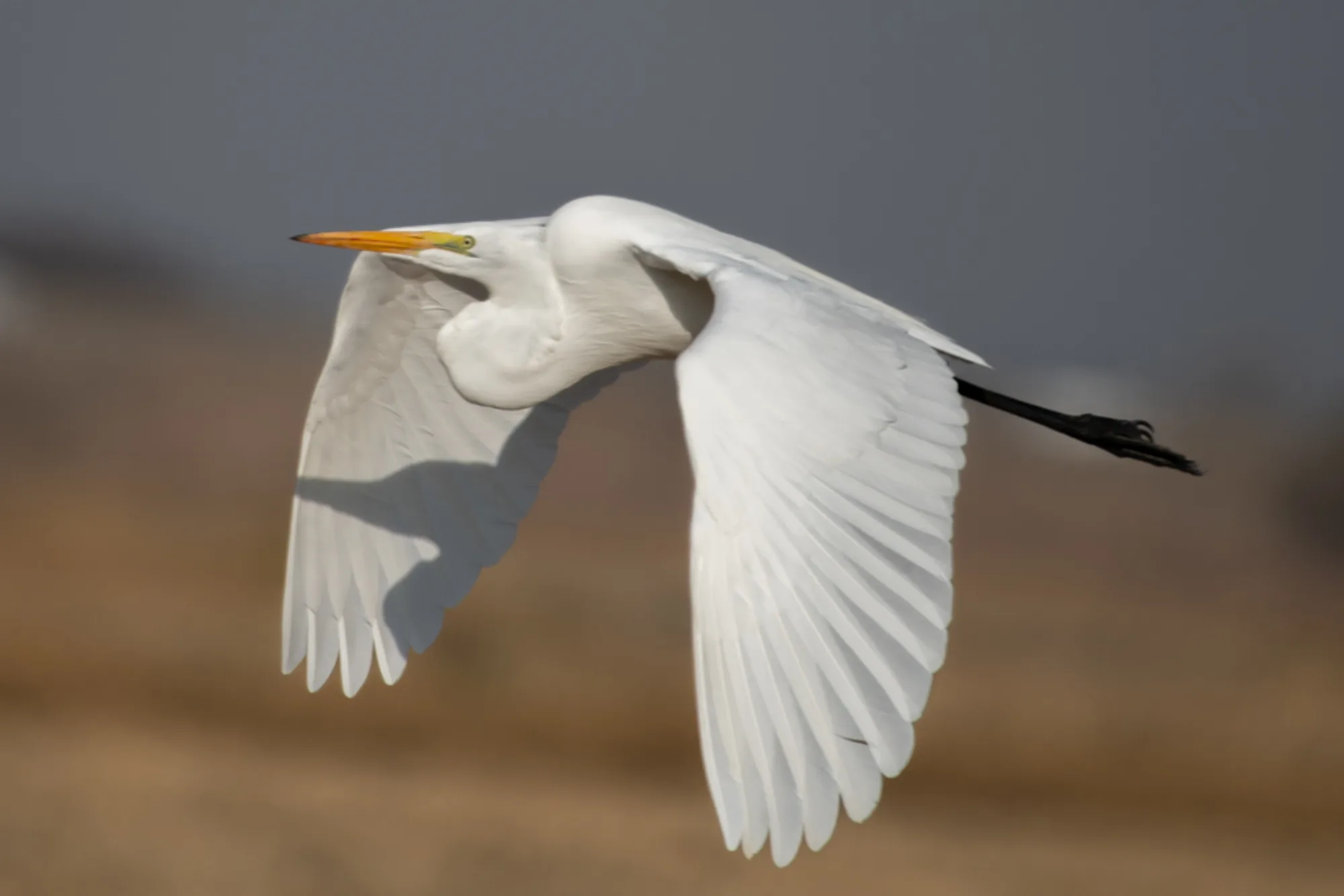
Great Egret
Ardea alba
White from head to tail, the Great Egret is a large heron that can stand up to 1 m tall, and its wings span 131 to 170 cm. Look for a yellow bill alongside black feet and legs, though the bill can darken and the lower legs become paler in the breeding season. At that time, fine ornamental feathers appear on its back. Watch for its slow flight, with the neck drawn in, or its walk with the neck extended and wings held close. Usually quiet, the bird makes a hoarse, low croak if disturbed, while loud croaks and higher-pitched squawks sound from breeding colonies.
Great Egrets occur across Asia, Africa, the Americas and southern Europe, and have been spreading farther north in Europe. They live in tropical and warmer temperate regions, and can be seen near wetlands and water in urban and suburban areas. In shallow water or drier places, they forage for fish, frogs, mice, snakes, crayfish and insects. They nest together in trees beside extensive wetlands or large, reed-fringed lakes, building nests from sticks lined with plant material. Each season, birds form pairs, and both parents incubate the eggs and feed the young. The young can fly within 6 to 7 weeks.
Towards the close of the 19th century, many Great Egrets in North America were killed for their plumes, which decorated hats; conservation measures have since helped their numbers recover. In parts of the southern United States, habitat loss has caused declines, with wetlands damaged by invasive plants, water extraction, rising salinity, burning, clearing, grazing and drainage.
Written from the English Wikipedia article Great egret (CC BY-SA 4.0).
- Records
- 4,330,003
- Countries
- 213
- Atlas places
- 41
- Kruger National Park· South Africa
- Chobe National Park· Botswana
- Okavango Delta· Botswana
- Chitwan National Park· Nepal
- Queen Elizabeth National Park· Uganda
- Zambezi National Park· Zimbabwe
- Akagera National Park· Rwanda
- Everglades National Park· United States
- Iguaçu National Park· Brazil
- Iguazú National Park· Argentina
- iSimangaliso Wetland Park· South Africa
- Lake Manyara National Park· Tanzania
- Lower Zambezi National Park· Zambia
- Mana Pools National Park· Zimbabwe
- Ngorongoro Conservation Area· Tanzania
- South Luangwa National Park· Zambia
- Yala National Park· Sri Lanka
- Aberdare National Park· Kenya
- Amboseli National Park· Kenya
- Annapurna Conservation Area· Nepal
- Arenal· Costa Rica
- Arusha National Park· Tanzania
- Baluran National Park· Indonesia
- Bwabwata National Park· Namibia
- Cuyabeno Wildlife Reserve· Ecuador
- Fiordland National Park· New Zealand
- Gonarezhou National Park· Zimbabwe
- Hell's Gate National Park· Kenya
- Hwange National Park· Zimbabwe
- Koshi Tappu Wildlife Reserve· Nepal
- Lake Nakuru National Park· Kenya
- Machalilla National Park· Ecuador
- Manú National Park· Peru
- Murchison Falls National Park· Uganda
- Nairobi National Park· Kenya
- Nyerere National Park· Tanzania
- Tarangire National Park· Tanzania
- Volcanoes National Park· Rwanda
- West Bali National Park· Indonesia
- Westland Tai Poutini National Park· New Zealand
- Yasuní National Park· Ecuador
These are open occurrence records, so they show where people looked for and recorded the Great Egret as much as where it lives. Cells are up to 25 km across, and every location is generalised to its cell.
Generalised encounter areas, not exact locations. Each shape is a grid cell coloured by how likely the species is there.
- Very likelyUnited States25 km zone · high confidence · 3134546 records · updated 86 days ago
- Very likelyTaiwan25 km zone · high confidence · 158485 records · updated 86 days ago
- Very likelyMexico25 km zone · high confidence · 106514 records · updated 86 days ago
- Very likelyCanada25 km zone · high confidence · 97262 records · updated 86 days ago
- Very likelyAustralia25 km zone · high confidence · 56274 records · updated 86 days ago
- Very likelyBelgium25 km zone · high confidence · 53366 records · updated 86 days ago
- Very likelyCosta Rica25 km zone · high confidence · 39792 records · updated 86 days ago
- Very likelyArgentina25 km zone · high confidence · 28695 records · updated 86 days ago
- Very likelyFrance25 km zone · high confidence · 28668 records · updated today
- Very likelyIndia25 km zone · high confidence · 28618 records · updated today
Conservation status not assessed here yet, so every location is generalised to its grid cell.