Antarctic Fur Seal
Arctocephalus gazella
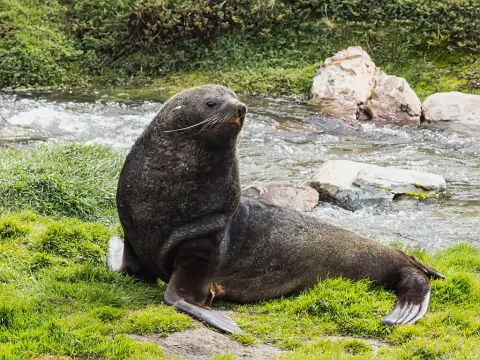
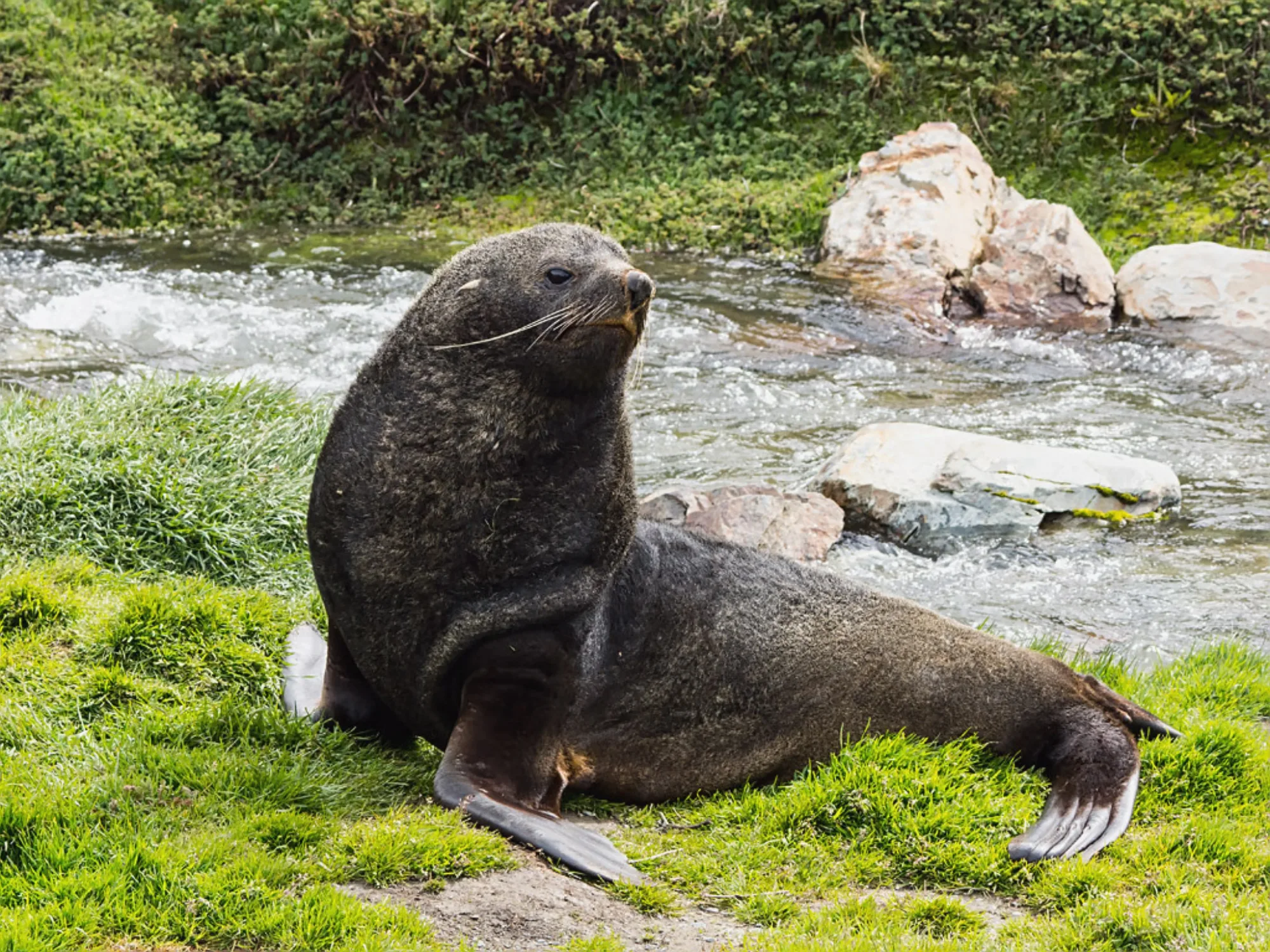
Look for a pointed muzzle, a relatively long neck and prominent external ears when identifying an Antarctic Fur Seal. Adult males are dark brown and much larger than females, reaching 2 m in length; females reach 1.4 m and are usually paler, with lighter undersides. Pups are almost black at birth, though colouring varies among these seals.
Despite its name, this seal lives mostly around subantarctic islands, with its largest gathering on South Georgia in the southern Atlantic. Breeding colonies also occur on islands across the southern Indian and Pacific oceans. In winter, the seals travel widely, reaching the Falkland Islands and southern Argentina as well as the Antarctic continent. They appear to forage and migrate alone, and dive at night to feed. Krill, fish and squid are their main foods, although diet varies by region: colonies on Kerguelen and Macquarie eat more fish and squid. Males establish breeding grounds in October or early November; females generally arrive in December and give birth to one pup several days later. The pups are weaned at about four months, after which young seals may remain at sea for several years.
Sealing for fur once brought the species close to extinction, and its recovery has varied across its former range. Warmer oceans and receding sea ice push krill into deeper water in search of cold, leaving less food available for seals. Discarded fishing gear and other debris can entangle seals, while fishing may compete with them for prey. At some South Shetland Islands sites, leopard seals take enough pups that predation may cause a population decline.
Written from the English Wikipedia article Antarctic fur seal (CC BY-SA 4.0).
- Records
- 43,251
- Countries
- 6
No atlas park has a record of the Antarctic Fur Seal in or around it yet.
These are open occurrence records, so they show where people looked for and recorded the Antarctic Fur Seal as much as where it lives. Cells are up to 25 km across, and every location is generalised to its cell.
Generalised encounter areas, not exact locations. Each shape is a grid cell coloured by how likely the species is there.
- Very likelySouth Africa25 km zone · high confidence · 20822 records · updated 80 days ago
- Very likelySouth Georgia & South Sandwich Islands25 km zone · high confidence · 7430 records · updated 80 days ago
- Very likelyAntarctica25 km zone · high confidence · 4752 records · updated 80 days ago
- Very likelyHeard & McDonald Islands25 km zone · high confidence · 4393 records · updated 80 days ago
- Very likelyBouvet Island25 km zone · high confidence · 3580 records · updated 80 days ago
- Very likelyUnnamed area25 km zone · high confidence · 1546 records · updated 80 days ago
- Very likelyFrench Southern Territories25 km zone · high confidence · 728 records · updated 80 days ago
Conservation status not assessed here yet, so every location is generalised to its grid cell.