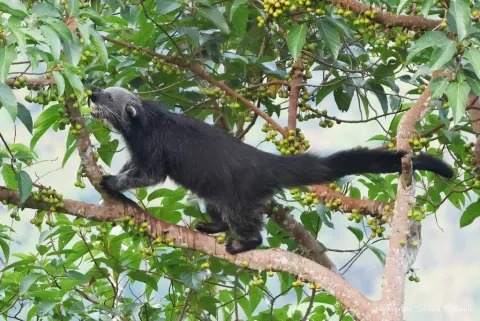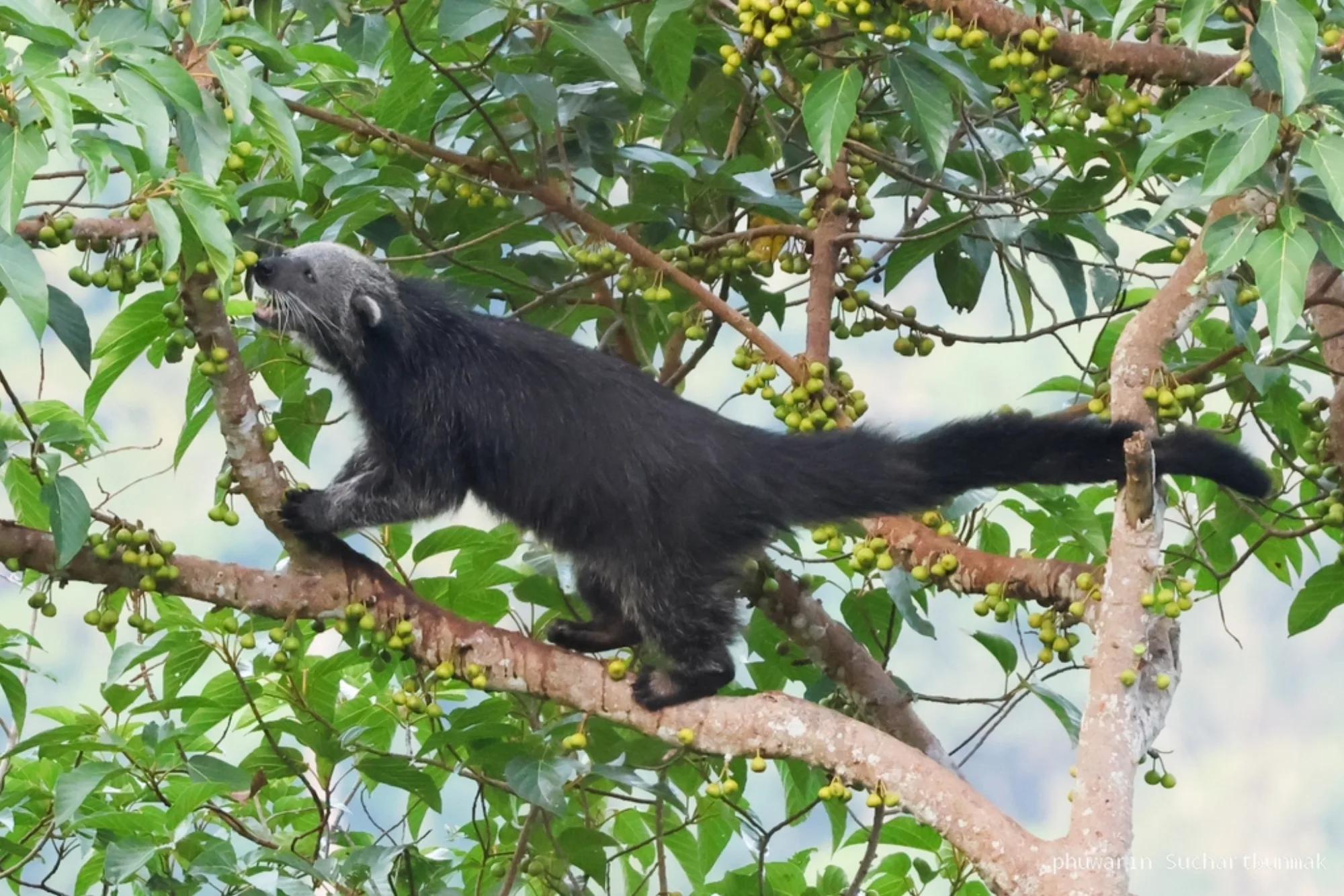
Binturong
Arctictis binturong
Often called the bearcat, the Binturong is a tree-dwelling mammal of South and Southeast Asia. Its long, coarse coat is mostly dark, sometimes flecked with white or buff, and its rounded ears carry conspicuous black tufts. White whiskers frame its face, while a long, bushy tail curls inward at the tip. The tail is nearly as long as its head and body and helps it balance among branches. Its scent has been compared to hot, buttered popcorn.
Its range includes India, Nepal, Thailand, Malaysia, Indonesia and the Philippines, among other countries. Binturongs favour lowland forest, both primary and secondary, and have also been observed in evergreen forest and forest bordering grassland. They are mainly active at night and around dawn and dusk, although sightings during the day have also been recorded. They climb slowly and skilfully, sometimes moving beneath branches, and are likely to come down to the ground to travel between trees. Their varied diet includes fruit, especially figs, as well as insects, birds and small mammals. By dispersing fig seeds, they play an important role in the forest.
Binturongs breed throughout the year, and females can delay a pregnancy until conditions are favourable. Captive births have produced litters of between one and six young, typically two. Logging and conversion of forest to plantations are major threats, particularly as lowland habitat is lost. Binturongs can survive in degraded and fragmented forest, but may face greater hunting pressure there. They are hunted for meat and skins, while young animals are captured for trade; the illegal pet trade and kopi luwak production also threaten them.
Written from the English Wikipedia article Binturong (CC BY-SA 4.0).
- Records
- 0
- Countries
- 1
- Atlas places
- 1
These are open occurrence records, so they show where people looked for and recorded the Binturong as much as where it lives. Cells are up to 25 km across, and every location is generalised to its cell.
Generalised encounter areas, not exact locations. Each shape is a grid cell coloured by how likely the species is there.
- Very likelyMalaysia25 km zone · low confidence · 0 records · updated 80 days ago
Conservation status not assessed here yet, so every location is generalised to its grid cell.