Sheepshead
Archosargus probatocephalus
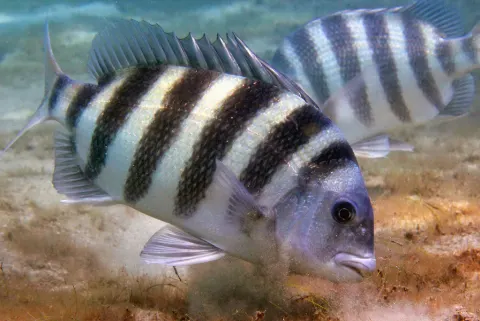
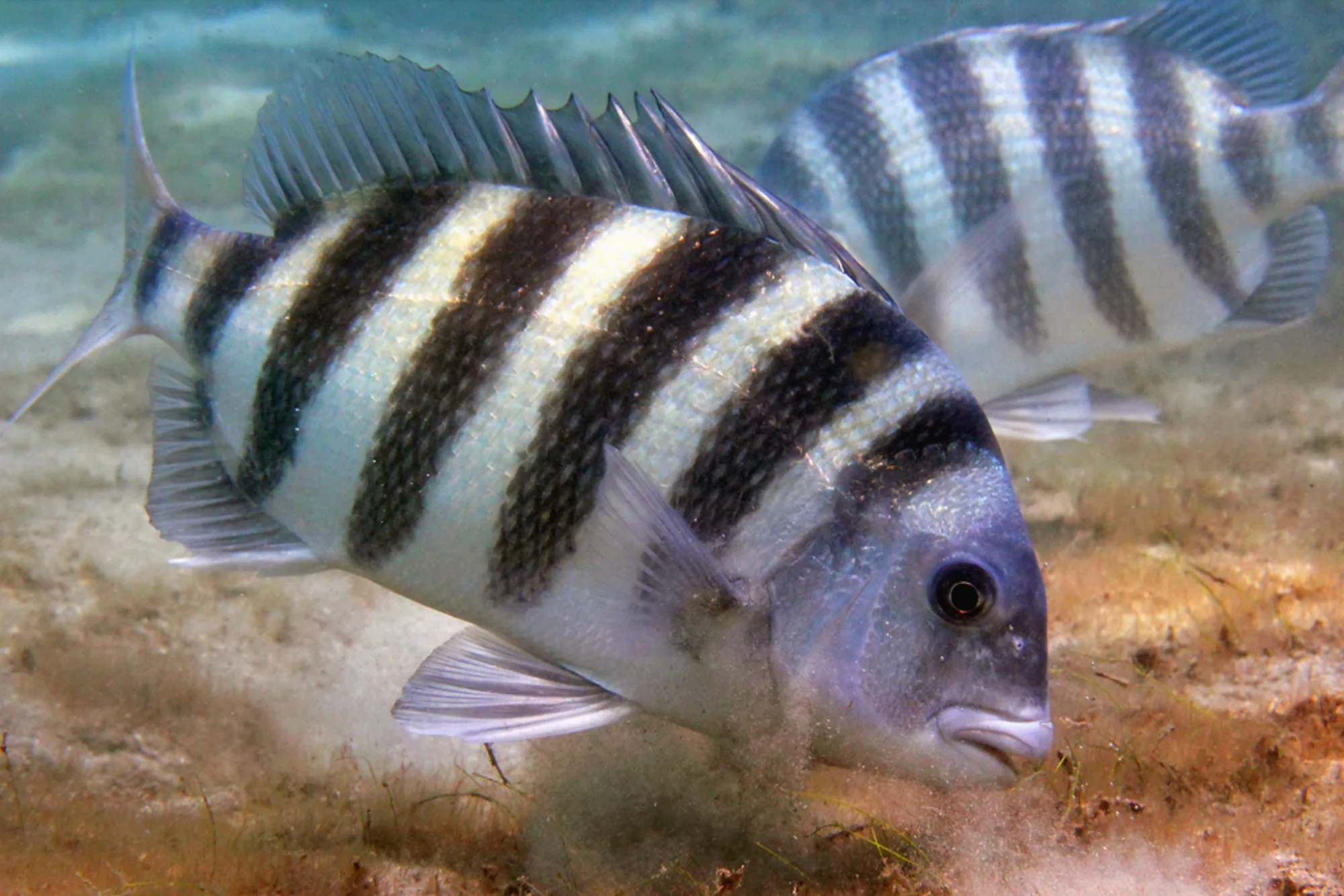
Silvery to greenish-yellow, the Sheepshead has an oval, deep body, a small blunt head and five or six dark bars down its sides. Those bars fade as the fish ages, while its forked tail and side fins have a greenish colour. Broad, flattened front teeth give it a distinctive appearance and help it tackle hard-shelled food. A typical fish measures 35 cm, although the maximum published length is 91 cm.
In the western Atlantic, its range reaches south from Nova Scotia to Brazil's Rio Grande do Sul, with populations in the Caribbean Sea and Gulf of Mexico. Look for it in coastal waters around rock pilings, jetties, mangrove roots and piers, as well as in tidal creeks. It favours brackish water, seeks warmer places near springs and river discharges, and sometimes enters freshwater in winter. Fishers also look for it over rocky bottoms and around obstructions, including bridge pilings.
Larger juveniles and adults eat blue crabs, other crustaceans, shellfish and small fish, with plant matter occasionally on the menu. They use their flattened teeth to crush protected prey and prise barnacles from rocks and other hard surfaces, while younger fish feed on zooplankton, polychaetes and chironomid larvae. Adults move farther offshore to spawn before returning to coastal waters and estuaries; off the southern United States, spawning takes place mainly in early spring. Young fish gather chiefly among seagrass and above muddy bottoms, leaving the beds to join adults when they reach around 50 mm. The species was overfished in the past, and Gulf of Mexico commercial fisheries are placing renewed importance on it as other sought-after fish decline through overfishing.
Written from the English Wikipedia article Archosargus probatocephalus (CC BY-SA 4.0).
- Records
- 11,291
- Countries
- 3
- Atlas places
- 1
These are open occurrence records, so they show where people looked for and recorded the Sheepshead as much as where it lives. Cells are up to 25 km across, and every location is generalised to its cell.
Generalised encounter areas, not exact locations. Each shape is a grid cell coloured by how likely the species is there.
- Very likelyUnited States25 km zone · high confidence · 11213 records · updated 80 days ago
- LikelyMexico25 km zone · medium confidence · 73 records · updated 80 days ago
- PossibleBrazil25 km zone · medium confidence · 5 records · updated 80 days ago
Conservation status not assessed here yet, so every location is generalised to its grid cell.