Ruby-throated Hummingbird
Archilochus colubris
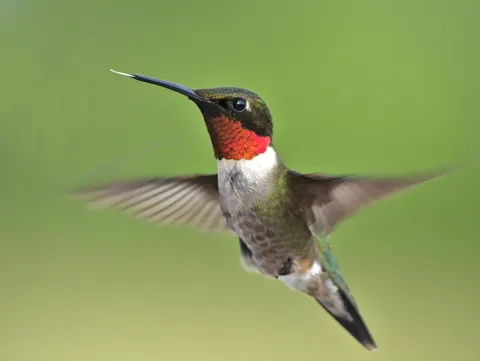
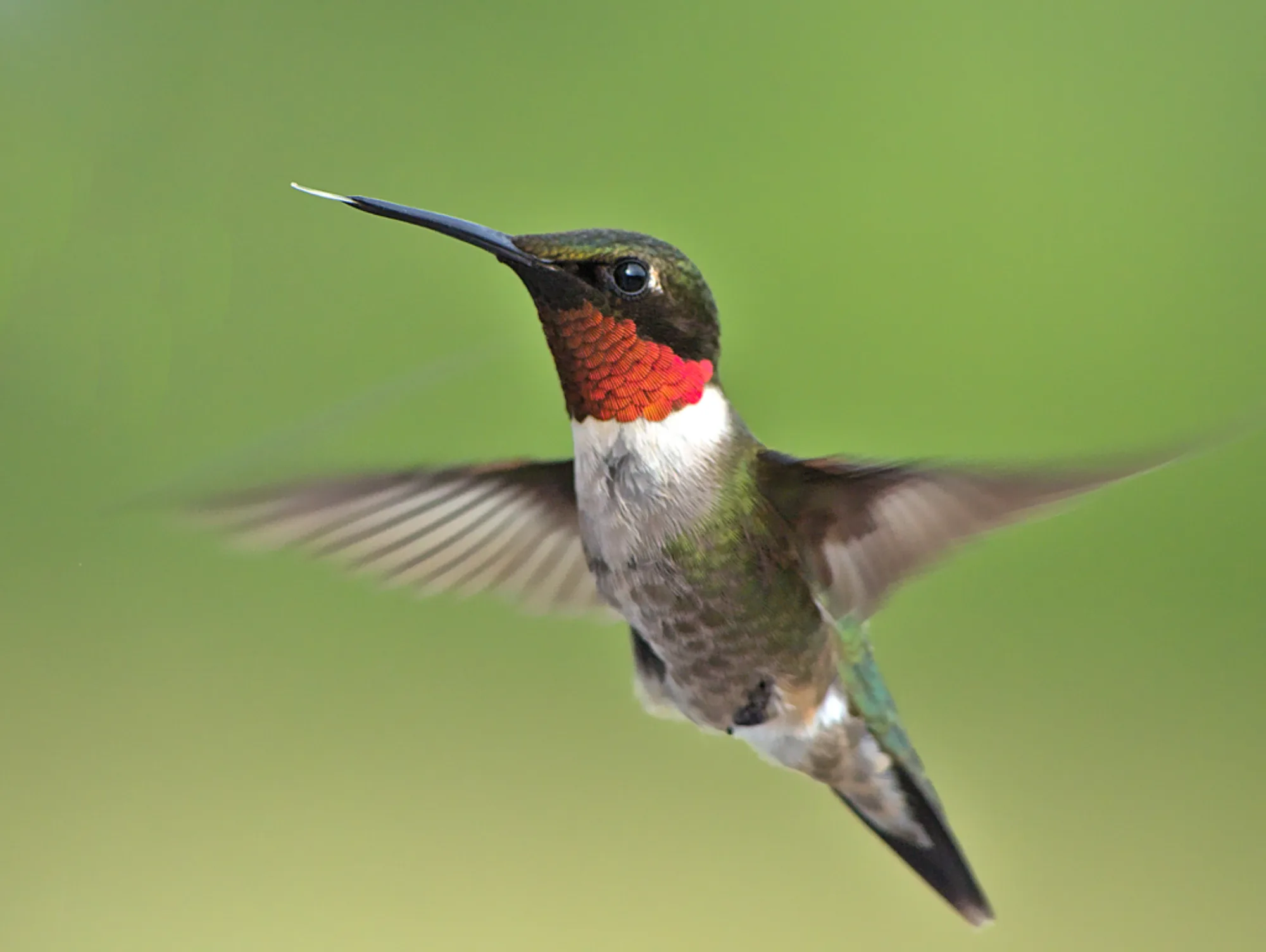
A flash of metallic green may reveal a Ruby-throated Hummingbird among the trees and flowers of eastern North America. Just 7 to 9 cm long, it has a greyish white underside, near-black wings and a long, slender bill. The adult male's ruby-red throat can look dull black from many angles, while the female has a white throat, sometimes with dusky markings. Her tail feathers show bands of green, black and white; his tail is forked and black.
In summer, the species breeds across much of the eastern United States and in parts of southern Canada, using deciduous and pine forests, forest edges, orchards and gardens. It winters in Florida, southern Mexico, the West Indies and Central America, reaching the far west of Panama. During spring migration, some birds cross 800 km of open water from Mexico's Yucatan Peninsula, reaching Florida and Louisiana. They build up fat before the crossing and use their reserves during the 20-hour flight.
Usually solitary, these hummingbirds may chase others away from feeding territories, and they feed frequently during the day. They hover at flowers for nectar, favouring red, orange and bright pink tubular blooms, and catch small insects or pick them from vegetation and spiders' webs. Spiders are also on the menu, while young birds receive insects for protein. The female builds a camouflaged nest, often on a tree limb, using materials including lichen, plant fibres and spider silk. She tends the eggs and young alone, and the young make their first flight at 18 to 22 days old. Predators include small raptors and domestic cats, while blue jays, other birds and small mammals may raid nests. Praying mantises have also been seen ambushing adults at feeders.
Written from the English Wikipedia article Ruby-throated hummingbird (CC BY-SA 4.0).
- Records
- 1,375,550
- Countries
- 3
- Atlas places
- 1
These are open occurrence records, so they show where people looked for and recorded the Ruby-throated Hummingbird as much as where it lives. Cells are up to 25 km across, and every location is generalised to its cell.
Generalised encounter areas, not exact locations. Each shape is a grid cell coloured by how likely the species is there.
- Very likelyUnited States25 km zone · high confidence · 1261776 records · updated 80 days ago
- Very likelyCanada25 km zone · high confidence · 104731 records · updated 80 days ago
- Very likelyMexico25 km zone · high confidence · 9043 records · updated 80 days ago
Conservation status not assessed here yet, so every location is generalised to its grid cell.