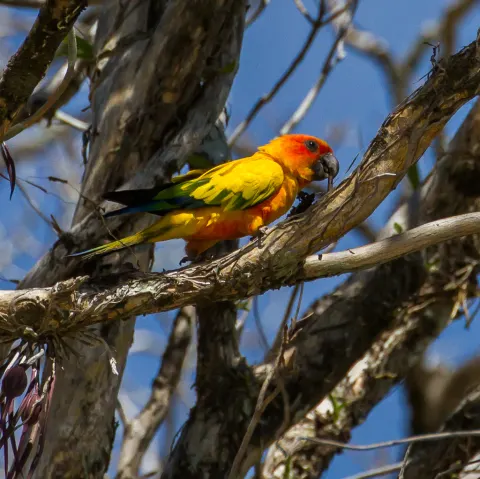
Sun Parakeet
Aratinga solstitialis
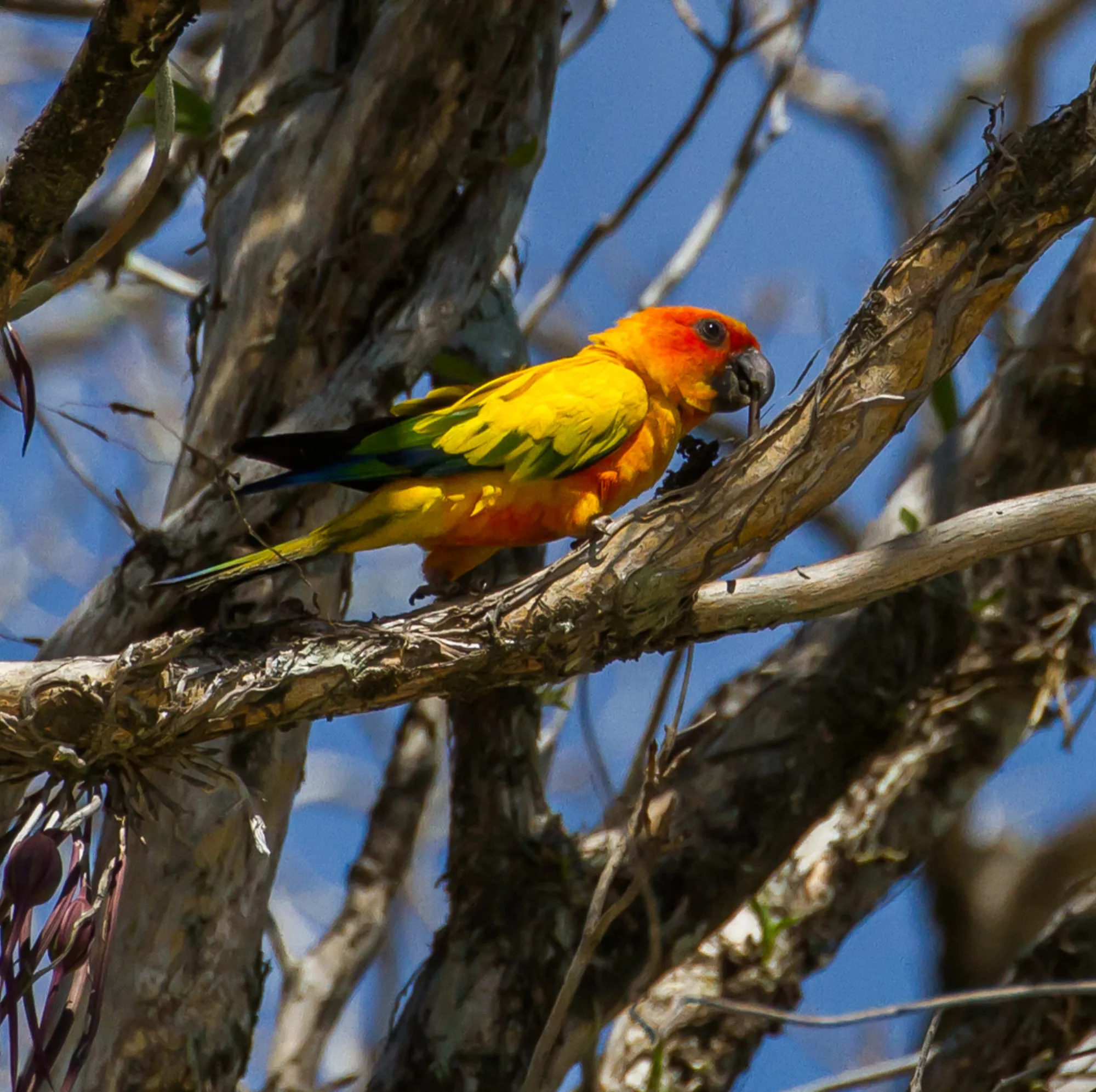
Golden yellow, orange and green make the Sun Parakeet a striking sight in northeastern South America. This medium-sized parrot has a black beak, an orange face and belly, and green wings and tail marked with blue. Males and females look much alike, while young birds are mainly green and gain their yellow, orange and reddish colouring as they mature. Adults average around 30 cm in length and weigh around 110 g. Its small range includes southern parts of Guyana and French Guiana, the far south of Suriname, and Roraima in northern Brazil. Recent sightings suggest it mainly occupies humid forest edges in the Guiana Shield foothills, below 1,200 m, crossing open savannah as it travels between forest patches. Fruiting trees and palm groves are usual haunts.
Sun Parakeets are social birds, usually travelling in flocks of 15 to 30. They can be noisy in flight, calling loudly, though feeding flocks are relatively quiet. During daylight hours, flock members rest, bathe, preen and feed one another. Their varied diet includes fruit, flowers, seeds, nuts and insects; near Karasabai, flocks have been seen feeding on monkey brush plants. Pairs form lasting bonds and may feed and groom each other before breeding. They nest in trees or palm cavities, and both parents feed the chicks. Some active nests have held several adults alongside eggs and young of different ages, suggesting that the birds may sometimes breed cooperatively.
Habitat loss and trapping for feathers or the pet trade threaten the species. Capture for the pet trade has driven a rapid population decline, and poaching wild birds remains a serious threat.
Written from the English Wikipedia article Sun conure (CC BY-SA 4.0).
- Records
- 15
- Countries
- 3
No atlas park has a record of the Sun Parakeet in or around it yet.
These are open occurrence records, so they show where people looked for and recorded the Sun Parakeet as much as where it lives. Cells are up to 25 km across, and every location is generalised to its cell.
Generalised encounter areas, not exact locations. Each shape is a grid cell coloured by how likely the species is there.
- Very likelyUnited States25 km zone · medium confidence · 6 records · updated 80 days ago
- Very likelyGuyana25 km zone · medium confidence · 5 records · updated 80 days ago
- PossibleTaiwan25 km zone · medium confidence · 4 records · updated 80 days ago
Conservation status not assessed here yet, so every location is generalised to its grid cell.