Arapaima
Arapaima gigas
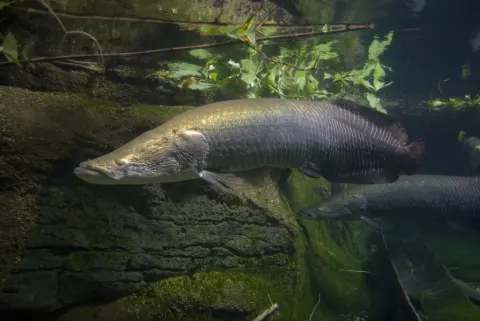
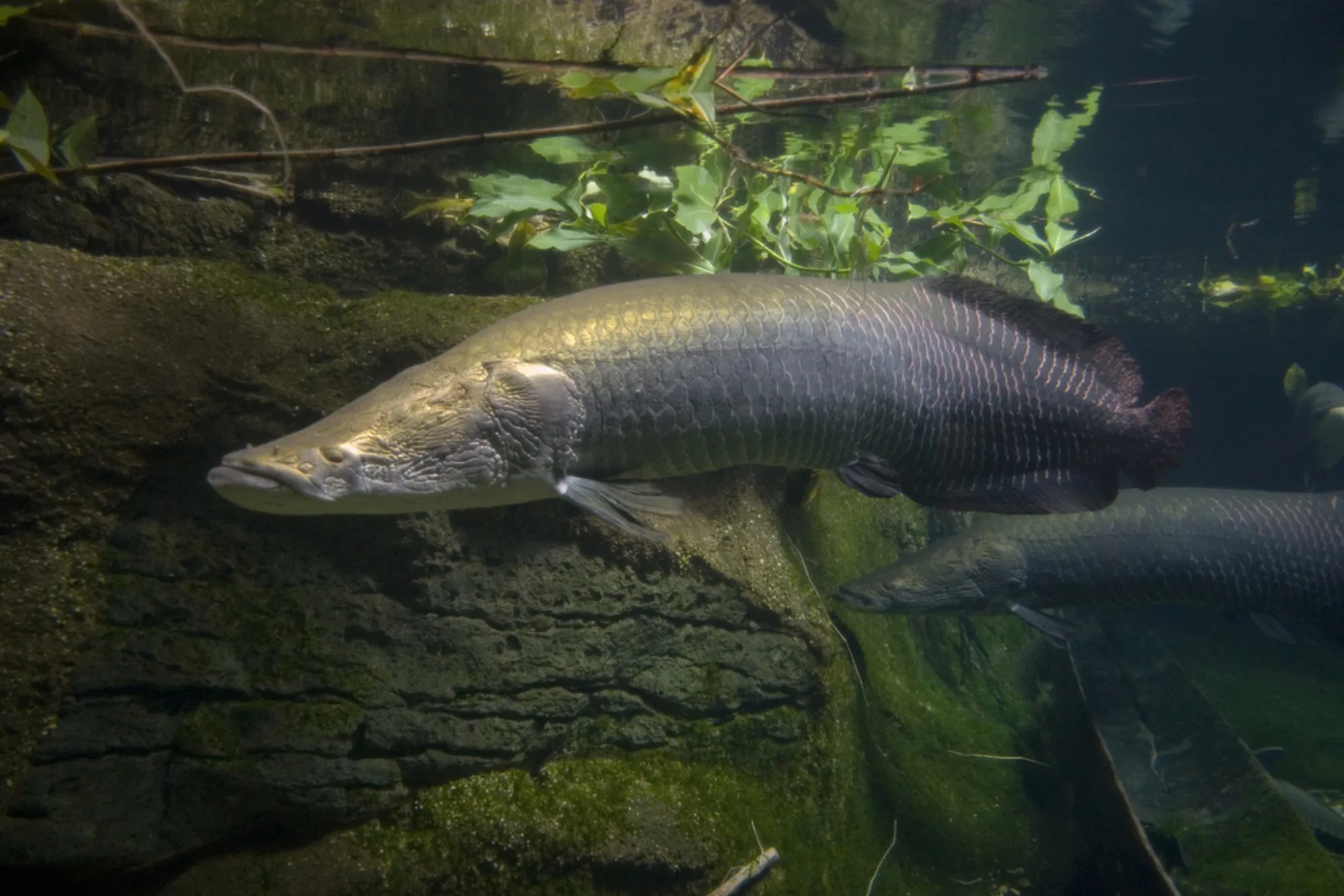
Among the largest freshwater fish, the Arapaima commonly measures 200 cm and can reportedly reach 450 cm in exceptional cases. Its streamlined body is grey to grey-green, with fins set far back towards the tail and red flecks on the scales near it. Mature males can show red over much of the body, while overlapping, armour-like scales help protect the fish from piranhas. Native to the Amazon and Tocantins-Araguaia river basins, it occurs in Brazil and Peru, with small populations also recorded in Ecuador, Colombia and Guyana. Introduced populations have spread into Bolivian waters, where the fish is considered a threat to native species.
Arapaima move between river channels and floodplains as water levels change, using flooded forests during high water and lakes when levels fall. Flooded forests offer food for adults and their young, as well as a place for parental care. The fish must surface every 5 to 15 minutes to gulp air, often loudly. It eats mainly fish, along with invertebrates, and also takes birds, mammals, fruit and seeds at the water surface. Young fish favour insects and fish larvae. During low water, spawning takes place in lakes and river channels, where parents dig nest holes in the substrate. Males stay to guard their offspring for three to six months.
In its native range, the Arapaima has been heavily affected by overfishing, and its regular trips to the surface make it easy to harpoon. Habitat loss, environmental degradation and commercial overexploitation have reduced genetic diversity, while lost migration routes can isolate populations. Some local populations have disappeared from areas of Brazil and Peru, and illegal fishing remains widespread in the lower Amazon.
Written from the English Wikipedia article Arapaima gigas (CC BY-SA 4.0).
- Records
- 61
- Countries
- 5
- Atlas places
- 3
These are open occurrence records, so they show where people looked for and recorded the Arapaima as much as where it lives. Cells are up to 25 km across, and every location is generalised to its cell.
Generalised encounter areas, not exact locations. Each shape is a grid cell coloured by how likely the species is there.
- Very likelyBrazil25 km zone · medium confidence · 51 records · updated 80 days ago
- LikelyPeru25 km zone · medium confidence · 6 records · updated 80 days ago
- PossibleEcuador25 km zone · medium confidence · 2 records · updated 80 days ago
- PossibleUnited States25 km zone · medium confidence · 1 record · updated 80 days ago
- UncommonColombia25 km zone · medium confidence · 1 record · updated 80 days ago
Conservation status not assessed here yet, so every location is generalised to its grid cell.